Jin Rui, Wang Xiaoxiao, Li Xiaohe, Yang Jia, Liu Baiyi, Wei Lai, Liu Feng, Rao Huiying
Peking University People's Hospital, Peking University Hepatology Institute, Beijing Key Laboratory of Hepatitis C and Immunotherapy for Liver Diseases, Beijing International Cooperation Base for Science and Technology on NAFLD Diagnosis, Beijing, China.
Beijing Tsinghua Changgung Hospital, Tsinghua University, Beijing, China.
Front Med (Lausanne). 2022 Jul 6;9:919502. doi: 10.3389/fmed.2022.919502. eCollection 2022.
Liver steatosis, as the main feature of metabolic associated fatty liver disease (MAFLD), was associated with the progression of liver fibrosis and metabolic syndrome, which needed to be estimated accurately. In this study, we explored the significance of appendicular skeletal muscle index (ASMI) in evaluating liver steatosis of MAFLD patients.
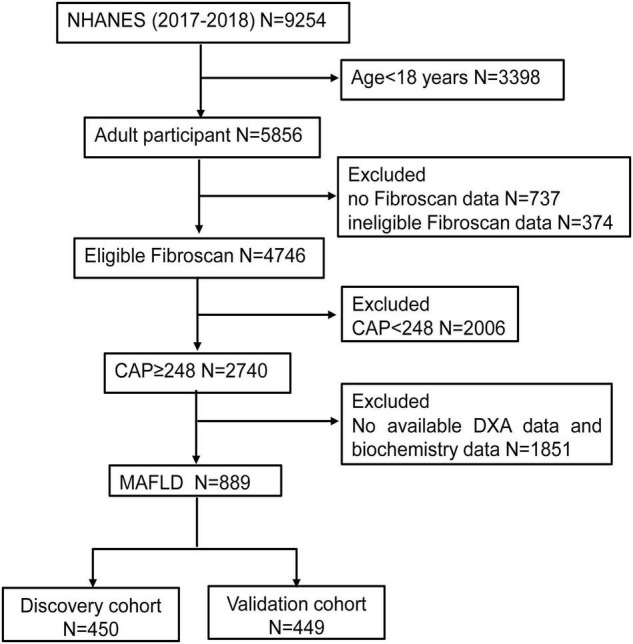
Eight hundred and ninety-nine cases with MAFLD from 2017 to 2018 National Health and Nutrition Examination Surveys (NHANES) database were included. All the analyzed data were obtained from NHANES database. The association between ASMI and liver steatosis were evaluated using R and EmpowerStats.
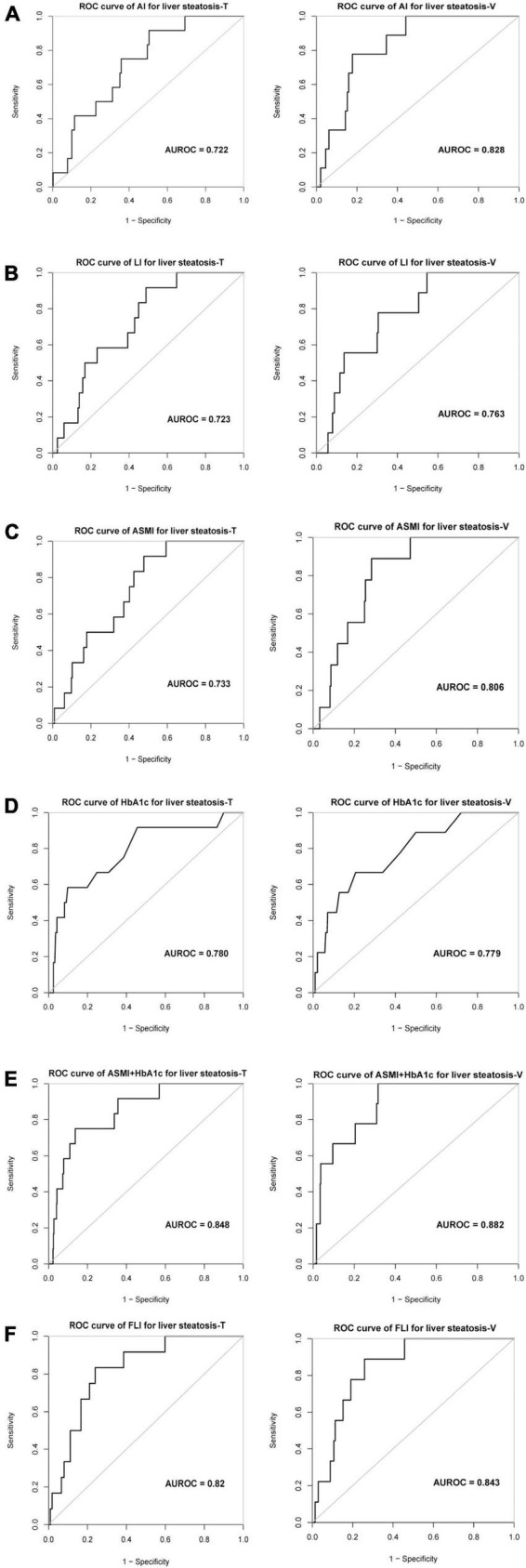
MAFLD individuals were randomly divided into a training ( = 450) and validation cohort ( = 449). In univariate analysis, HbA1c, arms fat, arms lean mass, legs lean mass, trunk lean mass, total fat, total lean mass and ASMI were significantly associated with liver steatosis ( < 0.05). Multivariate analysis showed that HbA1c (OR: 1.6732; 95% CI: 1.2753-2.1929, = 0.0002) and ASMI (OR: 1.6723; 95% CI: 1.1760-2.5204, = 0.0052) were independently associated with severe liver steatosis. ASMI accurately evaluated severe liver steatosis with an AUROC of 0.73 and 0.81 in training and validation cohort, respectively. Compared with ASMI only, ASMI combined with HbA1c improved the AUROC to 0.85 and 0.88. Furthermore, the AUROC of our model was superior to FLI in the evaluation of liver steatosis.
ASMI combined with HbA1c has good evaluation value for liver steatosis in MAFLD patients, which might be beneficial for the management of MAFLD clinically.
肝脂肪变性作为代谢相关脂肪性肝病(MAFLD)的主要特征,与肝纤维化进展及代谢综合征相关,需要准确评估。本研究探讨了四肢骨骼肌指数(ASMI)在评估MAFLD患者肝脂肪变性中的意义。
纳入2017年至2018年国家健康与营养检查调查(NHANES)数据库中的899例MAFLD患者。所有分析数据均来自NHANES数据库。使用R和EmpowerStats评估ASMI与肝脂肪变性之间的关联。
MAFLD个体被随机分为训练队列(n = 450)和验证队列(n = 449)。单因素分析中,糖化血红蛋白、上肢脂肪、上肢瘦体重、下肢瘦体重、躯干瘦体重、总脂肪、总瘦体重和ASMI与肝脂肪变性显著相关(P < 0.05)。多因素分析显示,糖化血红蛋白(OR:1.6732;95%CI:1.2753 - 2.1929,P = 0.0002)和ASMI(OR:1.6723;95%CI:1.1760 - 2.5204,P = 0.0052)与严重肝脂肪变性独立相关。ASMI在训练队列和验证队列中分别以0.73和0.81的曲线下面积(AUROC)准确评估严重肝脂肪变性。与单独使用ASMI相比,ASMI联合糖化血红蛋白可将AUROC提高至0.85和0.88。此外,我们模型的AUROC在肝脂肪变性评估中优于脂肪肝指数(FLI)。
ASMI联合糖化血红蛋白对MAFLD患者的肝脂肪变性具有良好的评估价值,可能对MAFLD的临床管理有益。