Zeng Rui-Xiang, Xu Jun-Peng, Kong Yong-Jie, Tan Jia-Wei, Guo Li-Heng, Zhang Min-Zhou
The Second Clinical College of Guangzhou University of Chinese Medicine, Guangzhou, China.
Department of Critical Care Medicine, Guangdong Provincial Hospital of Chinese Medicine, Guangzhou, China.
Front Cardiovasc Med. 2022 Jul 7;9:903481. doi: 10.3389/fcvm.2022.903481. eCollection 2022.
Non-HDL-C is well established causal risk factor for the progression of atherosclerotic cardiovascular disease. However, there remains a controversial pattern of how non-HDL-C relates to all-cause and cardiovascular mortality, and the concentration of non-HDL-C where the risk of mortality is lowest is not defined.
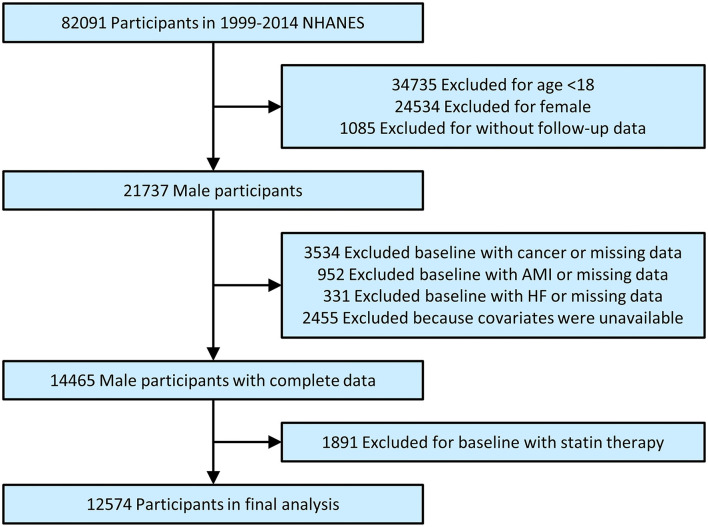
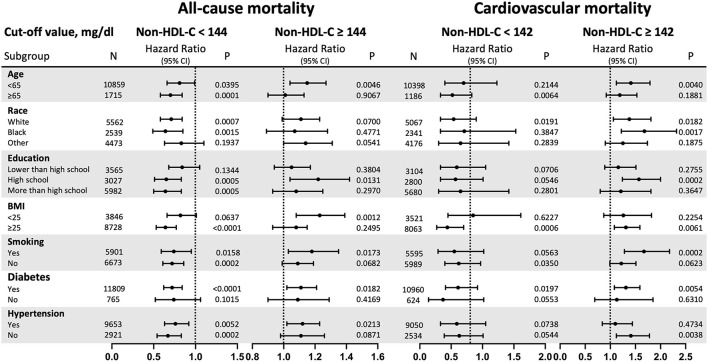
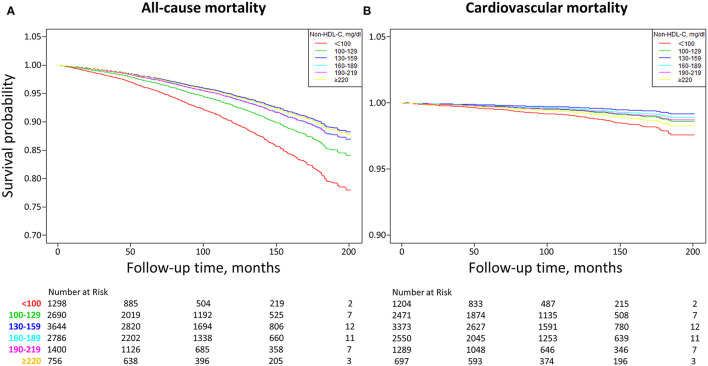
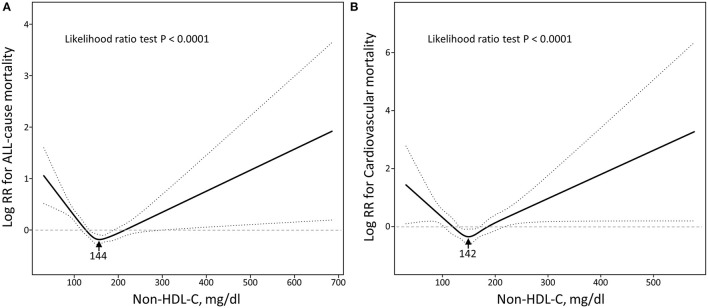
A population-based cohort study using data from the National Health and Nutrition Examination Survey (NHANES) from 1999 to 2014. Male participants without statin therapy were divided into the six groups according to non-HDL-C levels (<100, 100-129, 130-159, 160-189, 190-219, ≥220 mg/dl). Multivariable Cox proportional hazards models were conducted with a hazard ratio (HR) and corresponding 95% confidence interval (CI). To further explore the relationship between non-HDL-C and mortality, Kaplan-Meier survival curves, restricted cubic spline curves, and subgroup analysis were performed.
Among 12,574 individuals (average age 44.29 ± 16.37 years), 1,174(9.34%) deaths during a median follow-up 98.38 months. Both low and high non-HDL-C levels were significantly associated with increased risk of all-cause and cardiovascular mortality, indicating a U-shaped association. Threshold values were detected at 144 mg/dl for all-cause mortality and 142 mg/dl for cardiovascular mortality. Below the threshold, per 30 mg/dl increase in non-HDL-C reduced a 28 and 40% increased risk of all-cause ( < 0.0001) and cardiovascular mortality ( = 0.0037), respectively. Inversely, above the threshold, per 30 mg/dl increase in non-HDL-C accelerated risk of both all-cause mortality (HR 1.11, 95% CI 1.03-1.20, = 0.0057) and cardiovascular mortality (HR 1.30, 95% CI 1.09-1.54, = 0.0028).
Non-HDL-C was U-shaped related to all-cause and cardiovascular mortality among men without statin therapy.
非高密度脂蛋白胆固醇(Non-HDL-C)是动脉粥样硬化性心血管疾病进展中已明确的因果风险因素。然而,Non-HDL-C与全因死亡率和心血管死亡率之间的关系模式仍存在争议,且死亡率风险最低时的Non-HDL-C浓度尚未明确。
一项基于人群的队列研究,使用1999年至2014年美国国家健康与营养检查调查(NHANES)的数据。未接受他汀类药物治疗的男性参与者根据Non-HDL-C水平(<100、100 - 129、130 - 159、160 - 189、190 - 219、≥220mg/dl)分为六组。采用多变量Cox比例风险模型计算风险比(HR)及相应的95%置信区间(CI)。为进一步探究Non-HDL-C与死亡率之间的关系,进行了Kaplan-Meier生存曲线、受限立方样条曲线及亚组分析。
在12574名个体(平均年龄44.29±16.37岁)中,中位随访98.38个月期间有1174人(9.34%)死亡。Non-HDL-C水平过低和过高均与全因死亡率和心血管死亡率风险增加显著相关,呈U形关联。全因死亡率的阈值为1�4mg/dl,心血管死亡率的阈值为142mg/dl。低于阈值时,Non-HDL-C每升高30mg/dl,全因死亡率(<0.0001)和心血管死亡率(=0.0037)风险分别降低28%和40%。相反,高于阈值时,Non-HDL-C每升高30mg/dl,全因死亡率(HR ʌ11,95%CI 1.03 - 1.20,=0.0057)和心血管死亡率(HR 1.30,95%CI 1.09 - 1.54,=0.0028)风险均加速上升。
在未接受他汀类药物治疗的男性中,Non-HDL-C与全因死亡率和心血管死亡率呈U形关系。