Balloux François, Tan Cedric, Swadling Leo, Richard Damien, Jenner Charlotte, Maini Mala, van Dorp Lucy
UCL Genetics Institute, University College London, London WC1E 6BT, UK.
Division of Infection and Immunity, University College London, London NW3 2PP, UK.
Oxf Open Immunol. 2022 Jun 20;3(1):iqac003. doi: 10.1093/oxfimm/iqac003. eCollection 2022.
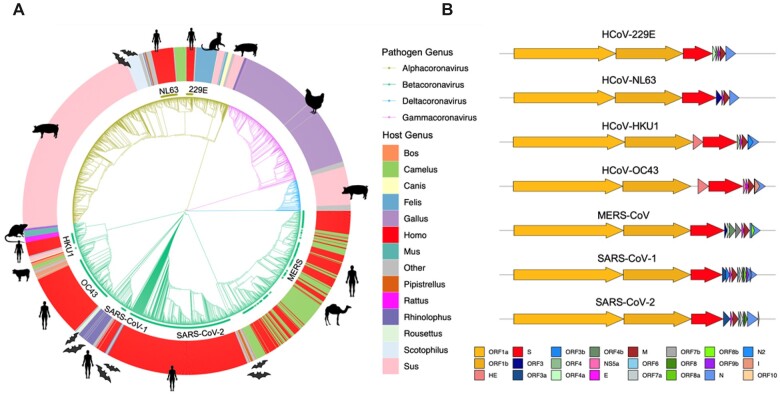
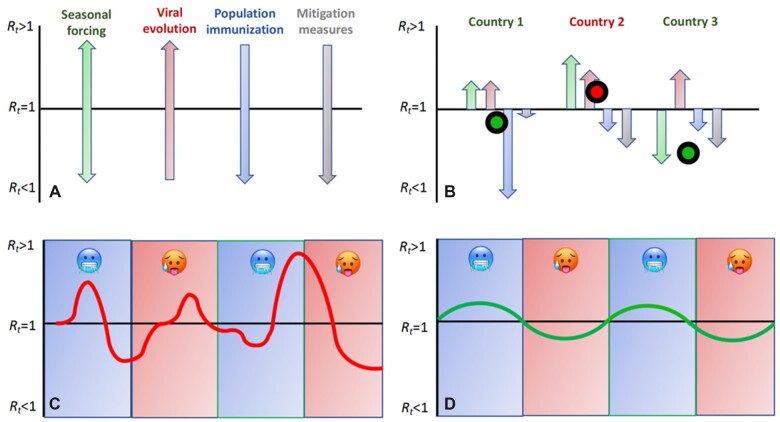
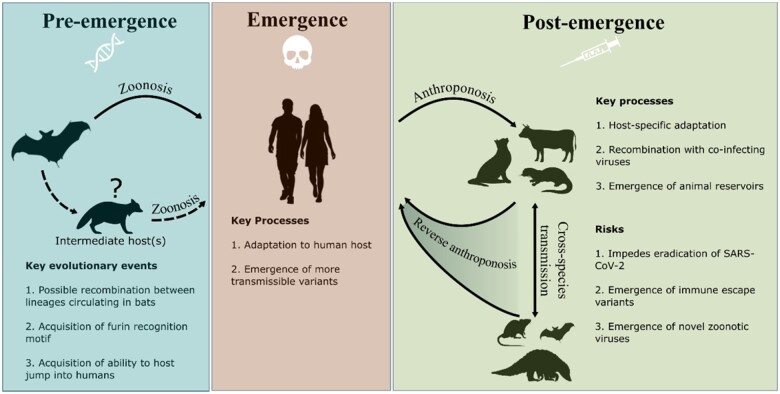
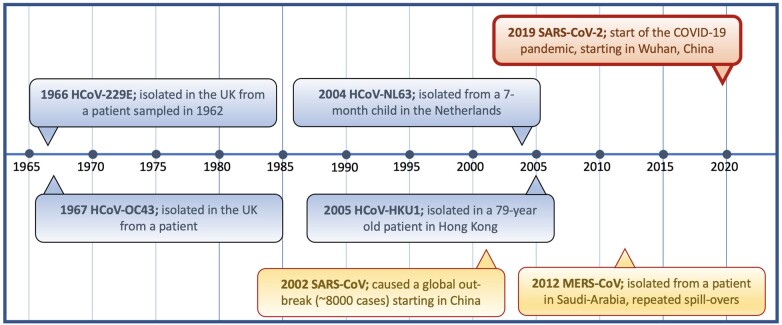
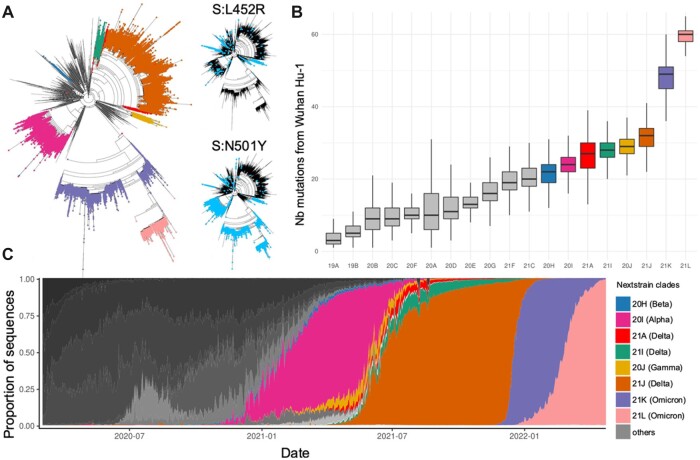
SARS-CoV-2, the agent of the COVID-19 pandemic, emerged in late 2019 in China, and rapidly spread throughout the world to reach all continents. As the virus expanded in its novel human host, viral lineages diversified through the accumulation of around two mutations a month on average. Different viral lineages have replaced each other since the start of the pandemic, with the most successful Alpha, Delta and Omicron variants of concern (VoCs) sequentially sweeping through the world to reach high global prevalence. Neither Alpha nor Delta was characterized by strong immune escape, with their success coming mainly from their higher transmissibility. Omicron is far more prone to immune evasion and spread primarily due to its increased ability to (re-)infect hosts with prior immunity. As host immunity reaches high levels globally through vaccination and prior infection, the epidemic is expected to transition from a pandemic regime to an endemic one where seasonality and waning host immunization are anticipated to become the primary forces shaping future SARS-CoV-2 lineage dynamics. In this review, we consider a body of evidence on the origins, host tropism, epidemiology, genomic and immunogenetic evolution of SARS-CoV-2 including an assessment of other coronaviruses infecting humans. Considering what is known so far, we conclude by delineating scenarios for the future dynamic of SARS-CoV-2, ranging from the good-circulation of a fifth endemic 'common cold' coronavirus of potentially low virulence, the bad-a situation roughly comparable with seasonal flu, and the ugly-extensive diversification into serotypes with long-term high-level endemicity.
严重急性呼吸综合征冠状病毒2(SARS-CoV-2)是2019年末在中国出现的新型冠状病毒肺炎大流行的病原体,并迅速传播至全球各大洲。随着这种病毒在其新的人类宿主中传播,病毒谱系通过平均每月积累约两个突变而多样化。自疫情开始以来,不同的病毒谱系相互更替,最具传播优势的阿尔法(Alpha)、德尔塔(Delta)和奥密克戎(Omicron)变异株依次席卷全球,在全球范围内广泛传播。阿尔法和德尔塔变异株均未表现出强大的免疫逃逸能力,它们的成功主要源于更高的传播性。奥密克戎变异株更容易发生免疫逃逸并传播,主要原因是其再次感染具有先前免疫力宿主的能力增强。随着全球通过疫苗接种和既往感染使宿主免疫力达到较高水平,预计疫情将从大流行阶段过渡到地方流行阶段,届时季节性因素和宿主免疫水平下降预计将成为塑造未来SARS-CoV-2谱系动态的主要力量。在这篇综述中,我们考虑了一系列关于SARS-CoV-2的起源、宿主嗜性、流行病学、基因组和免疫遗传学进化的证据,包括对其他感染人类的冠状病毒的评估。基于目前已知的情况,我们通过描绘SARS-CoV-2未来动态的几种情景来得出结论,从低毒力的第五种地方性“普通感冒”冠状病毒的良好传播情况,到大致与季节性流感相当的糟糕情况,再到演变成具有长期高流行率的血清型的可怕情况。