Basic Sciences Division, Fred Hutchinson Cancer Research Center, Seattle, WA 98109, USA.
Department of Genome Sciences, University of Washington, Seattle, WA 98109, USA.
Science. 2022 Jul 22;377(6604):420-424. doi: 10.1126/science.abo7896. Epub 2022 Jun 28.
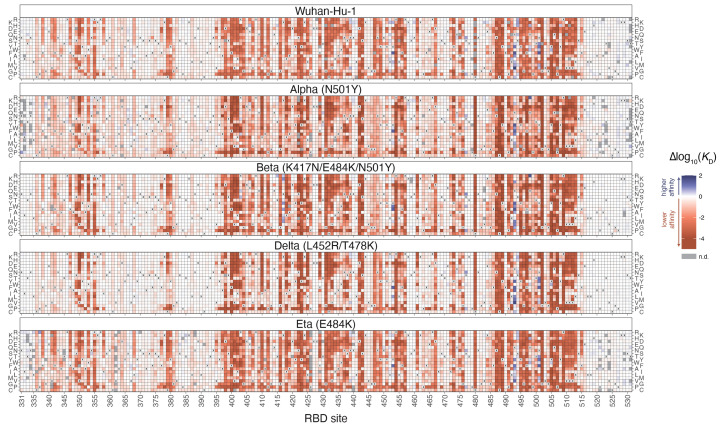
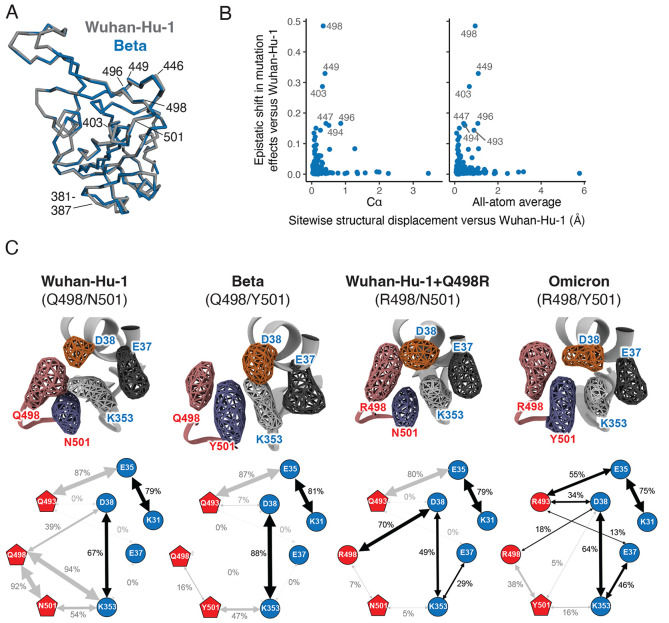
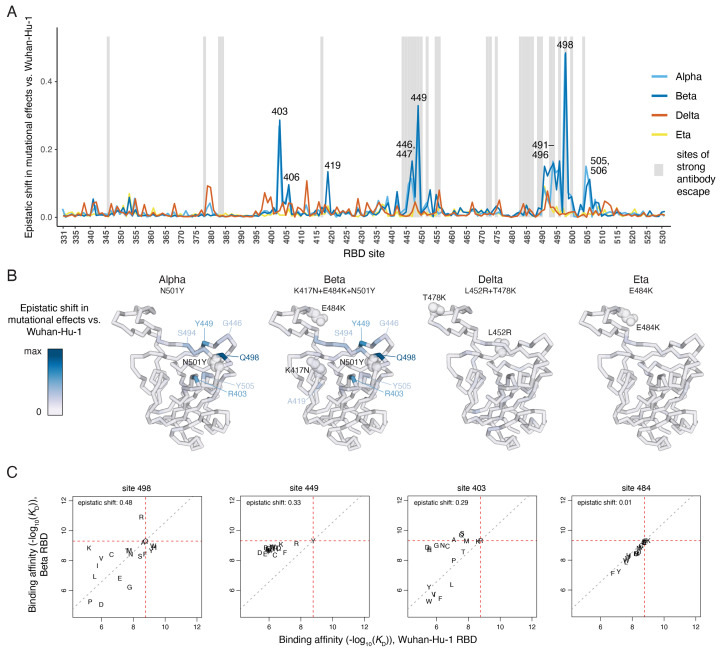
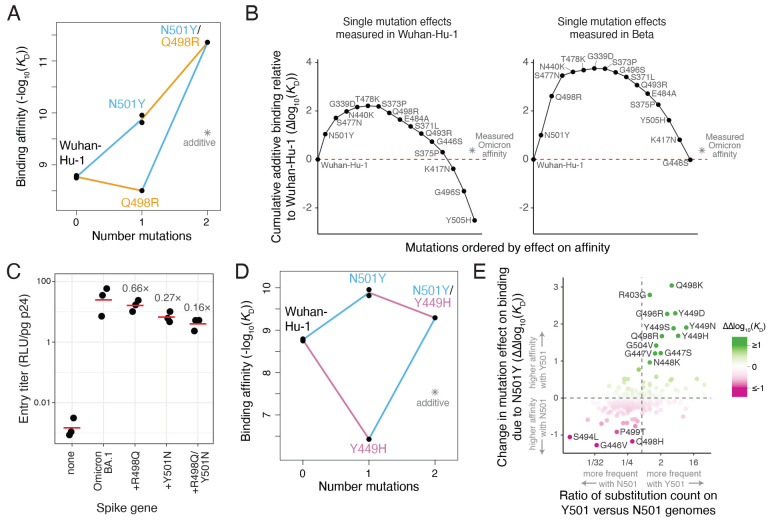
Severe acute respiratory syndrome coronavirus 2 (SARS-CoV-2) has evolved variants with substitutions in the spike receptor-binding domain (RBD) that affect its affinity for angiotensin-converting enzyme 2 (ACE2) receptor and recognition by antibodies. These substitutions could also shape future evolution by modulating the effects of mutations at other sites-a phenomenon called epistasis. To investigate this possibility, we performed deep mutational scans to measure the effects on ACE2 binding of all single-amino acid mutations in the Wuhan-Hu-1, Alpha, Beta, Delta, and Eta variant RBDs. Some substitutions, most prominently Asn→Tyr (N501Y), cause epistatic shifts in the effects of mutations at other sites. These epistatic shifts shape subsequent evolutionary change-for example, enabling many of the antibody-escape substitutions in the Omicron RBD. These epistatic shifts occur despite high conservation of the overall RBD structure. Our data shed light on RBD sequence-function relationships and facilitate interpretation of ongoing SARS-CoV-2 evolution.
严重急性呼吸综合征冠状病毒 2(SARS-CoV-2)已经进化出具有刺突受体结合域(RBD)取代的变体,这些取代会影响其与血管紧张素转换酶 2(ACE2)受体的亲和力和抗体的识别。这些取代也可能通过调节其他位点突变的影响来塑造未来的进化——这一现象称为上位性。为了研究这种可能性,我们进行了深度突变扫描,以测量武汉株、阿尔法、贝塔、德尔塔和伊塔变体 RBD 中所有单一氨基酸突变对 ACE2 结合的影响。一些取代,最明显的是天冬酰胺→酪氨酸(N501Y),导致其他位点突变的影响发生上位性转变。这些上位性转变塑造了随后的进化变化——例如,使奥密克戎 RBD 中的许多抗体逃逸取代成为可能。尽管 RBD 整体结构高度保守,但这些上位性转变仍在发生。我们的数据阐明了 RBD 序列-功能关系,并有助于解释正在进行的 SARS-CoV-2 进化。