Department of laboratory medicine, University Hospitals Leuven, Leuven, Belgium.
Department of Microbiology, Immunology and Transplantation, Laboratory of Clinical Bacteriology and Mycology, KU Leuven, Leuven, Belgium.
Front Cell Infect Microbiol. 2022 Jul 7;12:934485. doi: 10.3389/fcimb.2022.934485. eCollection 2022.
Fracture-related infection (FRI) is an important complication related to orthopaedic trauma. Although the scientific interest with respect to the diagnosis and treatment of FRI is increasing, data on the microbiological epidemiology remains limited. Therefore, the primary aim of this study was to evaluate the microbiological epidemiology related to FRI, including the association with clinical symptoms and antimicrobial susceptibility data. The secondary aim was to analyze whether there was a relationship between the time to onset of infection and the microbiological etiology of FRI.
FRI patients treated at the University Hospitals of Leuven, Belgium, between January 1st 2015 and November 24th 2019 were evaluated retrospectively. The microbiological etiology and antimicrobial susceptibility data were analyzed. Patients were classified as having an early (<2 weeks after implantation), delayed (2-10 weeks) or late-onset (> 10 weeks) FRI.
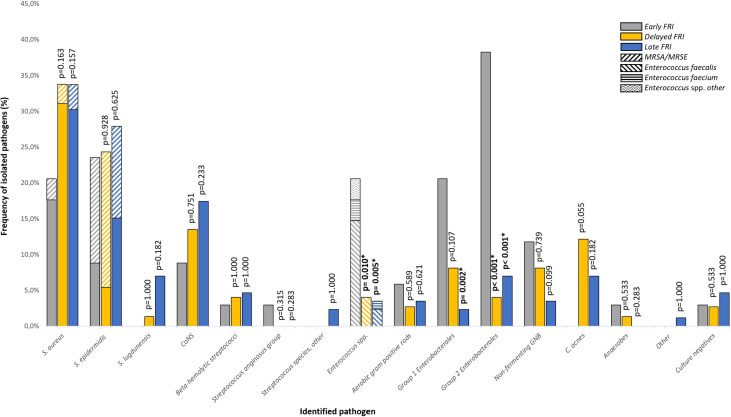
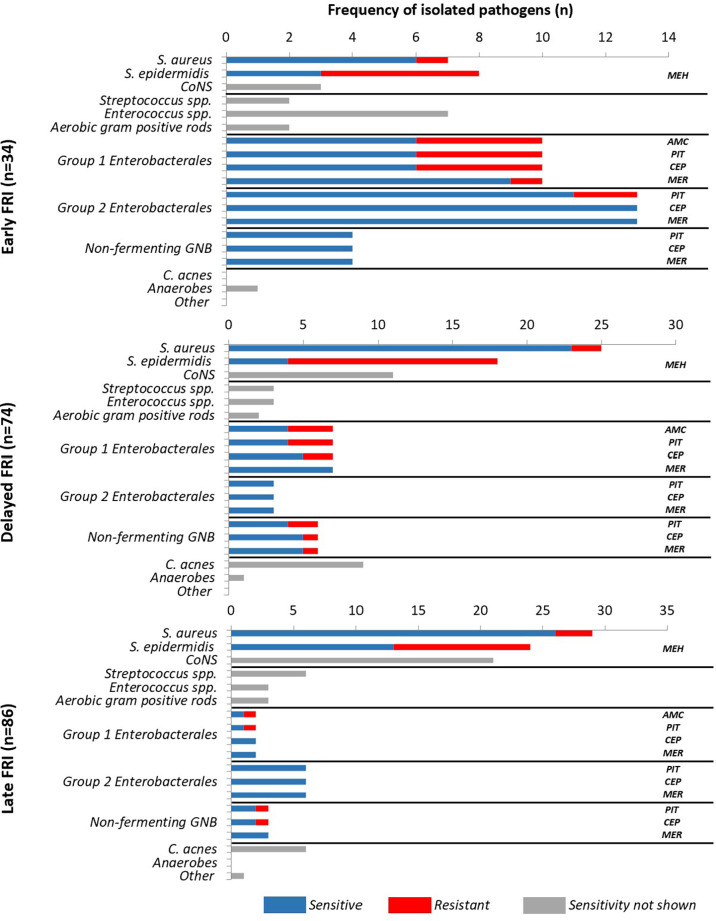
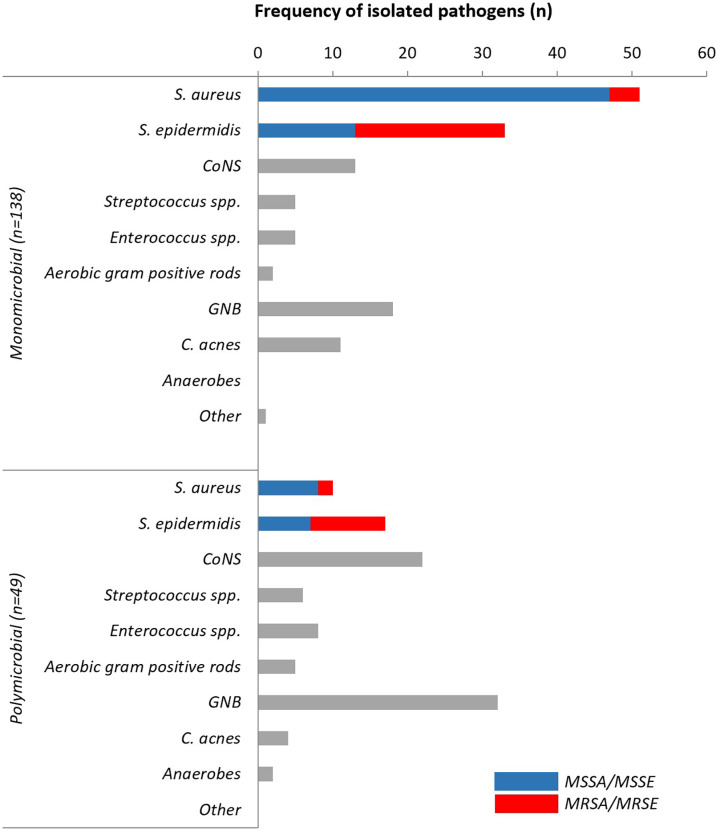
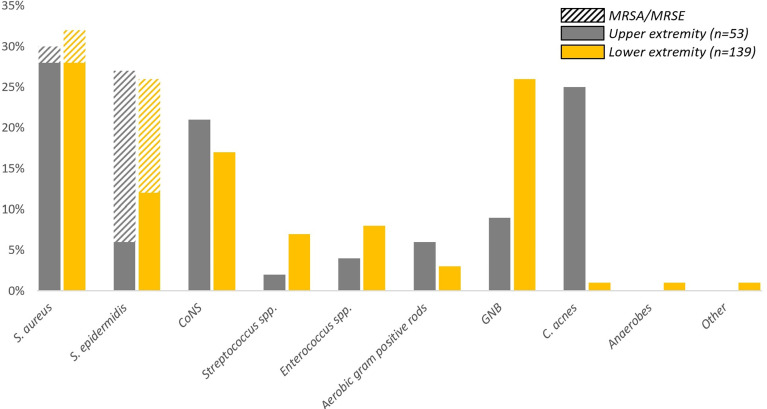
One hundred ninety-one patients with 194 FRIs, most frequently involving the tibia (23.7%) and femur (18.6%), were included. was the most frequently isolated pathogen, regardless of time to onset (n=61; 31.4%), followed by (n=50; 25.8%) and non- coagulase-negative staphylococci (n=35; 18.0%). Polymicrobial infections (n=49; 25.3%), mainly involving Gram negative bacilli (GNB) (n=32; 65.3%), were less common than monomicrobial infections (n=138; 71.1%). Virulent pathogens in monomicrobial FRIs were more likely to cause pus or purulent discharge (n=45;54.9%; p=0.002) and fistulas (n=21;25.6%; p=0.030). Susceptibility to piperacillin/tazobactam for GNB was 75.9%. Vancomycin covered 100% of Gram positive cocci.
This study revealed that in early FRIs, polymicrobial infections and infections including Enterobacterales and enterococcal species were more frequent. A time-based FRI classification is not meaningful to estimate the microbiological epidemiology and cannot be used to guide empiric antibiotic therapy. Large multicenter prospective studies are necessary to gain more insight into the added value of (broad) empirical antibiotic therapy.
骨折相关感染(FRI)是骨科创伤相关的重要并发症。尽管人们对 FRI 的诊断和治疗的科学兴趣日益增加,但有关微生物流行病学的数据仍然有限。因此,本研究的主要目的是评估与 FRI 相关的微生物流行病学,包括与临床症状的关联和抗菌药物敏感性数据。次要目的是分析感染发病时间与 FRI 微生物病因之间是否存在关系。
回顾性评估了 2015 年 1 月 1 日至 2019 年 11 月 24 日期间在比利时鲁汶大学医院治疗的 FRI 患者。分析了微生物病因和抗菌药物敏感性数据。患者被分为早期(植入后<2 周)、延迟(2-10 周)或晚期(>10 周) FRI。
共纳入 191 例 194 例 FRI 患者,最常涉及胫骨(23.7%)和股骨(18.6%)。金黄色葡萄球菌(n=61;31.4%)是最常分离出的病原体,无论发病时间如何(n=50;25.8%)和非凝固酶阴性葡萄球菌(n=35;18.0%)。混合感染(n=49;25.3%),主要涉及革兰氏阴性杆菌(GNB)(n=32;65.3%),比单一感染(n=138;71.1%)少见。单一微生物 FRI 中的毒力病原体更可能引起脓液或脓性分泌物(n=45;54.9%;p=0.002)和瘘管(n=21;25.6%;p=0.030)。GNB 对哌拉西林/他唑巴坦的敏感性为 75.9%。万古霉素覆盖 100%的革兰氏阳性球菌。
本研究表明,在早期 FRI 中,混合感染和包括肠杆菌科和肠球菌属在内的感染更为常见。基于时间的 FRI 分类对于估计微生物流行病学没有意义,也不能用于指导经验性抗生素治疗。需要大型多中心前瞻性研究来更深入地了解(广泛)经验性抗生素治疗的附加值。