Liu Qingsong, Wang Shaofeng, Hao Yanwei, Li Jiaxin, Li Wei, Zhang Yi, Li Bin
Department of Gastroenterology, Hospital of Chengdu University of Traditional Chinese Medicine, Chengdu 610072, China.
School of Clinical Medicine, Chengdu University of Traditional Chinese Medicine, Chengdu 610075, China.
Evid Based Complement Alternat Med. 2022 Jul 15;2022:3389180. doi: 10.1155/2022/3389180. eCollection 2022.
Yuanzhi powder (YZP) has been extensively investigated as a natural prescription with therapeutic benefits for Alzheimer's disease (AD). However, its active compounds and underlying immune mechanism for treating AD are still unclear. This study aimed to investigate the immune mechanism of YZP against AD through high-performance liquid chromatography (HPLC)-based network pharmacology and gene chip technology.
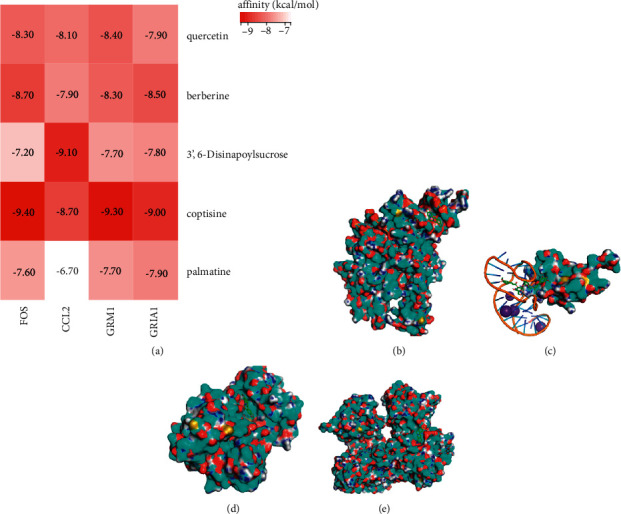
Active components of YZP were obtained from HPLC and public databases. Subsequently, GSE5281, GSE28146, GSE29378, and GSE97760 from the Gene Expression Omnibus (GEO) database were downloaded to extract AD difference genes (DEGs). The active components-targets network and protein interaction network were then constructed by Cytoscape. The biological processes and signaling pathways, which implicate the targets of YZP for AD, were analyzed using the ClueGo Cytoscape plug-in. Molecular docking experiments were performed to verify the affinity of targets and ligands. Ultimately, the link between the hub genes and immune cell infiltration was assessed via CIBERSORT.
83 YZP active compounds and 641 DEGs associated with AD, including quercetin, berberine, 3,6'-disinapoylsucrose, coptisine, and palmatine, were evaluated. We showed that FOS, CCL2, and GJA1 were the core targets and that the gap junction is an essential signaling pathway in YZP for AD. Furthermore, the AD group had a higher infiltration level of naïve B cells and resting CD4 memory T cells, as determined by the CIBERSORT. Notably, the immune cells-targets network demonstrates that GJA1 and GRM1 are intimately related to naïve B cells and plasma cells.
YZP may help treat AD by targeting proteins with key active compounds to regulate naïve B cells and plasma cells. Our results demonstrate a new immune mechanism for treating AD with YZP.
远志散(YZP)作为一种对阿尔茨海默病(AD)具有治疗作用的天然方剂已被广泛研究。然而,其治疗AD的活性成分和潜在免疫机制仍不清楚。本研究旨在通过基于高效液相色谱(HPLC)的网络药理学和基因芯片技术研究YZP抗AD的免疫机制。
从HPLC和公共数据库中获取YZP的活性成分。随后,从基因表达综合数据库(GEO)下载GSE5281、GSE28146、GSE29378和GSE97760,以提取AD差异基因(DEG)。然后用Cytoscape构建活性成分-靶点网络和蛋白质相互作用网络。使用ClueGo Cytoscape插件分析涉及YZP治疗AD靶点的生物学过程和信号通路。进行分子对接实验以验证靶点与配体的亲和力。最后,通过CIBERSORT评估枢纽基因与免疫细胞浸润之间的联系。
评估了83种YZP活性化合物和641个与AD相关的DEG,包括槲皮素、小檗碱、3,6'-二芥子酰蔗糖、黄连碱和巴马汀。我们发现FOS、CCL2和GJA1是核心靶点,间隙连接是YZP治疗AD的重要信号通路。此外,通过CIBERSORT测定,AD组初始B细胞和静息CD4记忆T细胞的浸润水平较高。值得注意的是,免疫细胞-靶点网络表明GJA1和GRM1与初始B细胞和浆细胞密切相关。
YZP可能通过靶向具有关键活性化合物的蛋白质来调节初始B细胞和浆细胞,从而有助于治疗AD。我们的结果证明了YZP治疗AD的一种新的免疫机制。