Chen Peiming, Liu Tai-Wa, Tse Mimi M Y, Lai Claudia K Y, Tsoh Joshua, Ng Shamay S M
Department of Rehabilitation Sciences, The Hong Kong Polytechnic University, Kowloon, Hong Kong SAR, China.
School of Nursing & Health Studies, Hong Kong Metropolitan University, Ho Man Tin, Hong Kong SAR, China.
Front Neurol. 2022 Jul 7;13:926130. doi: 10.3389/fneur.2022.926130. eCollection 2022.
Recent findings of clinical studies have demonstrated a significant positive relationship between Fugl-Meyer Assessment of upper extremity score and the action research arm test (ARAT) score in people with stroke. Although the motor activity log (MAL) can assess the self-perception of motor performance, which can affect the performance of the upper limb, the relationship between MAL score and ARAT score still remains unclear. The objective of this study is to quantify the independent contribution of MAL score and FMA-hand score on the ARAT score in people with stroke.
This is a cross-sectional study. There were a total of 87 subjects (50 males, 37 females; mean age = 61.12 ± 6.88 years, post-stroke duration=6.31 ± 2.84 years) included in this study. Self-perceived performance in using the paretic limb was measured by MAL, including subscale of the amount of usage (MAL-AOU) and quality of movement (MAL-QOM). Functional performance of the upper limb was measured by action research arm test (ARAT). Upper limb motor control of the hand was measured by hand section of Fugl-Meyer assessment (FMA-hand).
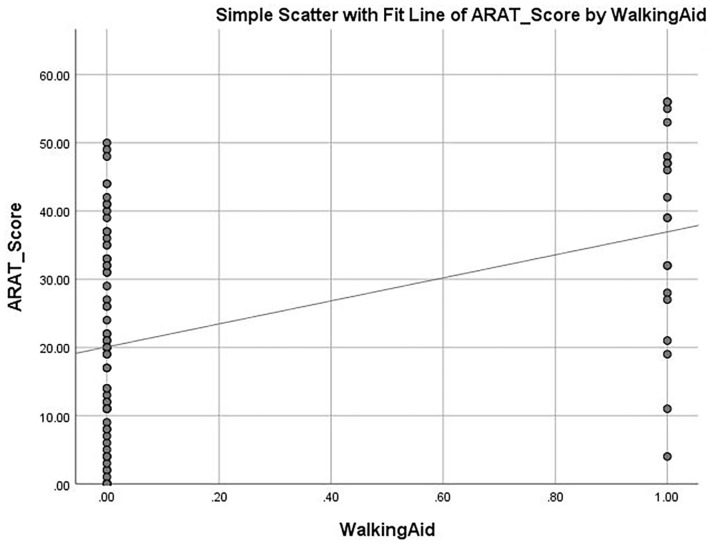
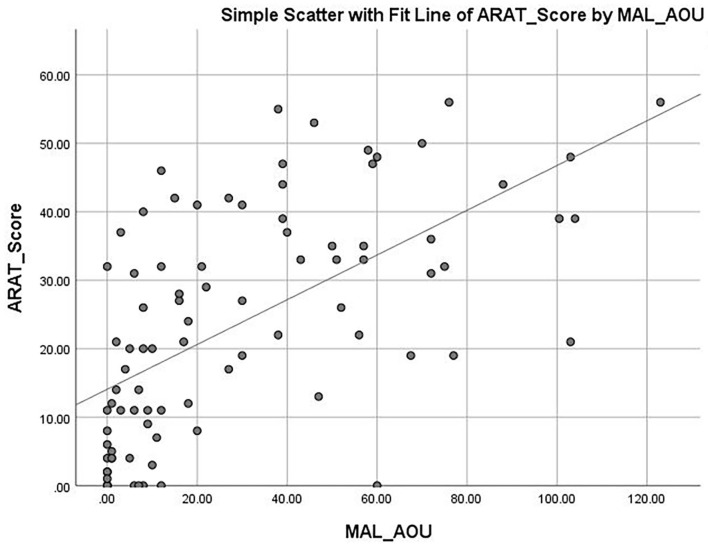
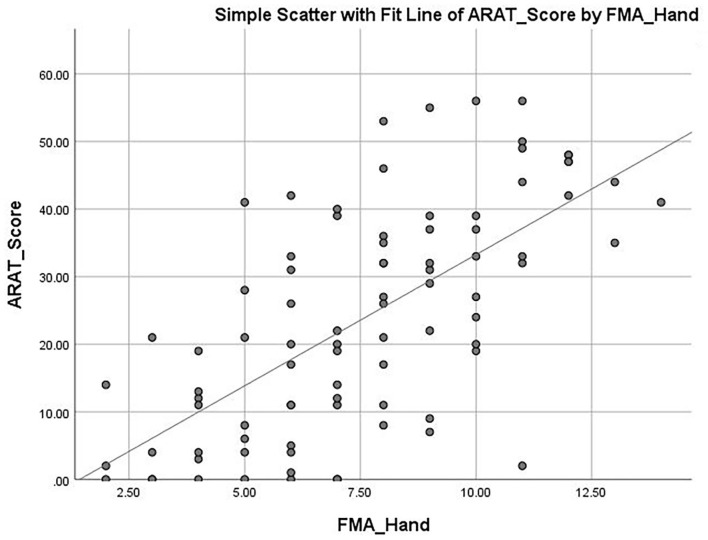
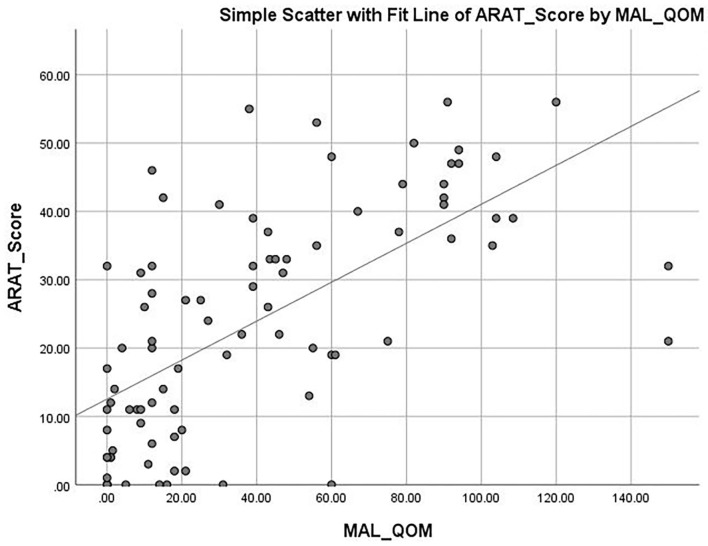
The result showed that MAL-QOM ( = 0.648, < 0.001), MAL-AOU ( = 0.606, < 0.001), FMA-hand scores ( = 0.663, < 0.001), and the use of a walking aid ( = -0.422, < 0.001) were significantly correlated with the ARAT scores. A total 66.9% of the variance in the ARAT scores was predicted by the final regression model including MAL-QOM, MAL-AOU, FMA-hand scores, and walking aid. The FMA-hand score was the best predictor of ARAT scores, which can predict a 36.4% variance of ARAT scores in people with stroke, which controlled the effect of using a walking aid. After controlling for use of a walking aid and FMA-hand scores, the multiple linear regression modeling showed that MAL-QOM and MAL-AOU scores could also independently predict an additional 10.4% of the variance in ARAT scores.
In addition to the FMA-hand score, the MAL score was significantly correlated with the ARAT score. Improving self-perceived performance should be one goal of rehabilitation in people with stroke. Further work developing and testing techniques to do so is clearly warranted.
临床研究的最新发现表明,中风患者上肢Fugl-Meyer评估得分与动作研究臂测试(ARAT)得分之间存在显著的正相关关系。尽管运动活动日志(MAL)可以评估运动表现的自我认知,而这种认知可能会影响上肢的表现,但MAL得分与ARAT得分之间的关系仍不明确。本研究的目的是量化MAL得分和Fugl-Meyer评估手部得分(FMA-手)对中风患者ARAT得分的独立贡献。
这是一项横断面研究。本研究共纳入87名受试者(50名男性,37名女性;平均年龄=61.12±6.88岁,中风后病程=6.31±2.84年)。使用MAL测量使用患侧肢体的自我感知表现,包括使用量子量表(MAL-AOU)和运动质量(MAL-QOM)。使用动作研究臂测试(ARAT)测量上肢的功能表现。使用Fugl-Meyer评估的手部部分(FMA-手)测量手部的上肢运动控制。
结果显示,MAL-QOM(r = 0.648,P < 0.001)、MAL-AOU(r = 0.606,P < 0.001)、FMA-手得分(r = 0.663,P < 0.001)以及是否使用助行器(r = -0.422,P < 0.001)与ARAT得分显著相关。最终回归模型(包括MAL-QOM、MAL-AOU、FMA-手得分和是否使用助行器)预测了ARAT得分中66.9%的方差。FMA-手得分是ARAT得分的最佳预测指标,在控制了使用助行器的影响后,它可以预测中风患者ARAT得分中36.4%的方差。在控制了使用助行器和FMA-手得分后,多元线性回归模型显示,MAL-QOM和MAL-AOU得分还可以独立预测ARAT得分中另外10.4%的方差。
除了FMA-手得分外,MAL得分与ARAT得分也显著相关。改善自我感知表现应是中风患者康复的一个目标。显然有必要进一步开展相关技术的开发和测试工作。