IRCCS Fondazione Don Gnocchi, Milano, Italy.
Rehabilitation Department, CRRF Mons. L. Novarese, Moncrivello, Italy.
Front Immunol. 2022 Jul 6;13:842269. doi: 10.3389/fimmu.2022.842269. eCollection 2022.
Heat sensitivity occurs in a high percentage of people with multiple sclerosis (PwMS), in response to environmental or exercise-induced increase in body temperature. However, the kinetic and magnitude of adaptation of the internal load and of the core body temperature (CBT) to a submaximal continuous exercise has been poorly addressed in PwMS; this may be relevant for the brief exercise bouts usually occurring in normal daily life. The aim of this work was to evaluate whether multiple sclerosis influences the acute adaptation of the internal load, the CBT and the perceptual load in response to a constant submaximal work step.
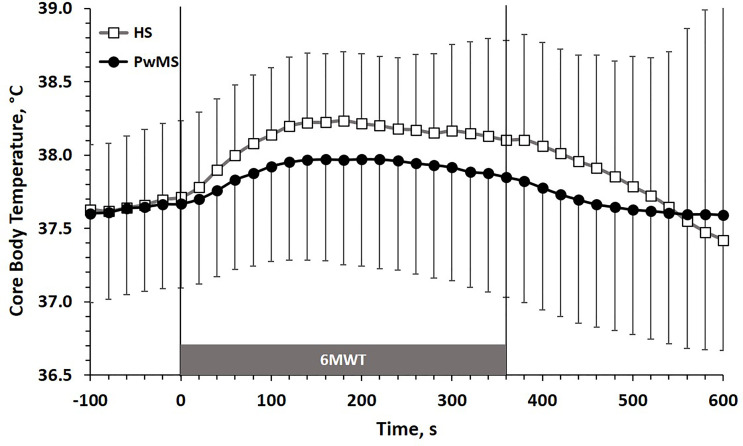
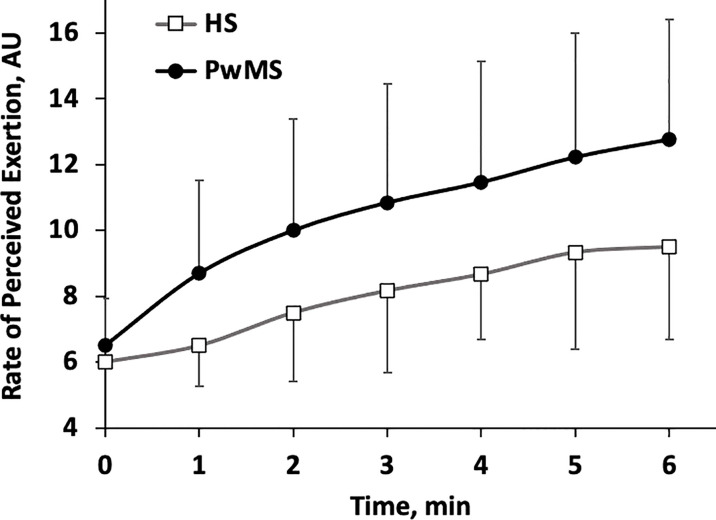
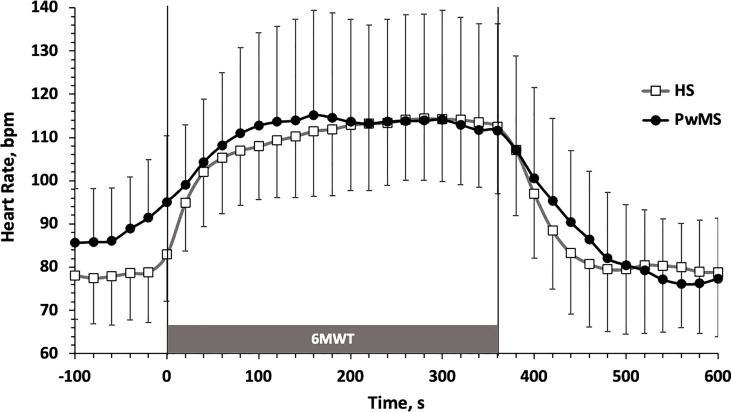
CBT has been continuously monitored (0.5 Hz) by a validated wearable heat-flux sensor and electrocardiography was recorded (250 Hz) by a wearable device during a standard 6-minute walk test (6MWT) in 14 PwMS (EDSS, 4.7 ± 1.2; disease duration: 13.0 ± 10.2 years; m ± SD) and 14 age, sex and BMI-matched healthy subjects (HS). The rate of perceived exertion (RPE) of the lower limbs was assessed during the 6MWT by the Borg scale (6-20).
As expected, PwMS walked a significantly shorter distance (361 ± 98 m) than the HS group (613 ± 62 m, p<0.001 vs PwMS). However, the kinetics of adaptation of CBT and the magnitude of CBT change from baseline did not differ between groups. Similarly, heart rate (HR) kinetics and HR change from baseline were comparable between groups during the 6MWT. Finally, lower limbs RPE gradually increased during the exercise test, but without significant differences between groups.
The internal load, the metabolic heat production, and the perceptive load due to a standard submaximal walking exercise seems to be preserved in PwMS, suggesting a comparable acute heat production and dissipation during exercise. Therefore, it is unlikely that the different distance achieved during the 6MWT may be caused by altered thermoregulatory responses to exercise. Rather, this appears to be a consequence of the known increased energy cost of locomotion in PwMS.
热敏感性发生在很大比例的多发性硬化症(PwMS)患者中,这是对环境或运动引起的体温升高的反应。然而,在 PwMS 中,对亚最大连续运动的内部负荷和核心体温(CBT)的适应动力学和幅度仍未得到充分解决;这对于正常日常生活中通常发生的短暂运动可能很重要。本工作的目的是评估多发性硬化症是否会影响内部负荷、CBT 和感知负荷对恒定亚最大工作步骤的急性适应。
通过经过验证的可穿戴热通量传感器连续监测 CBT(0.5 Hz),并通过可穿戴设备在标准 6 分钟步行测试(6MWT)期间以 250 Hz 记录心电图。在 14 名多发性硬化症患者(EDSS,4.7 ± 1.2;疾病持续时间:13.0 ± 10.2 年;m ± SD)和 14 名年龄、性别和 BMI 匹配的健康受试者(HS)中进行。6MWT 期间通过 Borg 量表(6-20)评估下肢感知用力(RPE)。
正如预期的那样,PwMS 行走的距离明显短于 HS 组(361 ± 98 m 与 613 ± 62 m,p<0.001 与 PwMS)。然而,CBT 的适应动力学和 CBT 从基线的变化幅度在两组之间没有差异。同样,在 6MWT 期间,两组之间的心率(HR)动力学和 HR 从基线的变化也相似。最后,下肢 RPE 在运动测试过程中逐渐增加,但两组之间没有差异。
在 PwMS 中,标准亚最大步行运动引起的内部负荷、代谢产热量和感知负荷似乎得以保留,这表明在运动过程中产生和散发的热量相当。因此,6MWT 中距离的不同不太可能是由于运动时的体温调节反应改变引起的。相反,这似乎是 PwMS 中运动能量成本增加的结果。