Spring Ecology Research Group, Department of Environmental Sciences, University of Basel, 4056 Basel, Switzerland.
Proteomics Core Facility, Biozentrum, University of Basel, 4056 Basel, Switzerland.
J Exp Biol. 2022 Aug 1;225(15). doi: 10.1242/jeb.244218. Epub 2022 Aug 11.
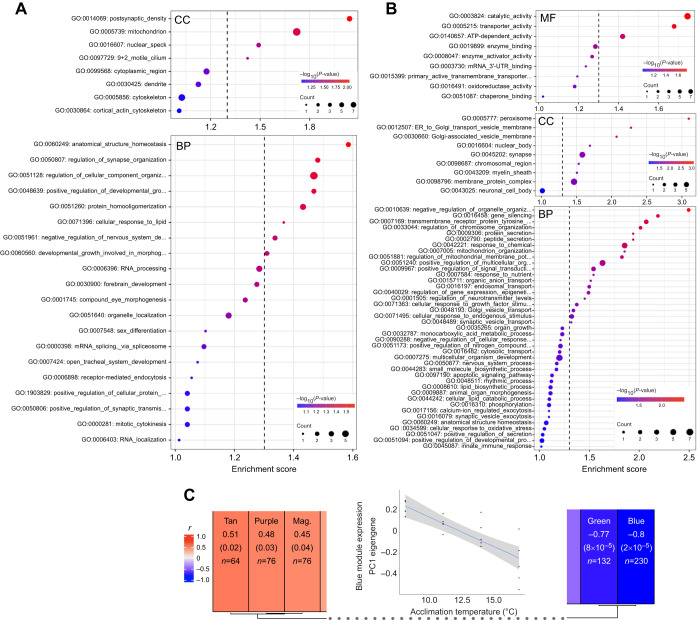
Species' acclimation capacity and their ability to maintain molecular homeostasis outside ideal temperature ranges will partly predict their success following climate change-induced thermal regime shifts. Theory predicts that ectothermic organisms from thermally stable environments have muted plasticity, and that these species may be particularly vulnerable to temperature increases. Whether such species retained or lost acclimation capacity remains largely unknown. We studied proteome changes in the planarian Crenobia alpina, a prominent member of cold-stable alpine habitats that is considered to be a cold-adapted stenotherm. We found that the species' critical thermal maximum (CTmax) is above its experienced habitat temperatures and that different populations exhibit differential CTmax acclimation capacity, whereby an alpine population showed reduced plasticity. In a separate experiment, we acclimated C. alpina individuals from the alpine population to 8, 11, 14 or 17°C over the course of 168 h and compared their comprehensively annotated proteomes. Network analyses of 3399 proteins and protein set enrichment showed that while the species' proteome is overall stable across these temperatures, protein sets functioning in oxidative stress response, mitochondria, protein synthesis and turnover are lower in abundance following warm acclimation. Proteins associated with an unfolded protein response, ciliogenesis, tissue damage repair, development and the innate immune system were higher in abundance following warm acclimation. Our findings suggest that this species has not suffered DNA decay (e.g. loss of heat-shock proteins) during evolution in a cold-stable environment and has retained plasticity in response to elevated temperatures, challenging the notion that stable environments necessarily result in muted plasticity.
物种的适应能力及其在理想温度范围之外维持分子内稳态的能力,将在一定程度上预测它们在气候变化引起的热态转变后能否成功适应。理论预测,来自热稳定环境的变温动物的可塑性较弱,这些物种可能特别容易受到温度升高的影响。这些物种是否保留或丧失了适应能力,在很大程度上仍然未知。我们研究了扁形动物 Crenobia alpina 的蛋白质组变化,它是一种生活在寒冷稳定的高山栖息地的著名成员,被认为是一种适应寒冷的狭温动物。我们发现,该物种的最高临界温度(CTmax)高于其经历的栖息地温度,并且不同种群表现出不同的 CTmax 适应能力,其中一个高山种群的可塑性降低。在另一个实验中,我们在 168 小时的时间里,将高山种群的 C. alpina 个体从高山种群中适应 8、11、14 或 17°C,并比较了它们全面注释的蛋白质组。对 3399 种蛋白质和蛋白质集富集的网络分析表明,尽管该物种的蛋白质组在这些温度下总体上是稳定的,但在温暖适应后,参与氧化应激反应、线粒体、蛋白质合成和周转的蛋白质集的丰度降低。与未折叠蛋白反应、纤毛发生、组织损伤修复、发育和先天免疫系统相关的蛋白质在温暖适应后丰度更高。我们的研究结果表明,该物种在寒冷稳定的环境中进化过程中没有遭受 DNA 衰退(例如热休克蛋白的丧失),并且在应对温度升高时保持了可塑性,这挑战了稳定环境必然导致可塑性降低的观点。