Department of Clinical Microbiology, Instituto de Investigación Sanitaria (IIS)-Fundación Jiménez Díaz, Universidad Autónoma de Madrid (UAM), Madrid, Spain.
Centre for Biomedical Research Network in Infectious Diseases (CIBERINFEC), CIBER de Enfermedades Infecciosas, Madrid, Spain.
Microbiol Spectr. 2022 Aug 31;10(4):e0085122. doi: 10.1128/spectrum.00851-22. Epub 2022 Jul 25.
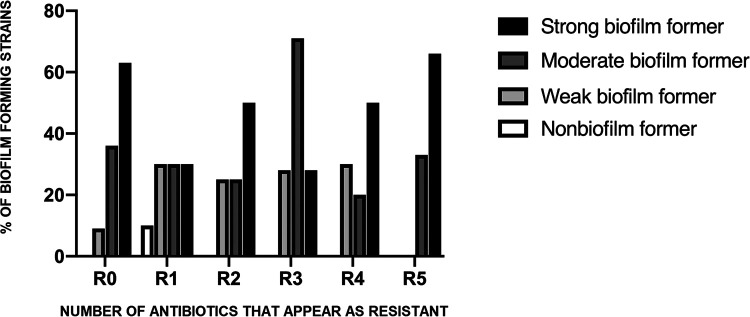
Prosthetic joint infections (PJIs) are typically caused by microorganisms that grow in biofilms. Traditional antimicrobial susceptibility tests are based on the study of planktonic bacteria that might lead to missing the biofilm behavior and to a treatment failure. This study was designed to analyze the antimicrobial susceptibility of clinical Gram-negative bacilli (GNB) isolates from PJIs in planktonic and sessile states and the possible relationship between antimicrobial resistance and biofilm formation. A total of 46 clinical isolates from patients with PJIs (mainly hip and knee prostheses) plus three GNB ATCC isolates were studied. The Minimal Inhibitory Concentration (MIC), minimal bactericidal concentration (MBC), minimal biofilm inhibitory concentration (MBIC), and minimal biofilm eradication concentration (MBEC) were assessed using a previously published methodology. Almost all of the GNB clinical isolates tested were biofilm forming. Pseudomonas aeruginosa was the largest biofilm-forming species. A comparison of MBIC versus MIC shows an increase higher than 1- to -2-fold dilutions in most antimicrobials studied, and MBEC90 was significantly higher than MIC90, becoming resistant to all the antimicrobial drugs tested. Higher biofilm production values were obtained in antibiotic-susceptible Escherichia coli in comparison to their resistant counterparts. However, regarding the relationships between antimicrobial resistance and biofilm formation, our analysis showed that each strain differed. A high antimicrobial resistance rate was found among the GNB studied. Moreover, almost all bacterial isolates were biofilm formers. Although there was no significant association between biofilm and antibiotic resistance, multidrug-resistant isolates were found to be greater biofilm formers than non-multidrug-resistant isolates. This study is the first one to analyze a high number of isolates of Gram-negative bacilli that are the cause of prosthetic joint infection. The analysis includes biofilm development and antimicrobial susceptibility testing of both planktonic and sessile bacteria. The obtained results support the clinical knowledge about the treatment of these bacteria when biofilms are involved.
人工关节感染(PJI)通常由生物膜中生长的微生物引起。传统的抗菌药敏试验基于浮游细菌的研究,这可能导致错过生物膜行为,并导致治疗失败。本研究旨在分析 PJI 中临床革兰氏阴性菌(GNB)浮游和静止状态下的抗菌药敏性,以及抗菌耐药性与生物膜形成之间的可能关系。共研究了 46 例来自 PJI 患者(主要为髋关节和膝关节假体)的临床分离株,外加 3 株 GNB ATCC 分离株。使用先前发表的方法评估最小抑菌浓度(MIC)、最小杀菌浓度(MBC)、最小生物膜抑制浓度(MBIC)和最小生物膜清除浓度(MBEC)。测试的大多数 GNB 临床分离株均为生物膜形成。铜绿假单胞菌是最大的生物膜形成物种。MBIC 与 MIC 的比较表明,在所研究的大多数抗菌药物中,增加了 1-2 倍以上的稀释度,MBEC90 明显高于 MIC90,对所有测试的抗菌药物均产生耐药性。与耐药对应物相比,在抗生素敏感的大肠杆菌中获得了更高的生物膜产生值。然而,关于抗菌耐药性与生物膜形成之间的关系,我们的分析表明,每种菌株都有所不同。在所研究的 GNB 中发现了很高的抗菌耐药率。此外,几乎所有细菌分离株都是生物膜形成者。尽管生物膜和抗生素耐药性之间没有显著关联,但发现多药耐药分离株比非多药耐药分离株更易形成生物膜。本研究首次分析了大量引起人工关节感染的革兰氏阴性菌分离株。分析包括浮游和静止细菌的生物膜发育和抗菌药敏试验。所获得的结果支持了关于涉及生物膜时这些细菌治疗的临床知识。