Department of Thoracic and Cardiovascular Surgery, Seoul National University Hospital, Seoul National University College of Medicine, Seoul, Korea.
Cancer Research Institute, Seoul National University College of Medicine, Seoul, Korea.
Interact Cardiovasc Thorac Surg. 2022 Jul 9;35(2). doi: 10.1093/icvts/ivac195.
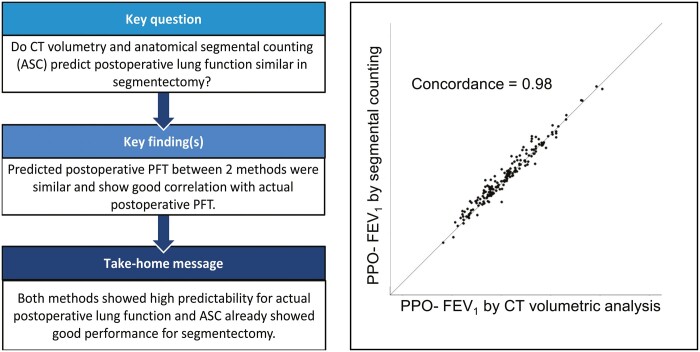
We compared the computed tomographic (CT) volumetric analysis and anatomical segment counting (ASC) for predicting postoperative forced expiratory volume in 1 s (FEV1) and diffusing capacity for carbon monoxide (DLCO) in patients who had segmentectomy for early-stage lung cancer.
A total of 175 patients who had segmentectomy for lung cancer and had postoperative pulmonary function test were included. CT volumetric analysis was performed by software, which could measure total lung and target segment volume from CT images. ASC and CT volumetric analysis were used to determine predicted postoperative (PPO) values and the concordance and difference of these values were assessed. The relationship between PPO values and actual postoperative values was also investigated.
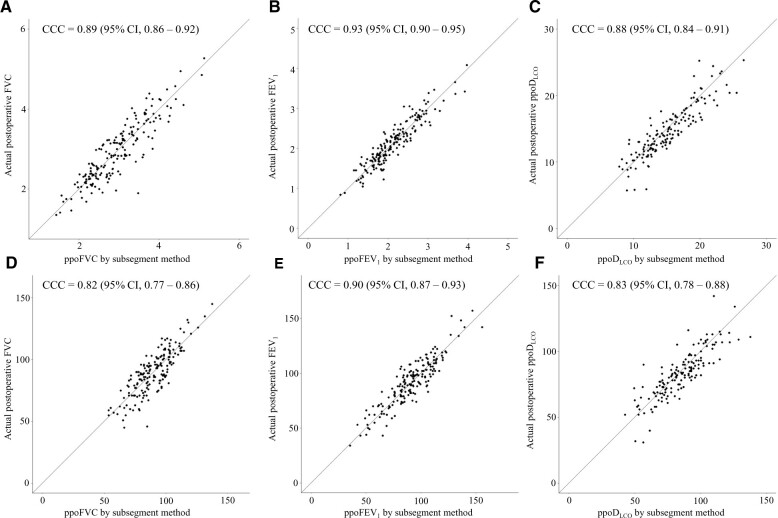
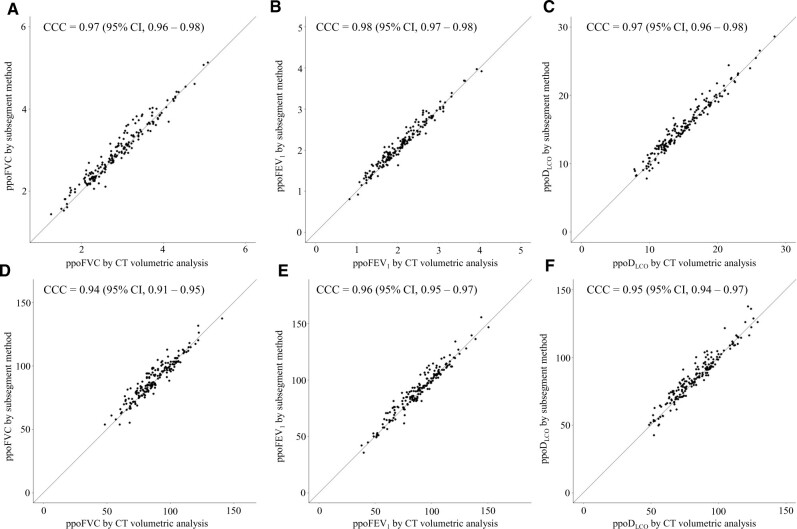
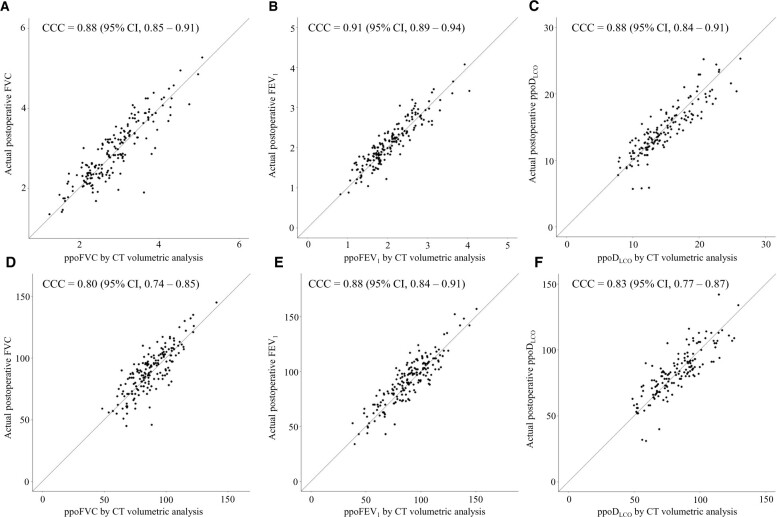
The PPO-FEV1 and PPO-DLCO showed high concordance between 2 methods (concordance correlation coefficient = 0.96 for PPO-FEV1 and 0.95 for PPO-DLCO). There was no significant difference between PPO values as determined by 2 methods (P = 0.53 for PPO-FEV1, P = 0.25 for PPO-DLCO) and actual postoperative values [P = 0.77 (ASC versus actual) and P = 0.20 (CT versus actual) for FEV1; P = 0.41 (ASC versus actual) and P = 0.80 (CT versus actual) for DLCO]. We subdivided the patients according to poor pulmonary function test, the number of resected segments and the location of the resected lobe. All subgroup analyses revealed no significant difference between PPO values and actual postoperative values.
Both CT volumetric analysis and ASC showed high predictability for actual postoperative FEV1 and DLCO in segmentectomy.
我们比较了计算机断层扫描(CT)容积分析和解剖节段计数(ASC)在预测早期肺癌患者行肺段切除术后 1 秒用力呼气量(FEV1)和一氧化碳弥散量(DLCO)的价值。
共纳入 175 例因肺癌行肺段切除术且术后行肺功能检查的患者。通过软件对 CT 容积进行分析,可从 CT 图像中测量全肺和目标节段的体积。使用 ASC 和 CT 容积分析来确定预测术后值(PPO),并评估这些值的一致性和差异。还研究了 PPO 值与实际术后值之间的关系。
2 种方法的 PPO-FEV1 和 PPO-DLCO 具有高度一致性(PPO-FEV1 的一致性相关系数为 0.96,PPO-DLCO 的一致性相关系数为 0.95)。2 种方法确定的 PPO 值之间没有显著差异(PPO-FEV1 的 P 值=0.53,PPO-DLCO 的 P 值=0.25),与实际术后值之间也没有显著差异[FEV1 时 ASC 与实际值相比 P 值=0.77(PPO 与实际值),CT 与实际值相比 P 值=0.20(PPO 与实际值);DLCO 时 ASC 与实际值相比 P 值=0.41(PPO 与实际值),CT 与实际值相比 P 值=0.80(PPO 与实际值)]。我们根据肺功能检查结果、切除节段数量和切除肺叶位置对患者进行了细分。所有亚组分析均显示 PPO 值与实际术后值之间无显著差异。
CT 容积分析和 ASC 均能高度预测肺段切除术后 FEV1 和 DLCO 的实际值。