Odette Cancer Centre, Sunnybrook Health Sciences Centre, Toronto, ON M4N3M5, Canada.
Department of Medicine, Division of Medical Oncology and Hematology, University of Toronto, Toronto, ON M5S1A1, Canada.
Curr Oncol. 2022 Jul 13;29(7):4956-4969. doi: 10.3390/curroncol29070394.
Approximately 75% of breast cancer (BC) is associated with luminal differentiation expressing endocrine receptors (ER). For ER+ HER2- tumors, adjuvant endocrine therapy (ET) is the cornerstone treatment. Although relapse events steadily continue, the ET benefits translate to dramatically lengthen life expectancy with bearable side-effects. This review of ER+ HER2- female BC outlines suitable adjuvant treatment strategies to help guide clinical decision making around appropriate therapy.
A literature search was conducted in Embase, Medline, and the Cochrane Libraries, using ER+ HER-, ET BC keywords.
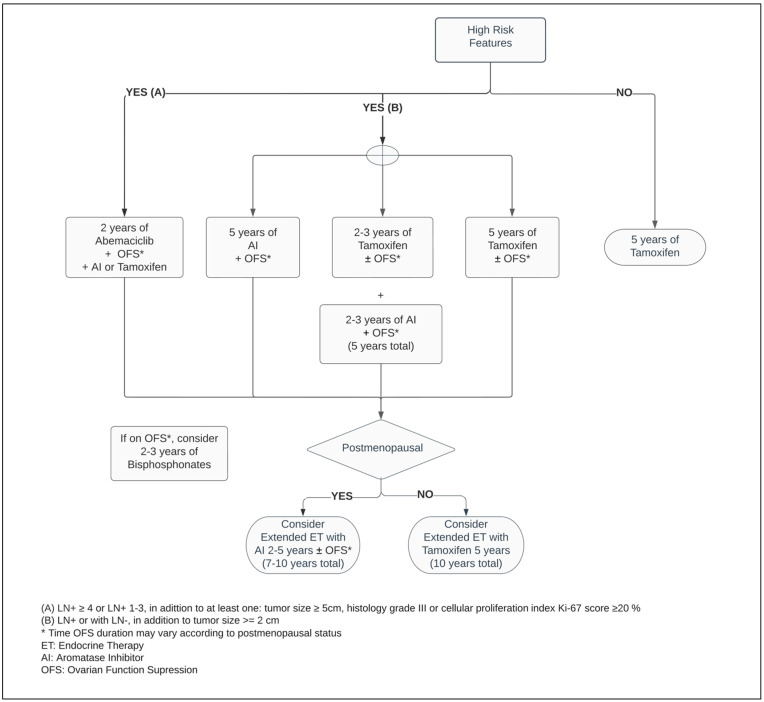
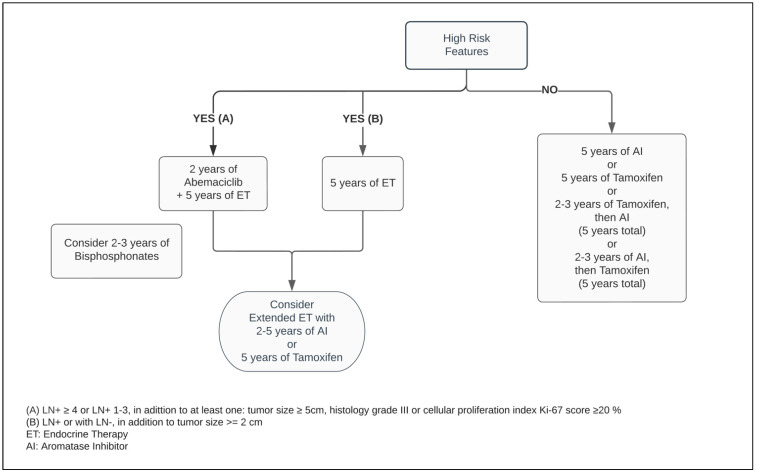
In low-risk patients: five years of ET is the standard option. While Tamoxifen remains the preferred selection for premenopausal women, AI is the choice for postmenopausal patients. In the high-risk category: ET plus/minus OFS with two years of Abemaciclib is recommended. Although extended ET for a total of ten years is an alternative, the optimal AI duration is undetermined; nevertheless an additional two to three years beyond the initial five years may be sufficient. In this postmenopausal group, bisphosphonate is endorsed.
Classifying the risk category assists in deciding the treatment route and its optimal duration. Tailoring the breadth of ET hinges on a wide array of factors to be appraised for each individualized case, including weighing its benefits and harms.
约 75%的乳腺癌(BC)与表达内分泌受体(ER)的腔型分化有关。对于 ER+HER2-肿瘤,辅助内分泌治疗(ET)是基石治疗。尽管复发事件仍在持续,但 ET 的益处确实显著延长了预期寿命,且副作用可耐受。本文回顾了 ER+HER2-女性 BC 的辅助治疗策略,以帮助指导临床决策,确定合适的治疗方法。
在 Embase、Medline 和 Cochrane 图书馆中使用 ER+HER-、ET BC 关键词进行文献检索。
在低危患者中:五年 ET 是标准选择。虽然他莫昔芬仍然是绝经前妇女的首选药物,但 AI 是绝经后患者的选择。在高危患者中:推荐 ET 加/不加 OFS 加两年 Abemaciclib。虽然延长 ET 总疗程至十年也是一种选择,但最佳 AI 持续时间尚未确定;尽管在最初的五年之后再延长两到三年可能就足够了。对于该绝经后患者群体,双膦酸盐被推荐使用。
对风险类别进行分类有助于决定治疗途径和最佳疗程。根据每个个体化病例的广泛因素来调整 ET 的广度,包括权衡其获益和风险。