Qiang Jiaqi, Wu Danning, Du Hanze, Zhu Huijuan, Chen Shi, Pan Hui
Key Laboratory of Endocrinology of National Health Commission, Department of Endocrinology, Peking Union Medical College Hospital, Chinese Academy of Medical Sciences and Peking Union Medical College, Beijing 100730, China.
Eight-Year Program of Clinical Medicine, Chinese Academy of Medical Sciences and Peking Union Medical College, Beijing 100730, China.
Bioengineering (Basel). 2022 Jun 23;9(7):273. doi: 10.3390/bioengineering9070273.
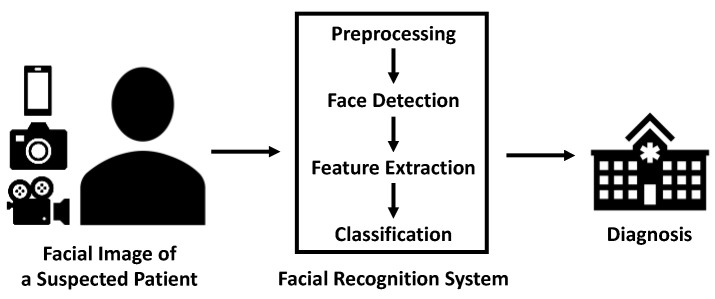
Diseases not only manifest as internal structural and functional abnormalities, but also have facial characteristics and appearance deformities. Specific facial phenotypes are potential diagnostic markers, especially for endocrine and metabolic syndromes, genetic disorders, facial neuromuscular diseases, etc. The technology of facial recognition (FR) has been developed for more than a half century, but research in automated identification applied in clinical medicine has exploded only in the last decade. Artificial-intelligence-based FR has been found to have superior performance in diagnosis of diseases. This interdisciplinary field is promising for the optimization of the screening and diagnosis process and assisting in clinical evaluation and decision-making. However, only a few instances have been translated to practical use, and there is need of an overview for integration and future perspectives. This review mainly focuses on the leading edge of technology and applications in varieties of disease, and discusses implications for further exploration.
疾病不仅表现为内部结构和功能异常,还具有面部特征和外观畸形。特定的面部表型是潜在的诊断标志物,特别是对于内分泌和代谢综合征、遗传性疾病、面部神经肌肉疾病等。面部识别(FR)技术已经发展了半个多世纪,但应用于临床医学的自动识别研究仅在过去十年中才蓬勃发展。基于人工智能的面部识别已被发现在疾病诊断中具有卓越性能。这个跨学科领域对于优化筛查和诊断过程以及辅助临床评估和决策很有前景。然而,只有少数实例已转化为实际应用,并且需要进行整合和展望未来的概述。本综述主要关注各种疾病中技术和应用的前沿,并讨论进一步探索的意义。