Institute of Peace, Leadership and Governance, Africa University, Mutare, Zimbabwe.
Leibniz Institute for Prevention Research and Epidemiology - BIPS, Bremen, Germany.
PLoS One. 2022 Jul 25;17(7):e0272038. doi: 10.1371/journal.pone.0272038. eCollection 2022.
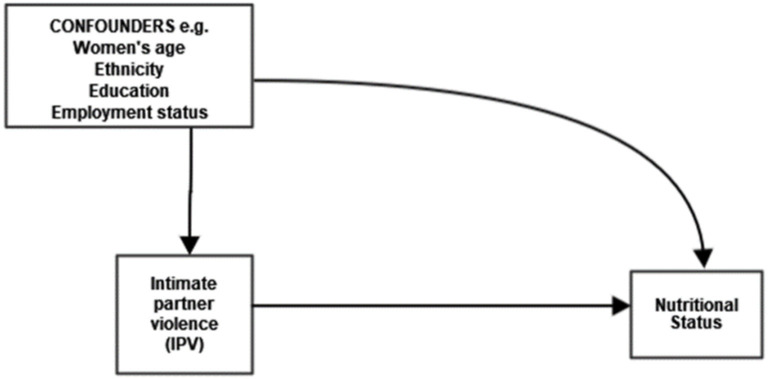
Intimate partner violence (IPV) against women and poor nutritional status are growing health problems in low and middle-income countries (LMICs). Moreover, violence against women has been shown to be associated with poor nutrition. This study investigated the relationship between IPV and nutritional status (i.e., underweight, overweight, and obesity) among women of reproductive age (15-49 years) in Zimbabwe.
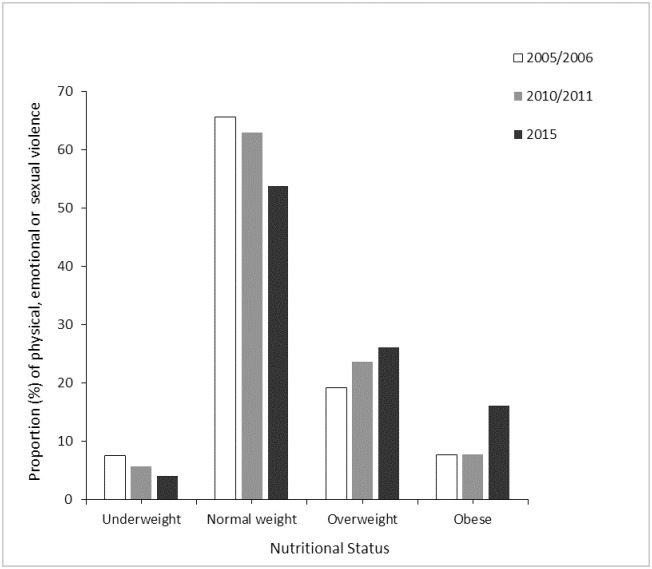
Pooled data from the 2005/2006, 2010/2011, and 2015 Zimbabwe Demographic Health Surveys (ZDHS) on 13,008 married/cohabiting women were analysed. Multinomial logistic regression models were used to examine the associations between the various forms of IPV and the nutritional status of women. We further estimated the prevalence of BMI ≥ 25.0 kg/m2 (overweight and obesity) by intimate partner violence type.
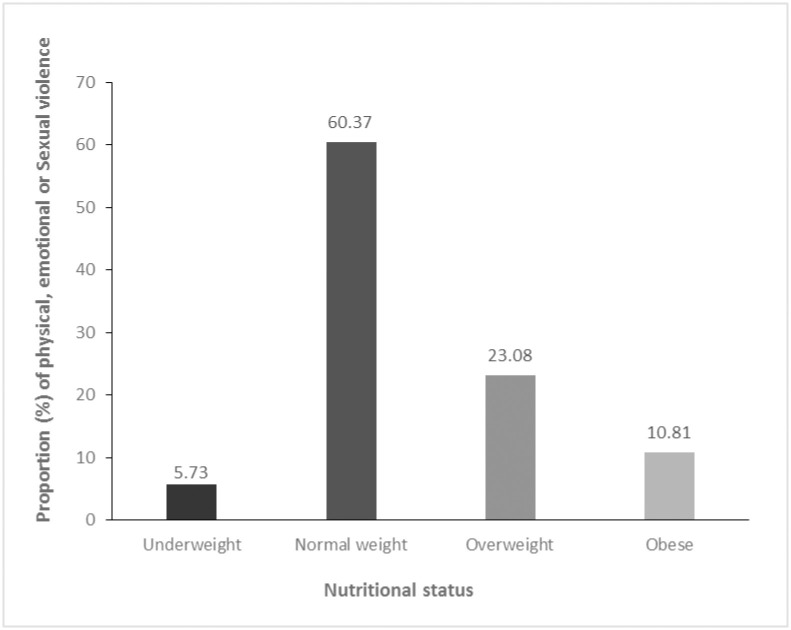
The mean BMI of women was 24.3 kg/m2, more than one-fifth (24%) were overweight and about 12% were obese. Forty-three percent (43%) of women reported to have ever experienced at least one form of intimate partner violence. More than one-third (35%) of women who reported to have ever experienced at least one form of intimate partner violence had a BMI ≥ 25.0 kg/m2 (p< 0.01). Relative to normal weight, women who had ever experienced at least one form of IPV (i.e., physical, emotional, or sexual) were more likely to be obese (aOR = 2.59; 95% CI = 1.05-6.39). Women's exposure to any form of intimate partner violence was not significantly associated with the likelihood of being underweight or overweight relative to normal weight.
The study findings show that women of reproductive age in Zimbabwe are at high risk of both IPV and excess weight. Moreover, we found a positive relationship between exposure to at least one form IPV and obesity. Public health interventions that target the well-being, empowerment and development of women are needed to address the complex issue of IPV and adverse health outcomes, including obesity.
亲密伴侣暴力(IPV)和营养不良是中低收入国家(LMICs)日益严重的健康问题。此外,暴力侵害妇女行为与营养不良有关。本研究调查了津巴布韦育龄妇女(15-49 岁)中 IPV 与营养状况(即体重不足、超重和肥胖)之间的关系。
对 2005/2006、2010/2011 和 2015 年津巴布韦人口与健康调查(ZDHS)中 13008 名已婚/同居妇女的数据进行了汇总分析。采用多变量逻辑回归模型来检验各种形式的 IPV 与妇女营养状况之间的关系。我们进一步估计了按亲密伴侣暴力类型划分的 BMI≥25.0kg/m2(超重和肥胖)的患病率。
妇女的平均 BMI 为 24.3kg/m2,超过五分之一(24%)超重,约 12%肥胖。43%的妇女报告曾遭受过至少一种形式的亲密伴侣暴力。超过三分之一(35%)报告曾遭受过至少一种形式的亲密伴侣暴力的妇女 BMI≥25.0kg/m2(p<0.01)。与正常体重相比,曾遭受过至少一种形式 IPV(即身体、情感或性暴力)的妇女更有可能肥胖(调整后的比值比[aOR]为 2.59;95%可信区间[CI]为 1.05-6.39)。与正常体重相比,妇女遭受任何形式的亲密伴侣暴力与体重不足或超重的可能性均无显著关联。
研究结果表明,津巴布韦育龄妇女面临 IPV 和超重的双重风险。此外,我们发现至少有一种形式的 IPV 暴露与肥胖呈正相关。需要采取以妇女福祉、赋权和发展为目标的公共卫生干预措施,以解决 IPV 和不良健康后果(包括肥胖)这一复杂问题。