Abubakar Adamu Abdul, Ali Ahmed Khalaf, Ibrahim Sahar Mohammed, Handool Kareem Obayes, Khan Mohammad Shuaib, Mustapha Noordin Mohamed, Ibrahim Tengku Azmi Tengku, Kaka Ubedullah, Yusof Loqman Mohamad
Department of Companion Animal Medicine and Surgery, Universiti Putra Malaysia, Serdang 43400, Malaysia.
Department of Veterinary Surgery and Radiology, Usmanu Danfodiyo University, Sokoto PMB 2346, Nigeria.
Membranes (Basel). 2022 Jul 14;12(7):707. doi: 10.3390/membranes12070707.
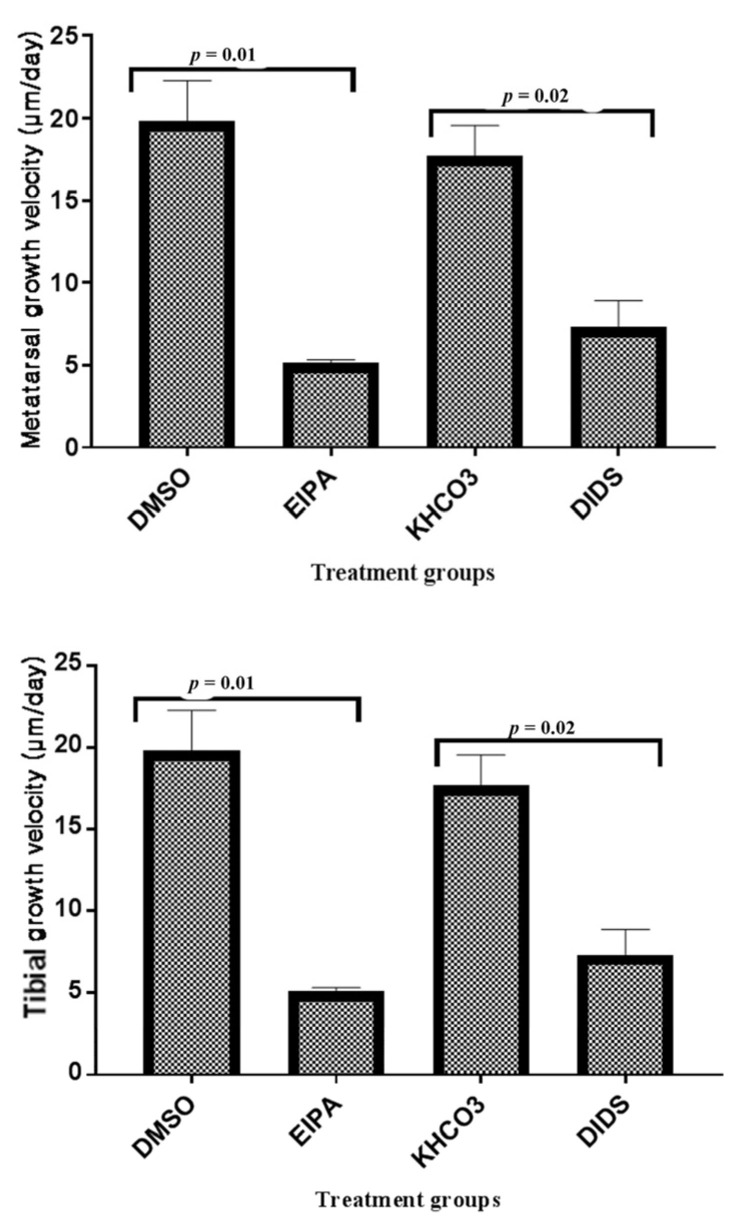
Mammalian long bone growth occurs through endochondral ossification, majorly regulated by the controlled enlargement of chondrocytes at the growth plate (GP). This study aimed to investigate the roles of Na+/H+ (sodium hydrogen exchanger (NHE1)) and HCO3− (anion exchanger [AE2]) during longitudinal bone growth in mammals. Bones from P10 SpragueDawley rat pups were cultured exvivo in the presence or absence of NHE1 and AE2 inhibitors to determine their effect on long bone growth. Gross morphometry, histomorphometry, and immunohistochemistry were used to assess the bone growth. The results revealed that the culture of the bones in the presence of NHE1 and AE2 inhibitors reduces bone growth significantly (p < 0.05) by approximately 11%. The inhibitor significantly (p < 0.05) reduces bone growth velocity and the length of the hypertrophic chondrocyte zone without any effect on the total GP length. The total GP chondrocyte density was significantly (p < 0.05) reduced, but hypertrophic chondrocyte densities remained constant. NHE1 fluorescence signaling across the GP length was higher than AE2, and their localization was significantly (p < 0.05) inhibited at the hypertrophic chondrocytes zone. The GP lengthening was majorly driven by an increase in the overall GP chondrocyte and hypertrophic chondrocyte densities apart from the regulatory volume phenomenon. This may suggest that NHE1 and AE2 could have a regulatory role in long bone growth.
哺乳动物的长骨生长通过软骨内成骨进行,主要受生长板(GP)处软骨细胞的可控增大调节。本研究旨在探讨Na+/H+(钠氢交换体(NHE1))和HCO3−(阴离子交换体[AE2])在哺乳动物纵向骨生长过程中的作用。将P10 SpragueDawley大鼠幼崽的骨骼在有或无NHE1和AE2抑制剂的情况下进行离体培养,以确定它们对长骨生长的影响。采用大体形态测量、组织形态测量和免疫组织化学方法评估骨生长情况。结果显示,在NHE1和AE2抑制剂存在的情况下培养骨骼,骨生长显著降低(p<0.05),降低幅度约为11%。该抑制剂显著(p<0.05)降低骨生长速度和肥大软骨细胞区的长度,而对生长板总长度无任何影响。生长板软骨细胞总密度显著(p<0.05)降低,但肥大软骨细胞密度保持不变。整个生长板长度上的NHE1荧光信号高于AE2,且在肥大软骨细胞区其定位受到显著(p<0.05)抑制。除调节性容积现象外,生长板延长主要由整个生长板软骨细胞和肥大软骨细胞密度增加驱动。这可能表明NHE1和AE2在长骨生长中可能具有调节作用。