• 文献检索
  • 文档翻译
  • 深度研究
  • 学术资讯
  • Suppr Zotero 插件Zotero 插件
  • 邀请有礼
  • 套餐&价格
  • 历史记录
应用&插件
Suppr Zotero 插件Zotero 插件浏览器插件Mac 客户端Windows 客户端微信小程序
定价
高级版会员购买积分包购买API积分包
服务
文献检索文档翻译深度研究API 文档MCP 服务
关于我们
关于 Suppr公司介绍联系我们用户协议隐私条款
关注我们

Suppr 超能文献

核心技术专利:CN118964589B侵权必究
粤ICP备2023148730 号-1Suppr @ 2026

文献检索

告别复杂PubMed语法,用中文像聊天一样搜索,搜遍4000万医学文献。AI智能推荐,让科研检索更轻松。

立即免费搜索

文件翻译

保留排版,准确专业,支持PDF/Word/PPT等文件格式,支持 12+语言互译。

免费翻译文档

深度研究

AI帮你快速写综述,25分钟生成高质量综述,智能提取关键信息,辅助科研写作。

立即免费体验

非病毒 mcDNA 介导的双特异性 CAR T 细胞在肝癌实验小鼠模型中杀死肿瘤细胞。

Nonviral mcDNA-mediated bispecific CAR T cells kill tumor cells in an experimental mouse model of hepatocellular carcinoma.

机构信息

Department of Liver Surgery and Transplantation, Liver Cancer Institute, Zhongshan Hospital, Fudan University, Shanghai, 200032, China.

Key Laboratory of Carcinogenesis and Cancer Invasion, Ministry of Education, Fudan University, Shanghai, 200032, China.

出版信息

BMC Cancer. 2022 Jul 25;22(1):814. doi: 10.1186/s12885-022-09861-1.

DOI:10.1186/s12885-022-09861-1
PMID:35879685
原文链接:https://pmc.ncbi.nlm.nih.gov/articles/PMC9310485/
Abstract

BACKGROUND

Hepatocellular carcinoma (HCC) is one of the most common cancers worldwide and the adoptive immunotherapy of which is worth studying. CD133, a kind of cancer stem cell (CSC) antigen, together with glypican-3 (GPC3) has been proved to be highly expressed in HCC cells and both of them are used as targets to generate chimeric antigen receptor (CAR) T cells. But there are limitations like "off-target" toxicity, low transfection efficacy and weak antitumor ability in CAR T cells treatment.

METHODS

The peripheral blood was acquired from healthy donors and T cells were separated by density-gradient centrifugation. We used an electroporation system to deliver anti-CD133 and anti-GPC3 single chain Fragment variable (scFv) structures as target genes into the T cells. The cell membrane was opened by the momentary electric current effect, and the target gene was delivered into the cell by non-viral minicircle DNA (mcDNA) vector. The flow cytometry and western blot assays were used to detect whether the two scFv were simultaneously transfected and the transfection efficacy of this bispecific CAR T cell generation method. We respectively detected the in vitro and in vivo tumor-suppression efficacy of CAR T cells through the CCK-8 assays and the HCC xenograft mice models. The CoG133-CAR T cells containing both CD133 and GPC3 antigen recognition sites were the effector cells. CD133-CAR T cells and GPC3-CAR T cells were defined as single-targeted control groups, normal T and mock T cells were defined as blank control groups.

RESULTS

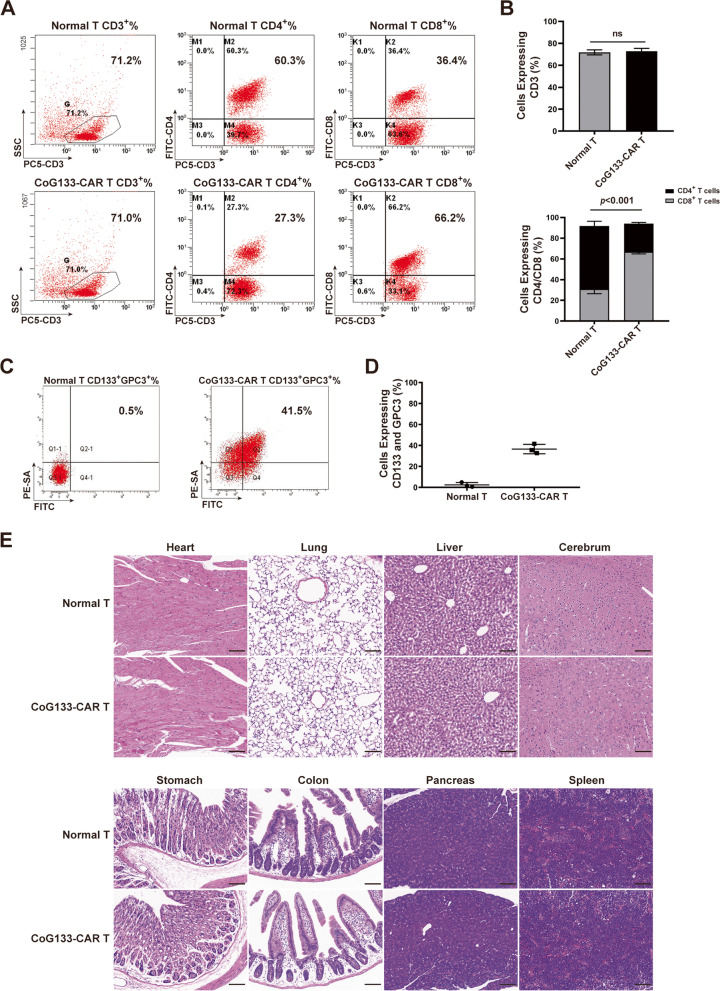
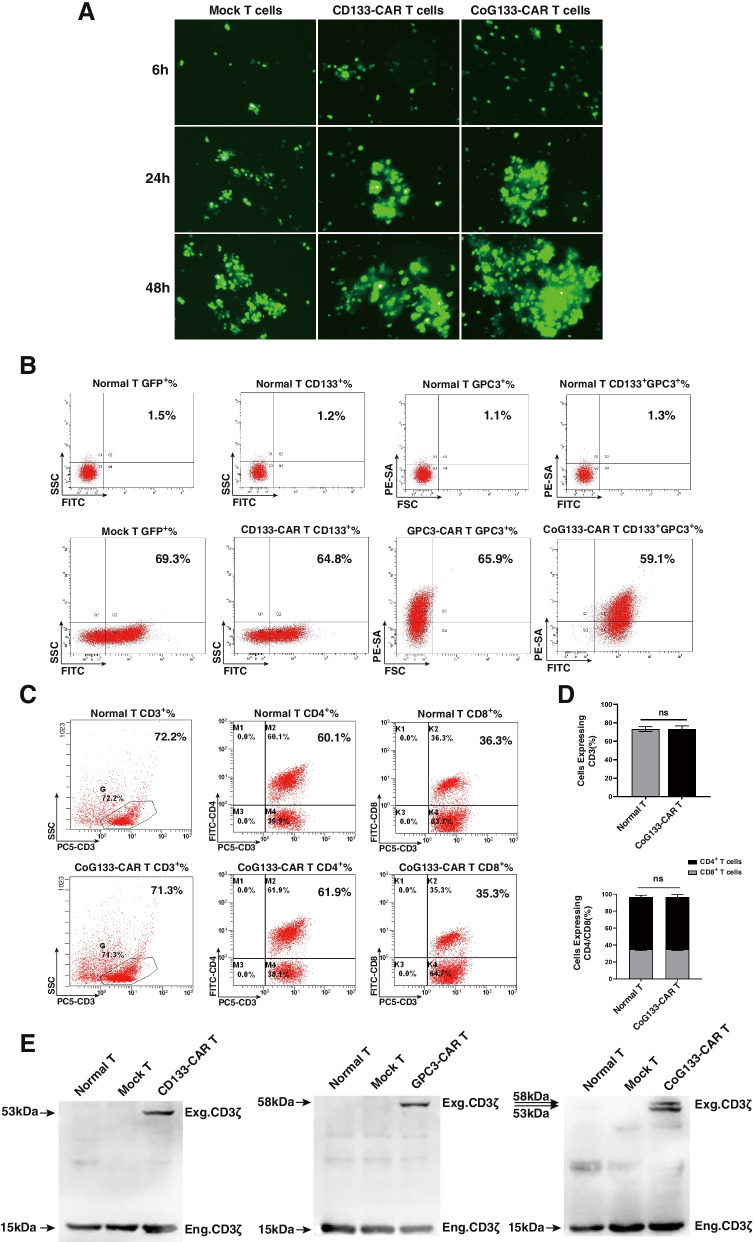
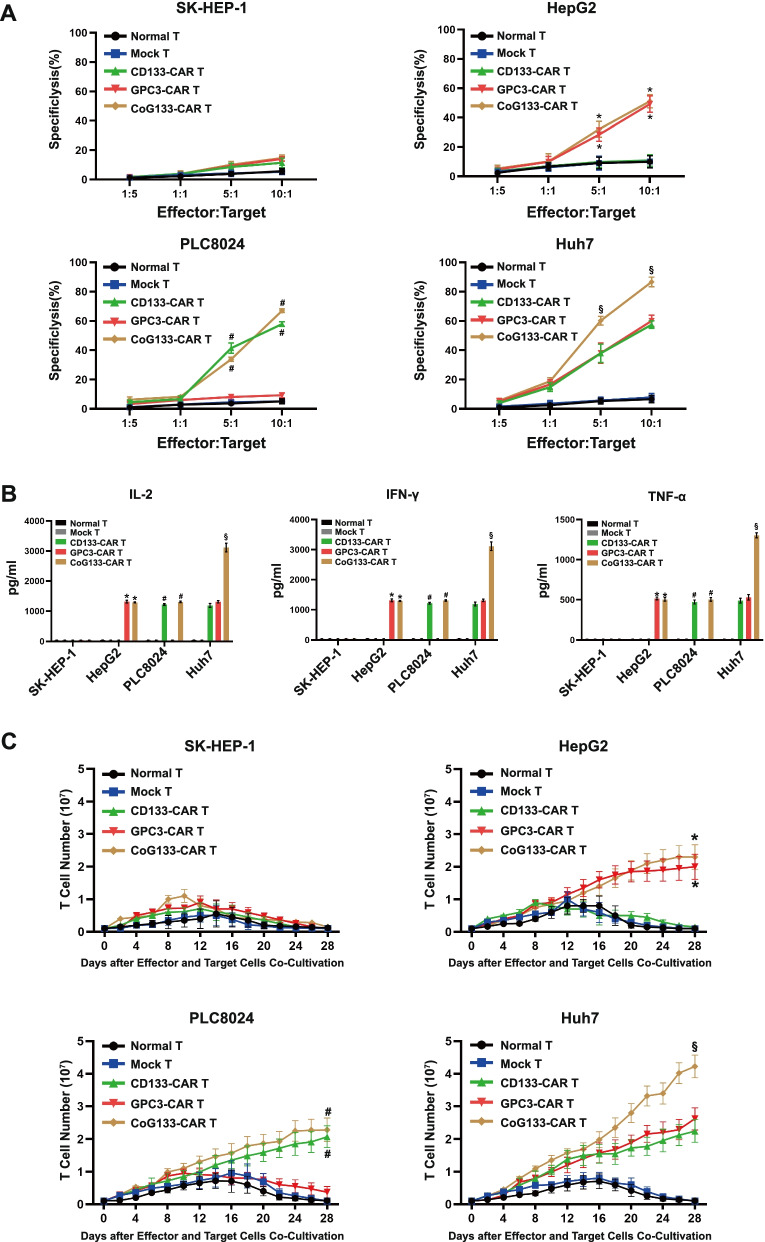
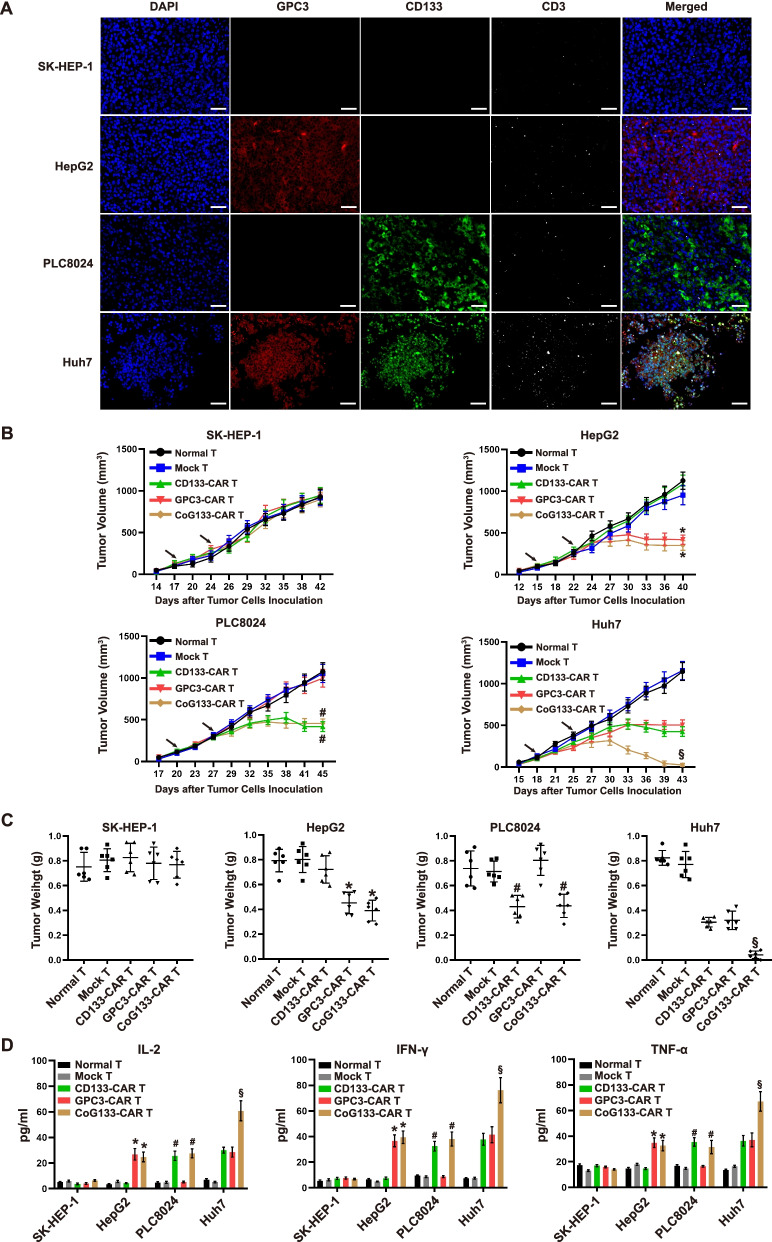
The mcDNA vector accommodated two target gene structures successfully transfected to generate bispecific CAR T cells. The detection methods on gene level and protein level confirmed that CoG133-CAR T cells had considerable transfection efficiency and exhibited both antigen-binding capacity of CD133 and GPC3. Compared to single-targeted CAR T cells or control T cells, CoG133-CAR T cells performed enhanced eliminated efficacy against CD133 and GPC3 double-positive HCC cell line in vitro and HCC xenograft mice in vivo. Hematoxylin and eosin (H&E) staining indicated no fatal "off-target" combination existed on CoG133-CAR T cells and major organs.

CONCLUSION

Our study suggests that it is with higher efficiency and more safety to prepare bispecific CAR T cells through non-viral mcDNA vectors. CoG133-CAR T cells have enhanced tumor-suppression capacity through dual antigen recognition and internal activation. It provides an innovative strategy for CAR T therapy of HCC, even solid tumors.

摘要

背景

肝细胞癌(HCC)是全球最常见的癌症之一,其过继免疫治疗值得研究。CD133 是一种癌症干细胞(CSC)抗原,与磷脂酰聚糖-3(GPC3)一起在 HCC 细胞中高表达,两者均被用作产生嵌合抗原受体(CAR)T 细胞的靶标。但是,CAR T 细胞治疗存在“脱靶”毒性、低转染效率和弱抗肿瘤能力等局限性。

方法

从健康供体采集外周血,通过密度梯度离心分离 T 细胞。我们使用电穿孔系统将抗 CD133 和抗 GPC3 单链片段可变(scFv)结构作为靶基因导入 T 细胞。瞬时电流效应打开细胞膜,通过非病毒微小环 DNA(mcDNA)载体将靶基因递送入细胞。流式细胞术和 Western blot 检测同时转染两个 scFv 的情况,以及这种双特异性 CAR T 细胞生成方法的转染效率。通过 CCK-8 检测和 HCC 异种移植小鼠模型,分别检测 CAR T 细胞的体外和体内肿瘤抑制效力。含有 CD133 和 GPC3 抗原识别位点的 CoG133-CAR T 细胞为效应细胞。CD133-CAR T 细胞和 GPC3-CAR T 细胞为单靶向对照组,正常 T 细胞和 mock T 细胞为空白对照组。

结果

mcDNA 载体成功容纳两个靶基因结构,转染生成双特异性 CAR T 细胞。基因水平和蛋白水平的检测方法证实,CoG133-CAR T 细胞具有相当高的转染效率,并表现出 CD133 和 GPC3 的抗原结合能力。与单靶向 CAR T 细胞或对照 T 细胞相比,CoG133-CAR T 细胞在体外对 CD133 和 GPC3 双阳性 HCC 细胞系和体内 HCC 异种移植小鼠具有增强的消除效力。苏木精和伊红(H&E)染色表明 CoG133-CAR T 细胞和主要器官上不存在致命的“脱靶”结合。

结论

本研究表明,使用非病毒 mcDNA 载体制备双特异性 CAR T 细胞具有更高的效率和安全性。CoG133-CAR T 细胞通过双重抗原识别和内部激活增强了肿瘤抑制能力。为 HCC 甚至实体瘤的 CAR T 治疗提供了一种创新策略。
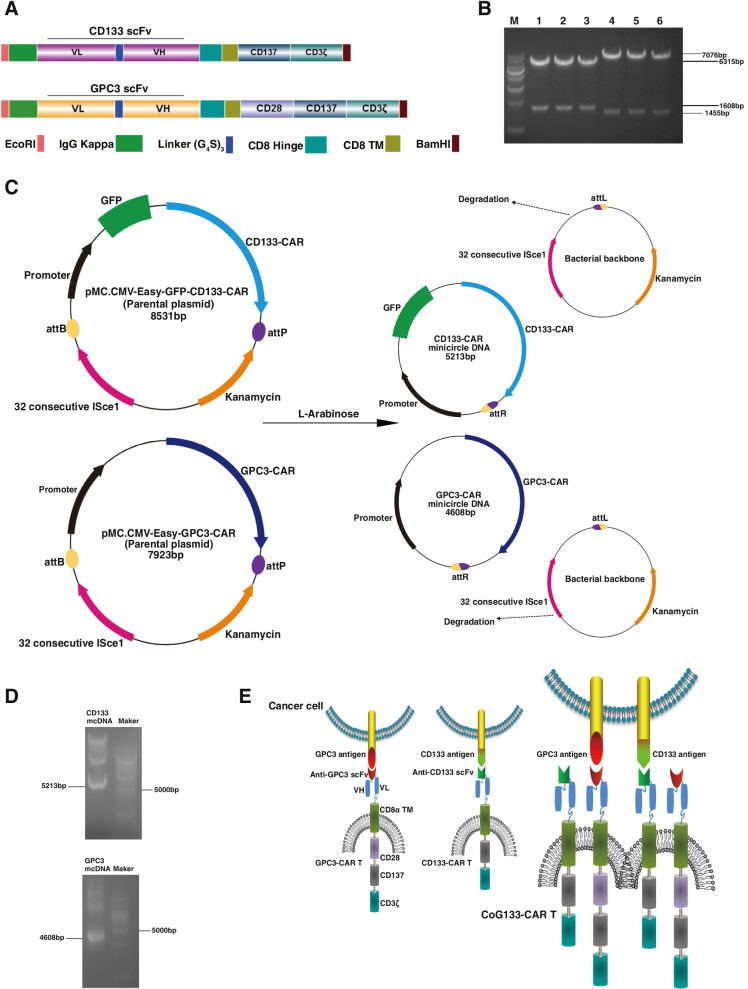
https://cdn.ncbi.nlm.nih.gov/pmc/blobs/bd9f/9310485/0d2c846a43d5/12885_2022_9861_Fig7_HTML.jpg
https://cdn.ncbi.nlm.nih.gov/pmc/blobs/bd9f/9310485/fc02a6529bc5/12885_2022_9861_Fig1_HTML.jpg
https://cdn.ncbi.nlm.nih.gov/pmc/blobs/bd9f/9310485/6dfe75e2bf6c/12885_2022_9861_Fig2_HTML.jpg
https://cdn.ncbi.nlm.nih.gov/pmc/blobs/bd9f/9310485/63e634bc453d/12885_2022_9861_Fig3_HTML.jpg
https://cdn.ncbi.nlm.nih.gov/pmc/blobs/bd9f/9310485/7c7bb499749e/12885_2022_9861_Fig4_HTML.jpg
https://cdn.ncbi.nlm.nih.gov/pmc/blobs/bd9f/9310485/ffa6ce4622f1/12885_2022_9861_Fig5_HTML.jpg
https://cdn.ncbi.nlm.nih.gov/pmc/blobs/bd9f/9310485/65f790540513/12885_2022_9861_Fig6_HTML.jpg
https://cdn.ncbi.nlm.nih.gov/pmc/blobs/bd9f/9310485/0d2c846a43d5/12885_2022_9861_Fig7_HTML.jpg
https://cdn.ncbi.nlm.nih.gov/pmc/blobs/bd9f/9310485/fc02a6529bc5/12885_2022_9861_Fig1_HTML.jpg
https://cdn.ncbi.nlm.nih.gov/pmc/blobs/bd9f/9310485/6dfe75e2bf6c/12885_2022_9861_Fig2_HTML.jpg
https://cdn.ncbi.nlm.nih.gov/pmc/blobs/bd9f/9310485/63e634bc453d/12885_2022_9861_Fig3_HTML.jpg
https://cdn.ncbi.nlm.nih.gov/pmc/blobs/bd9f/9310485/7c7bb499749e/12885_2022_9861_Fig4_HTML.jpg
https://cdn.ncbi.nlm.nih.gov/pmc/blobs/bd9f/9310485/ffa6ce4622f1/12885_2022_9861_Fig5_HTML.jpg
https://cdn.ncbi.nlm.nih.gov/pmc/blobs/bd9f/9310485/65f790540513/12885_2022_9861_Fig6_HTML.jpg
https://cdn.ncbi.nlm.nih.gov/pmc/blobs/bd9f/9310485/0d2c846a43d5/12885_2022_9861_Fig7_HTML.jpg

相似文献

1
Nonviral mcDNA-mediated bispecific CAR T cells kill tumor cells in an experimental mouse model of hepatocellular carcinoma.非病毒 mcDNA 介导的双特异性 CAR T 细胞在肝癌实验小鼠模型中杀死肿瘤细胞。
BMC Cancer. 2022 Jul 25;22(1):814. doi: 10.1186/s12885-022-09861-1.
2
Development of T cells carrying two complementary chimeric antigen receptors against glypican-3 and asialoglycoprotein receptor 1 for the treatment of hepatocellular carcinoma.携带两种针对磷脂酰肌醇蛋白聚糖-3和去唾液酸糖蛋白受体1的互补嵌合抗原受体的T细胞用于治疗肝细胞癌的研究进展
Cancer Immunol Immunother. 2017 Apr;66(4):475-489. doi: 10.1007/s00262-016-1949-8. Epub 2016 Dec 29.
3
Shed antigen-induced blocking effect on CAR-T cells targeting Glypican-3 in Hepatocellular Carcinoma.磷脂酰聚糖蛋白 3 靶向嵌合抗原受体 T 细胞治疗肝细胞癌的脱落抗原诱导阻断效应。
J Immunother Cancer. 2021 Apr;9(4). doi: 10.1136/jitc-2020-001875.
4
Persistent Polyfunctional Chimeric Antigen Receptor T Cells That Target Glypican 3 Eliminate Orthotopic Hepatocellular Carcinomas in Mice.靶向磷脂酰聚糖 3 的持久多功能嵌合抗原受体 T 细胞可消除小鼠原位肝癌。
Gastroenterology. 2020 Jun;158(8):2250-2265.e20. doi: 10.1053/j.gastro.2020.02.011. Epub 2020 Feb 12.
5
[Construction and function of Glypican-3-targeted fourth-generation chimeric antigen receptor T cells (secreting IL-7 and CCL19)].靶向磷脂酰肌醇蛋白聚糖-3的第四代嵌合抗原受体T细胞(分泌白细胞介素-7和C-C基序趋化因子19)的构建与功能
Sheng Wu Gong Cheng Xue Bao. 2020 May 25;36(5):979-991. doi: 10.13345/j.cjb.200106.
6
Minicircle DNA-Mediated CAR T Cells Targeting CD44 Suppressed Hepatocellular Carcinoma Both in vitro and in vivo.靶向CD44的微环DNA介导的嵌合抗原受体T细胞在体外和体内均能抑制肝细胞癌。
Onco Targets Ther. 2020 May 4;13:3703-3716. doi: 10.2147/OTT.S247836. eCollection 2020.
7
Development of T cells redirected to glypican-3 for the treatment of hepatocellular carcinoma.靶向磷脂酰聚糖蛋白 3 的 T 细胞的开发用于治疗肝细胞癌。
Clin Cancer Res. 2014 Dec 15;20(24):6418-28. doi: 10.1158/1078-0432.CCR-14-1170. Epub 2014 Oct 15.
8
Glypican-3-Specific CAR T Cells Coexpressing IL15 and IL21 Have Superior Expansion and Antitumor Activity against Hepatocellular Carcinoma.GPC3 特异性 CAR T 细胞共表达 IL15 和 IL21 可增强扩增并增强对肝细胞癌的抗肿瘤活性。
Cancer Immunol Res. 2020 Mar;8(3):309-320. doi: 10.1158/2326-6066.CIR-19-0293. Epub 2020 Jan 17.
9
T Cells Engineered to Express a T-Cell Receptor Specific for Glypican-3 to Recognize and Kill Hepatoma Cells In Vitro and in Mice.经基因工程改造表达针对磷脂酰聚糖-3 的 T 细胞受体的 T 细胞在体外和小鼠中识别并杀伤肝癌细胞。
Gastroenterology. 2015 Oct;149(4):1042-52. doi: 10.1053/j.gastro.2015.05.055. Epub 2015 Jun 5.
10
Targeted delivery of a PD-1-blocking scFv by CD133-specific CAR-T cells using nonviral Sleeping Beauty transposition shows enhanced antitumour efficacy for advanced hepatocellular carcinoma.利用 CD133 特异性嵌合抗原受体 T 细胞通过非病毒 Sleeping Beauty 转座实现 PD-1 阻断 scFv 的靶向递送,显著提高晚期肝细胞癌的抗肿瘤疗效。
BMC Med. 2023 Aug 28;21(1):327. doi: 10.1186/s12916-023-03016-0.

引用本文的文献

1
Targeting cancer stem cells with CAR-based immunotherapy: biology, evidence, and future directions.基于嵌合抗原受体的免疫疗法靶向癌症干细胞:生物学、证据及未来方向
Cancer Cell Int. 2025 Jul 28;25(1):289. doi: 10.1186/s12935-025-03846-3.
2
From molecular design to clinical translation: dual-targeted CAR-T strategies in cancer immunotherapy.从分子设计到临床转化:癌症免疫治疗中的双靶点嵌合抗原受体T细胞策略
Int J Biol Sci. 2025 Mar 31;21(6):2676-2691. doi: 10.7150/ijbs.108036. eCollection 2025.
3
CAR-T cell therapy for hepatocellular carcinoma: current trends and challenges.

本文引用的文献

1
Minicircle DNA-Engineered CAR T Cells Suppressed Tumor Growth in Mice.微环 DNA 工程 CAR T 细胞抑制小鼠肿瘤生长。
Mol Cancer Ther. 2020 Jan;19(1):178-186. doi: 10.1158/1535-7163.MCT-19-0204. Epub 2019 Oct 3.
2
Harnessing innate immunity in cancer therapy.利用先天免疫进行癌症治疗。
Nature. 2019 Oct;574(7776):45-56. doi: 10.1038/s41586-019-1593-5. Epub 2019 Oct 2.
3
Glypican 3-Targeted Therapy in Hepatocellular Carcinoma.肝细胞癌中针对磷脂酰肌醇蛋白聚糖3的治疗
嵌合抗原受体 T 细胞疗法治疗肝细胞癌:现状与挑战。
Front Immunol. 2024 Nov 6;15:1489649. doi: 10.3389/fimmu.2024.1489649. eCollection 2024.
4
Recent advancements in improving the efficacy and safety of chimeric antigen receptor (CAR)-T cell therapy for hepatocellular carcinoma.提高嵌合抗原受体(CAR)-T细胞疗法治疗肝细胞癌疗效和安全性的最新进展。
Naunyn Schmiedebergs Arch Pharmacol. 2025 Feb;398(2):1433-1446. doi: 10.1007/s00210-024-03443-7. Epub 2024 Sep 24.
5
Chimeric Antigen Receptor T Cell Therapy for Hepatocellular Carcinoma: Where Do We Stand?嵌合抗原受体T细胞疗法治疗肝细胞癌:我们目前的进展如何?
Int J Mol Sci. 2024 Feb 23;25(5):2631. doi: 10.3390/ijms25052631.
6
Immunosuppression in tumor immune microenvironment and its optimization from CAR-T cell therapy.肿瘤免疫微环境中的免疫抑制及其从 CAR-T 细胞治疗的优化。
Theranostics. 2022 Aug 29;12(14):6273-6290. doi: 10.7150/thno.76854. eCollection 2022.
Cancers (Basel). 2019 Sep 10;11(9):1339. doi: 10.3390/cancers11091339.
4
Next generation chimeric antigen receptor T cells: safety strategies to overcome toxicity.下一代嵌合抗原受体 T 细胞:克服毒性的安全策略。
Mol Cancer. 2019 Aug 20;18(1):125. doi: 10.1186/s12943-019-1057-4.
5
CAR T cells for brain tumors: Lessons learned and road ahead.嵌合抗原受体 T 细胞治疗脑肿瘤:经验教训与未来展望。
Immunol Rev. 2019 Jul;290(1):60-84. doi: 10.1111/imr.12773.
6
Antitumor activity of NKG2D CAR-T cells against human colorectal cancer cells in vitro and in vivo.NKG2D嵌合抗原受体T细胞在体外和体内对人结肠癌细胞的抗肿瘤活性。
Am J Cancer Res. 2019 May 1;9(5):945-958. eCollection 2019.
7
Gene editing for immune cell therapies.基因编辑免疫细胞疗法。
Nat Biotechnol. 2019 Dec;37(12):1425-1434. doi: 10.1038/s41587-019-0137-8. Epub 2019 Jun 3.
8
New emerging roles of CD133 in cancer stem cell: Signaling pathway and miRNA regulation.CD133 在癌症干细胞中的新出现作用:信号通路和 miRNA 调节。
J Cell Physiol. 2019 Dec;234(12):21642-21661. doi: 10.1002/jcp.28824. Epub 2019 May 17.
9
Hepatocellular Carcinoma.肝细胞癌
N Engl J Med. 2019 Apr 11;380(15):1450-1462. doi: 10.1056/NEJMra1713263.
10
Mesothelin is a target of chimeric antigen receptor T cells for treating gastric cancer.间皮素是用于治疗胃癌的嵌合抗原受体 T 细胞的靶点。
J Hematol Oncol. 2019 Feb 18;12(1):18. doi: 10.1186/s13045-019-0704-y.