Department of Experimental Research, State Key Laboratory of Oncology in South China, Collaborative Innovation Center for Cancer Medicine, Sun Yat-Sen University Cancer Center, Guangzhou, Guangdong, 510060, People's Republic of China.
Department of Biotherapy, Sun Yat-Sen University Cancer Center, Guangzhou, Guangdong, 510060, People's Republic of China.
BMC Med. 2023 Aug 28;21(1):327. doi: 10.1186/s12916-023-03016-0.
CD133 is considered a marker for cancer stem cells (CSCs) in several types of tumours, including hepatocellular carcinoma (HCC). Chimeric antigen receptor-specific T (CAR-T) cells targeting CD133-positive CSCs have emerged as a tool for the clinical treatment of HCC, but immunogenicity, the high cost of clinical-grade recombinant viral vectors and potential insertional mutagenesis limit their clinical application.
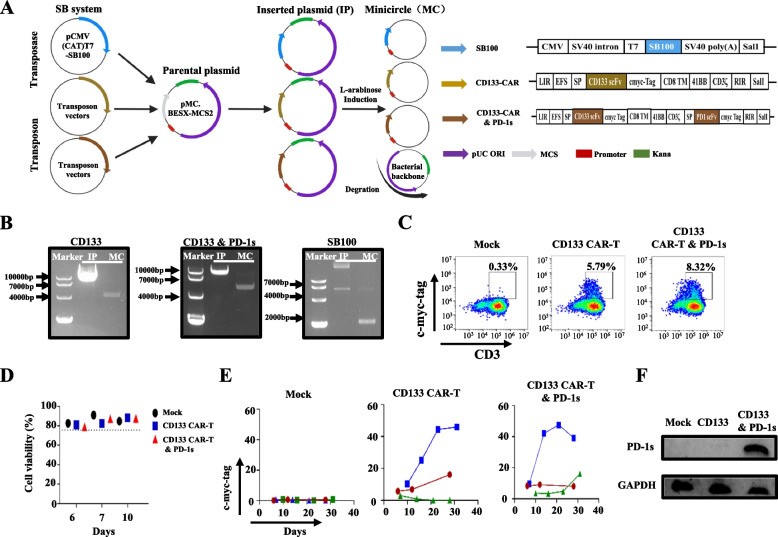
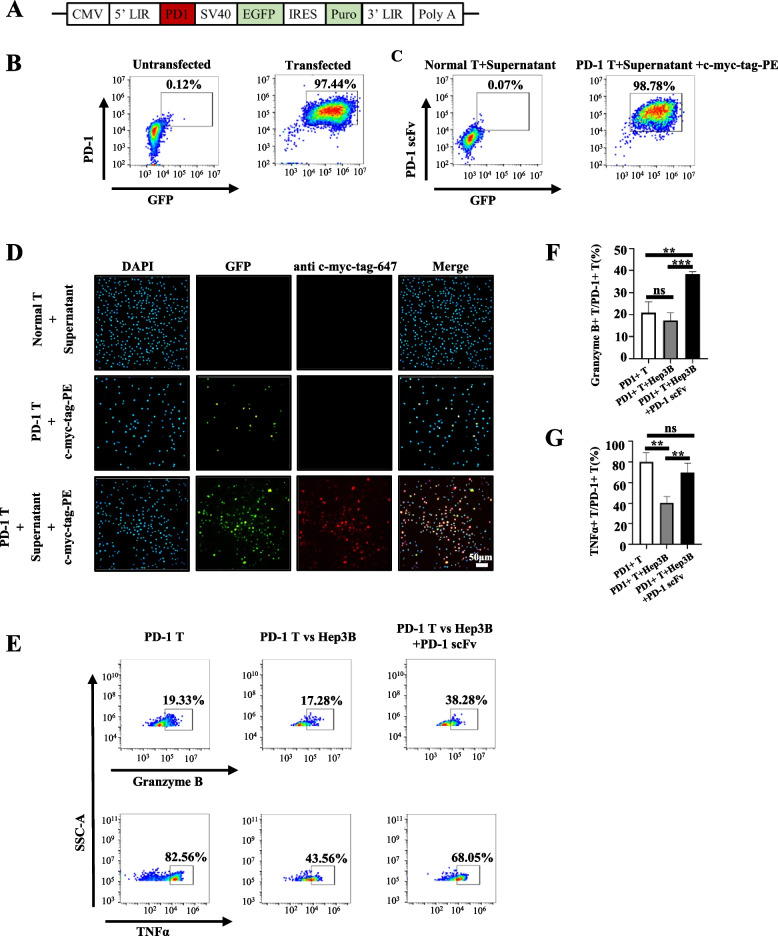
CD133-specific CAR-T cells secreting PD-1 blocking scFv (CD133 CAR-T and PD-1 s cells) were constructed using a sleeping beauty transposon system from minicircle technology, and the antitumour efficacy of CD133 CAR-T and PD-1 s cells was analysed in vitro and in vivo.
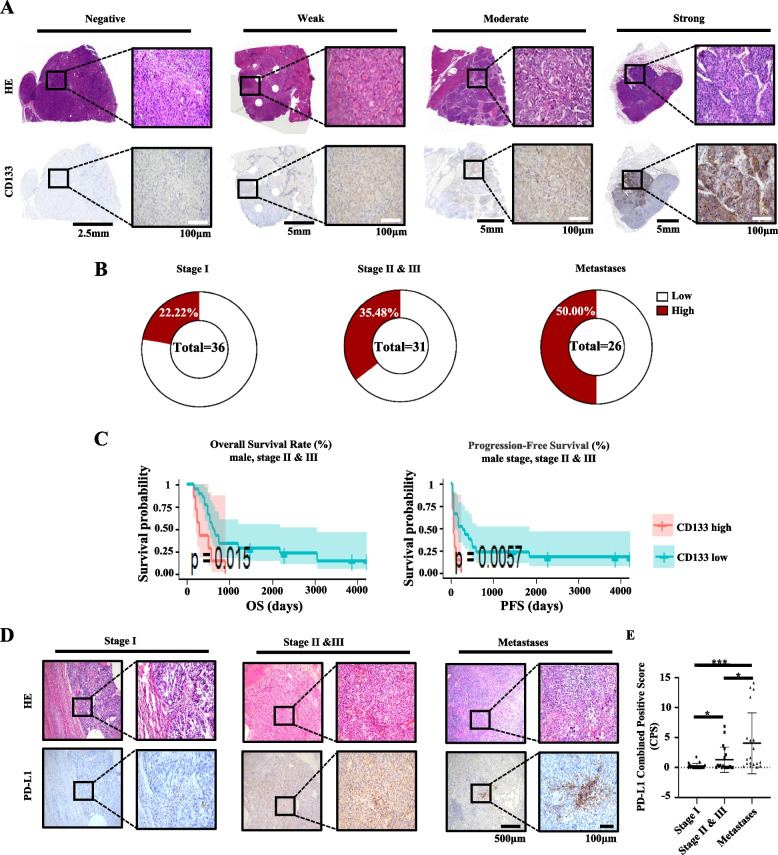
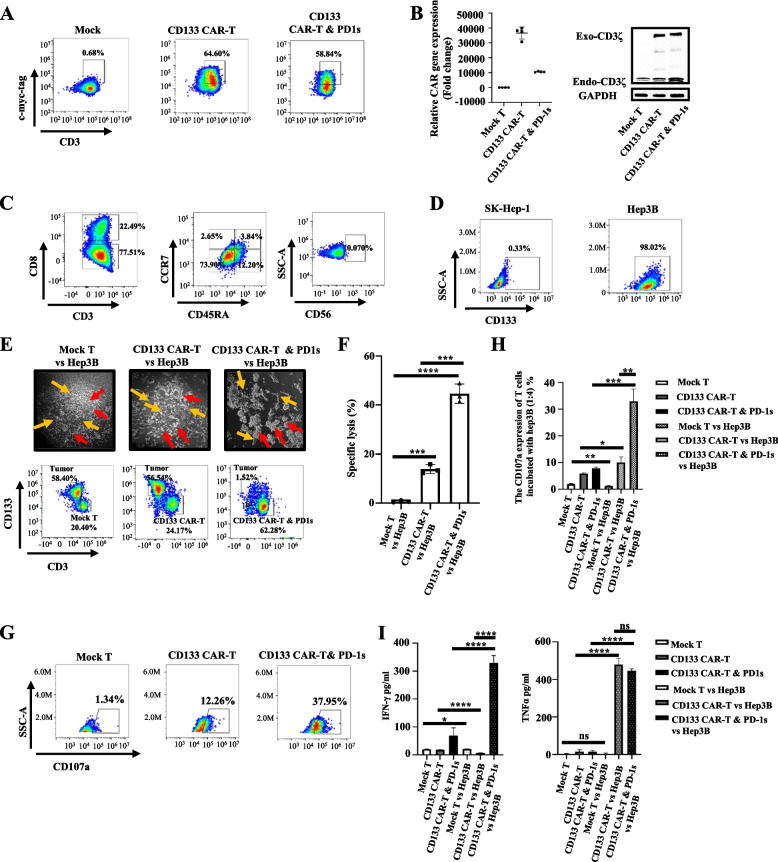
A univariate analysis showed that CD133 expression in male patients at the late stage (II and III) was significantly associated with worse progression-free survival (PFS) (P = 0.0057) and overall survival (OS) (P = 0.015), and a multivariate analysis showed a trend toward worse OS (P = 0.041). Male patients with advanced HCC exhibited an approximately 20-fold higher PD-L1 combined positive score (CPS) compared with those with HCC at an early stage. We successfully generated CD133 CAR-T and PD-1 s cells that could secrete PD-1 blocking scFv based on a sleeping beauty system involving minicircle vectors. CD133 CAR-T and PD-1 s cells exhibited significant antitumour activity against HCC in vitro and in xenograft mouse models. Thus, CD133 CAR-T and PD-1 s cells may be a therapeutically tractable strategy for targeting CD133-positive CSCs in male patients with advanced HCC.
Our study provides a nonviral strategy for constructing CAR-T cells that could also secrete checkpoint blockade inhibitors based on a Sleeping Beauty system from minicircle vectors and revealed a potential benefit of this strategy for male patients with advanced HCC and high CD133 expression (median immunohistochemistry score > 2.284).
CD133 被认为是多种肿瘤包括肝细胞癌(HCC)中的癌症干细胞(CSC)的标志物。针对 CD133 阳性 CSCs 的嵌合抗原受体特异性 T(CAR-T)细胞已成为 HCC 临床治疗的一种工具,但免疫原性、临床级重组病毒载体的高成本和潜在的插入突变限制了其临床应用。
使用源自微小环技术的睡眠美人转座子系统构建了分泌 PD-1 阻断 scFv 的 CD133 特异性 CAR-T 细胞(CD133 CAR-T 和 PD-1 s 细胞),并在体外和体内分析了 CD133 CAR-T 和 PD-1 s 细胞的抗肿瘤功效。
单因素分析显示,晚期(II 和 III 期)男性患者的 CD133 表达与无进展生存期(PFS)(P=0.0057)和总生存期(OS)(P=0.015)的恶化显著相关,多因素分析显示 OS 恶化的趋势(P=0.041)。晚期 HCC 男性患者的 PD-L1 联合阳性评分(CPS)比早期 HCC 患者高约 20 倍。我们成功地基于涉及微小环载体的睡眠美人系统生成了能够分泌 PD-1 阻断 scFv 的 CD133 CAR-T 和 PD-1 s 细胞。CD133 CAR-T 和 PD-1 s 细胞在体外和异种移植小鼠模型中对 HCC 具有显著的抗肿瘤活性。因此,CD133 CAR-T 和 PD-1 s 细胞可能是针对晚期 HCC 男性患者中 CD133 阳性 CSCs 的一种有治疗前途的策略。
我们的研究提供了一种非病毒策略,用于构建基于微小环载体的睡眠美人系统的 CAR-T 细胞,该系统还可以分泌检查点抑制剂阻断剂,并揭示了该策略对高 CD133 表达(中位数免疫组织化学评分>2.284)的晚期 HCC 男性患者的潜在益处。