Blood Purification Center, Department of Nephrology, The First Affiliated Hospital of Zhengzhou University, 1 East Jianshe Road, Zhengzhou, 450052, Henan, China.
Research Institute of Nephrology, Zhengzhou University, Zhengzhou, 450052, China.
J Transl Med. 2022 Jul 25;20(1):333. doi: 10.1186/s12967-022-03530-4.
Hyperkalemia is a common and potentially life-threatening electrolyte disorder in maintenance hemodialysis (MHD) patients. This study aimed to evaluate the efficacy and safety of potassium-lowering regimens during treatment of acute hyperkalemia in MHD patients.
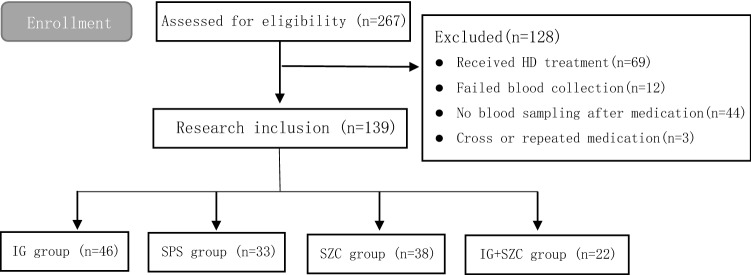
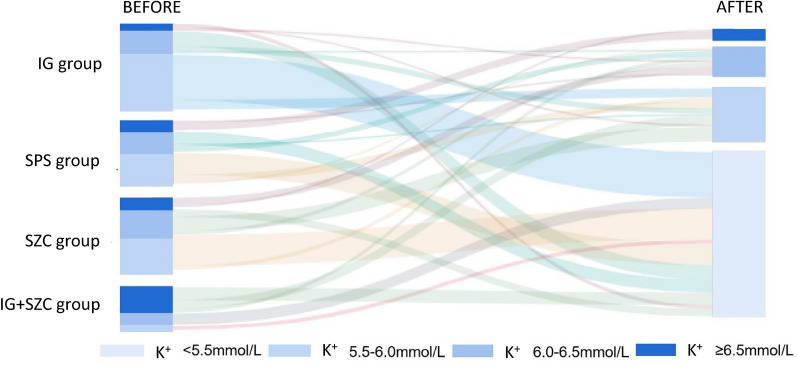
This retrospective real-world study (RWS) was conducted among 139 MHD patients. They were given different potassium-lowering regimens, viz. the insulin and glucose (IG) intravenous administration group (IG, 46 patients), the sodium polystyrene sulfonate group (SPS, 33 patients), the sodium zirconium cyclosilicate group (SZC, 38 patients), the IG + SZC group (22 patients). The primary efficacy end point was the rate of serum potassium decline at 2 h. The rates of adverse events were also compared.
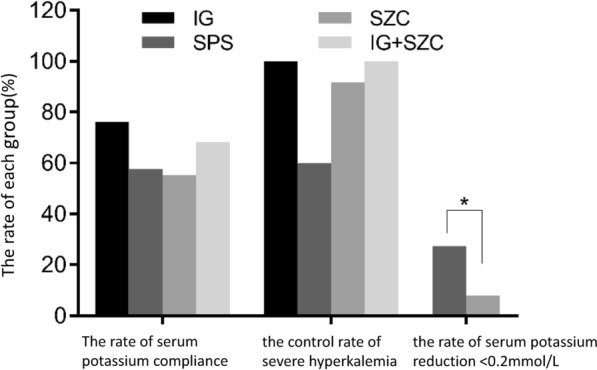
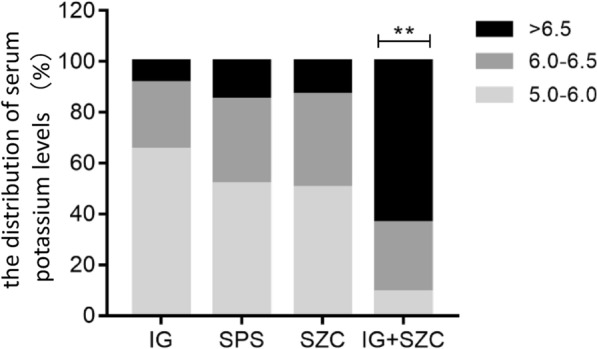
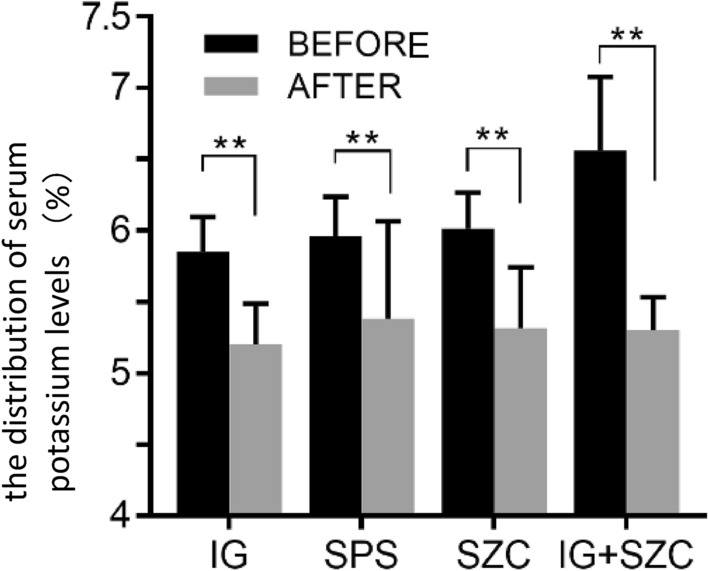
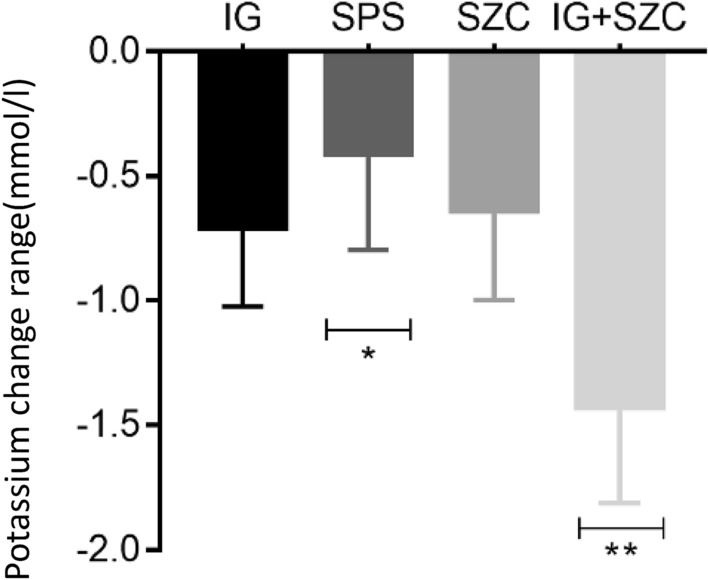
At 2 h, the mean ± SE change of serum potassium level was - 0.71 ± 0.32 mmol per liter (mmol/L) in IG group, - 0.43 ± 0.38 mmol/L in SPS group, - 0.64 ± 0.36 mmol/L in SZC group, - 1.43 ± 0.38 mmol/L in IG + SZC group (P < 0.01). The serum potassium level in IG + SZC group decreased more than that in the other three groups (P < 0.01), while the serum potassium level in SPS group decreased less than that in the other three groups (P < 0.05). There was no significant difference on the decrease of the serum potassium level between IG group and the SZC group (P = 0.374). The IG group and the IG + SZC group had higher rates of symptomatic hypoglycemia. The SPS group had significant decreases of serum calcium and serum magnesium after treatment.
Among MHD patients with acute hyperkalemia, SZC had similar potassium-lowering efficacy with IG intravenous administration at 2 h and superior on convenience and side-effects.
高钾血症是维持性血液透析(MHD)患者中常见且潜在威胁生命的电解质紊乱。本研究旨在评估不同降钾方案在 MHD 患者急性高钾血症治疗中的疗效和安全性。
本回顾性真实世界研究(RWS)纳入了 139 例 MHD 患者。他们分别接受了不同的降钾方案治疗,包括胰岛素和葡萄糖(IG)静脉给药组(IG,46 例)、聚苯乙烯磺酸钙(SPS)组(33 例)、硅酸锆钠(SZC)组(38 例)、IG+SZC 组(22 例)。主要疗效终点为 2 h 时血清钾下降率。同时比较各组不良反应发生率。
2 h 时,IG 组血清钾水平平均变化(均值±标准差)为-0.71±0.32 mmol/L,SPS 组为-0.43±0.38 mmol/L,SZC 组为-0.64±0.36 mmol/L,IG+SZC 组为-1.43±0.38 mmol/L(P<0.01)。IG+SZC 组的血清钾下降幅度大于其他三组(P<0.01),SPS 组的血清钾下降幅度小于其他三组(P<0.05)。IG 组与 SZC 组的血清钾下降幅度无显著差异(P=0.374)。IG 组和 IG+SZC 组有更高的症状性低血糖发生率。SPS 组治疗后血清钙和血清镁明显下降。
在 MHD 急性高钾血症患者中,SZC 在 2 h 时与 IG 静脉给药具有相似的降钾效果,且具有更好的便利性和更少的副作用。