Kovesdy Csaba P, Rowan Christopher G, Conrad Ansgar, Spiegel David M, Fogli Jeanene, Oestreicher Nina, Connaire Jeffrey J, Winkelmayer Wolfgang C
Department of Medicine, Division of Nephrology, University of Tennessee Health Science Center, Memphis, Tennessee, USA.
Department of Pharmacoepidemiology, COHRDATA, Santa Monica, California, USA.
Kidney Int Rep. 2018 Oct 29;4(2):301-309. doi: 10.1016/j.ekir.2018.10.020. eCollection 2019 Feb.
Patiromer is a potassium (K) binding polymer indicated for treating hyperkalemia. Among patients receiving chronic hemodialysis (HD), this study aimed to identify patient characteristics associated with patiromer initiation, describe patiromer utilization, and analyze serum K pre- and post-patiromer initiation.
In a retrospective cohort study, using electronic health record data from a large dialysis provider in the United States (study period: December 21, 2015, to December 20, 2016), HD patients were included who had a medication order for patiromer, sodium polystyrene sulfonate (SPS), or laboratory evidence of hyperkalemia (no K binder [NoKb] cohort). The index date was the first order for patiromer/SPS, or the first K ≥5.0 mEq/l (NoKb cohort), respectively. Using multivariable logistic regression, we identified patient characteristics associated with patiromer initiation. We evaluated patiromer utilization using Kaplan-Meier methodology and proportion of days covered. Serum K concentrations were assessed pre- versus post-patiromer initiation.
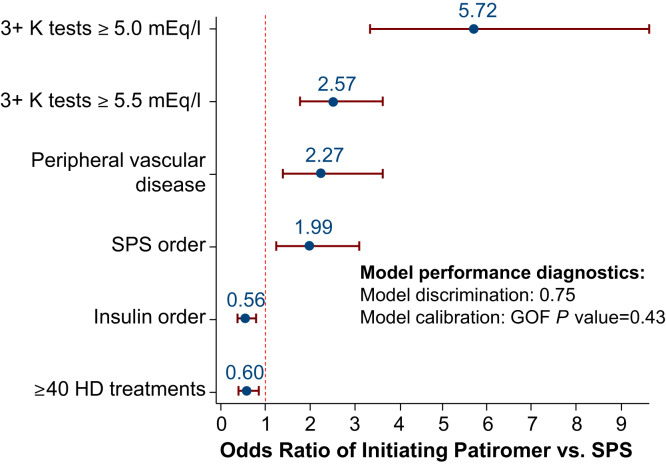
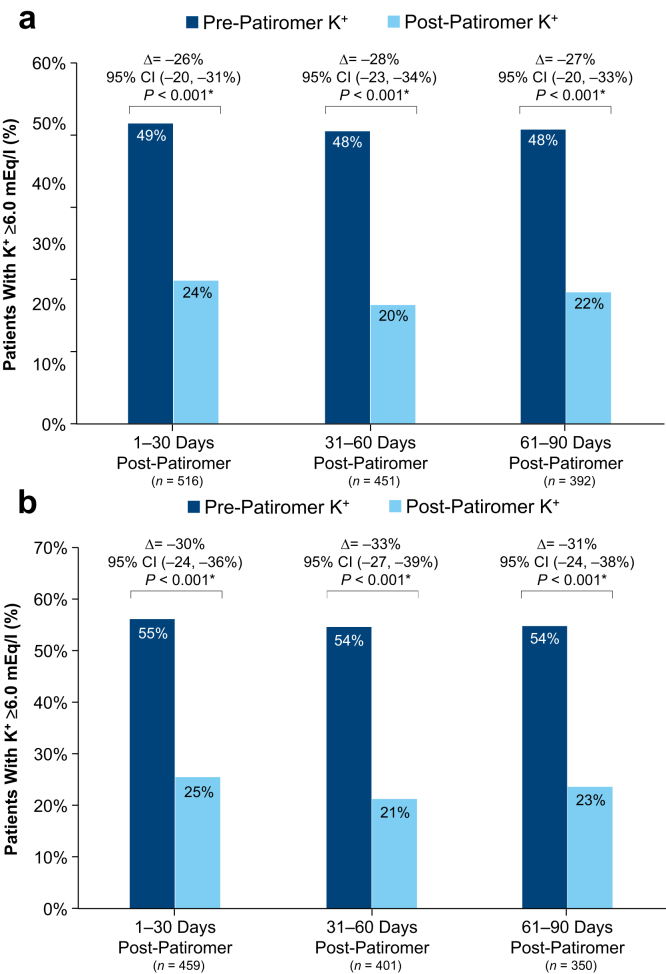
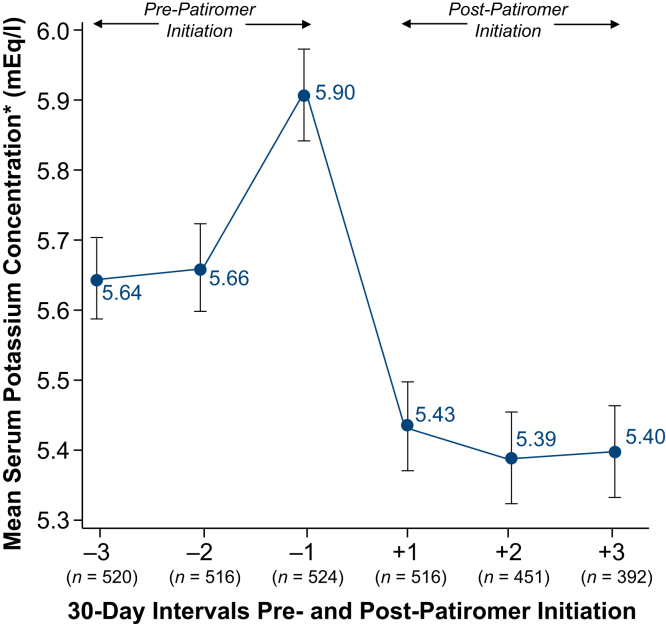
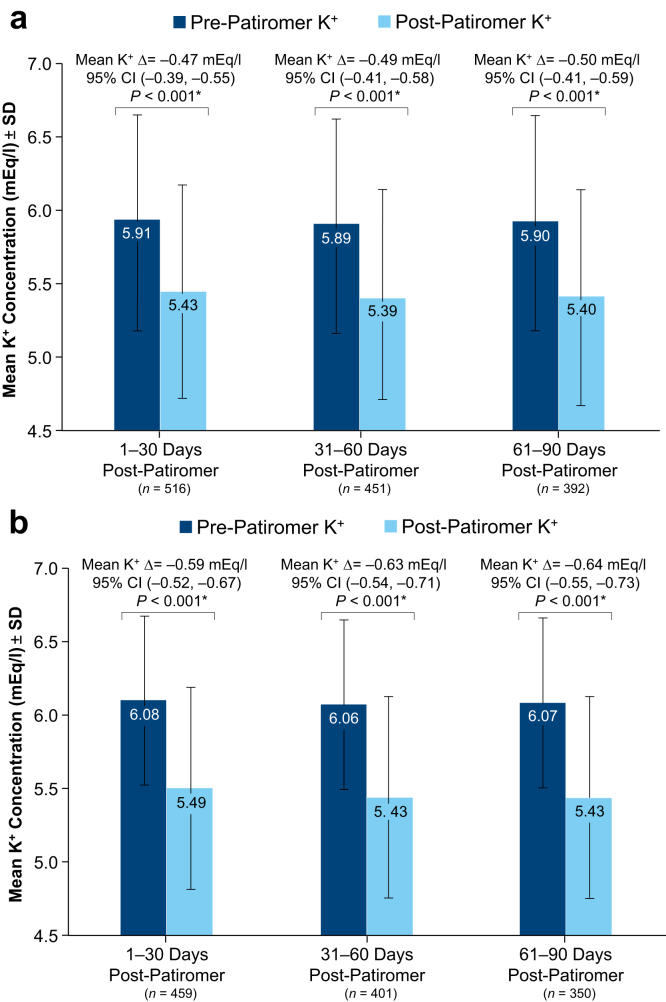
Study cohorts included 527 (patiromer), 852 (SPS), and 8747 (NoKb) HD patients. Median follow-up was 141 days. Patiromer initiators were 2.6 times more likely to have had multiple prior episodes of hyperkalemia (odds ratio [OR]: 2.6; 95% confidence interval [CI]: 1.8-3.7). Most (61%) commenced patiromer on 8.4 g once daily; 60% of patients' first patiromer order remained open after 180 days. Statistically significant reductions in K, averaging approximately -0.5 mEq/l, were observed post-patiromer initiation (48% pre-patiromer vs. 22% post-patiromer had K ≥6.0 mEq/l [ < 0.001]).
Patiromer initiators receiving chronic hemodialysis had comparatively more severe, uncontrolled baseline hyperkalemia. Medication order data show long-term patiromer use was associated with significantly reduced K.
帕替罗姆是一种用于治疗高钾血症的钾结合聚合物。在接受慢性血液透析(HD)的患者中,本研究旨在确定与开始使用帕替罗姆相关的患者特征,描述帕替罗姆的使用情况,并分析开始使用帕替罗姆前后的血清钾水平。
在一项回顾性队列研究中,使用来自美国一家大型透析服务提供商的电子健康记录数据(研究期间:2015年12月21日至2016年12月20日),纳入有帕替罗姆、聚苯乙烯磺酸钠(SPS)用药医嘱或高钾血症实验室证据的HD患者(无钾结合剂[NoKb]队列)。索引日期分别为帕替罗姆/SPS的首次医嘱,或首次血钾≥5.0 mEq/l(NoKb队列)。使用多变量逻辑回归,我们确定了与开始使用帕替罗姆相关的患者特征。我们使用Kaplan-Meier方法和覆盖天数比例评估帕替罗姆的使用情况。在开始使用帕替罗姆前后评估血清钾浓度。
研究队列包括527例(帕替罗姆组)、852例(SPS组)和8747例(NoKb组)HD患者。中位随访时间为141天。开始使用帕替罗姆的患者既往有多次高钾血症发作的可能性高2.6倍(比值比[OR]:2.6;95%置信区间[CI]:1.8 - 3.7)。大多数患者(61%)开始使用8.4 g帕替罗姆,每日一次;60%患者的首次帕替罗姆医嘱在180天后仍在使用。开始使用帕替罗姆后观察到血钾有统计学意义的显著降低,平均约-0.5 mEq/l(开始使用帕替罗姆前血钾≥6.0 mEq/l的患者占48%,开始使用后占22%[P < 0.001])。
接受慢性血液透析且开始使用帕替罗姆的患者基线高钾血症相对更严重且未得到控制。用药医嘱数据显示长期使用帕替罗姆与血钾显著降低相关。