Tang Nicole K Y, McEnery Katharine A M, Chandler Laura, Toro Carla, Walasek Lukasz, Friend Hannah, Gu Sai, Singh Swaran P, Meyer Caroline
Department of Psychology, University of Warwick, UK.
Warwick Manufacturing Group, University of Warwick, UK.
BJPsych Open. 2022 Jul 26;8(4):e138. doi: 10.1192/bjo.2022.523.
Early COVID-19 research suggests a detrimental impact of the initial lockdown on young people's mental health.
We investigated mental health among university students and young adults after the first UK lockdown and changes in symptoms over 6 months.
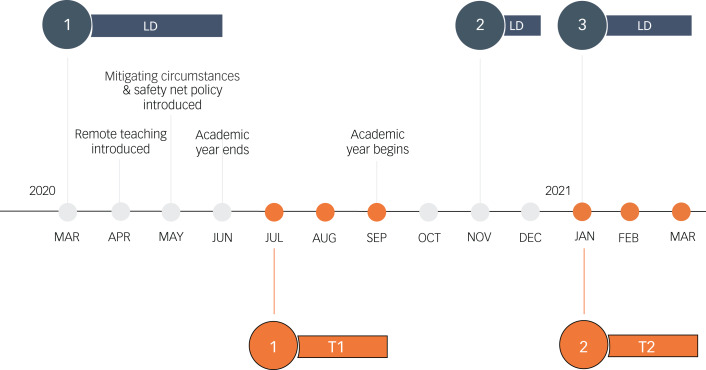
In total, 895 university students and 547 young adults not in higher education completed an online survey at T1 (July-September 2020). A subset of 201 university students also completed a 6 month follow-up survey at T2 (January-March 2021). Anxiety, depression, insomnia, substance misuse and suicide risk were assessed.
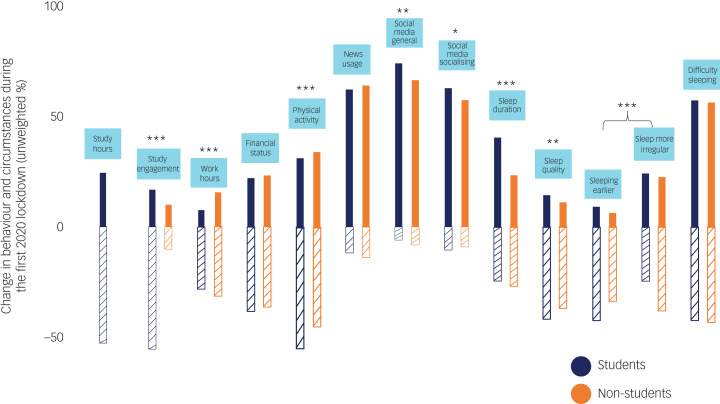
At T1, approximately 40%, 25% and 33% of the participants reported moderate to severe anxiety and depression and substance misuse risk, clinically significant insomnia and suicidal risk. In participants reassessed at T2, reductions were observed in anxiety and depression but not in insomnia, substance misuse or suicidality. Student and non-student participants reported similar levels of mental health symptoms. Student status was not a significant marker of mental health symptoms, except for lower substance misuse risk.Cross-sectionally, greater symptoms across measures were consistently associated with younger age, pre-existing mental health conditions, being a carer, worse financial status, increased sleep irregularity and difficulty since lockdown. Longitudinally, T2 symptoms were consistently associated with worse financial status and increased difficulty sleeping at T1. However, these associations were attenuated when baseline mental health symptoms were adjusted for in the models.
Mental health symptoms were prevalent in a large proportion of young people after the first UK lockdown. Risk factors identified may help characterise high-risk groups for enhanced support and inform interventions.
早期的新冠疫情研究表明,最初的封锁措施对年轻人的心理健康产生了不利影响。
我们调查了英国首次封锁后大学生和青年成年人的心理健康状况以及6个月内症状的变化。
共有895名大学生和547名未接受高等教育的青年成年人在T1(2020年7月至9月)完成了一项在线调查。201名大学生的一个子集还在T2(2021年1月至3月)完成了一项6个月的随访调查。评估了焦虑、抑郁、失眠、药物滥用和自杀风险。
在T1时,约40%、25%和33%的参与者报告有中度至重度焦虑、抑郁和药物滥用风险、具有临床意义的失眠和自杀风险。在T2重新评估的参与者中,焦虑和抑郁有所减轻,但失眠、药物滥用或自杀倾向没有减轻。学生和非学生参与者报告的心理健康症状水平相似。学生身份不是心理健康症状的重要指标,但药物滥用风险较低除外。横断面来看,各项指标中更多的症状一直与年龄较小、既往有心理健康问题、是照顾者、财务状况较差、睡眠不规律增加以及自封锁以来的困难有关。纵向来看,T2时的症状一直与财务状况较差和T1时睡眠困难增加有关。然而,当在模型中对基线心理健康症状进行调整后,这些关联减弱了。
在英国首次封锁后,很大一部分年轻人存在心理健康症状。确定的风险因素可能有助于确定需要加强支持的高危人群,并为干预措施提供信息。