
两种用于测量脂蛋白颗粒浓度的核磁共振波谱法的比较
Comparison of Two Nuclear Magnetic Resonance Spectroscopy Methods for the Measurement of Lipoprotein Particle Concentrations.
作者信息
Rief Martin, Raggam Reinhard, Rief Peter, Metnitz Philipp, Stojakovic Tatjana, Reinthaler Markus, Brodmann Marianne, März Winfried, Scharnagl Hubert, Silbernagel Günther
机构信息
Division of General Anaesthesiology, Emergency- and Intensive Care Medicine, Department of Anaesthesiology and Intensive Care Medicine, Medical University of Graz, A-8036 Graz, Austria.
Division of Angiology, Department of Internal Medicine, Medical University of Graz, A-8036 Graz, Austria.
出版信息
Biomedicines. 2022 Jul 21;10(7):1766. doi: 10.3390/biomedicines10071766.
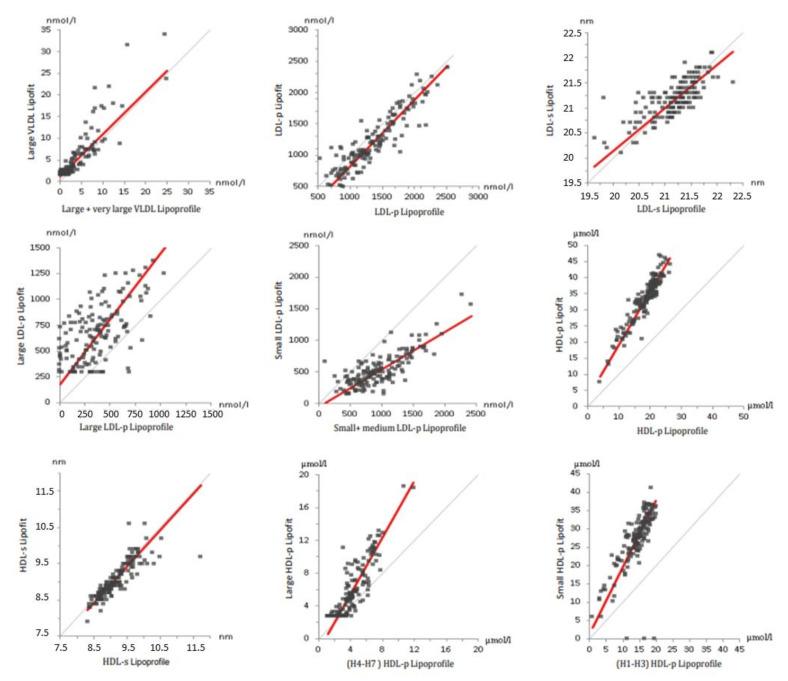
Background: Measuring lipoprotein particle concentrations may help to improve cardiovascular risk stratification. Both the lipofit (Numares) and lipoprofile (LabCorp) NMR methods are widely used for the quantification of lipoprotein particle concentrations. Objective: The aim of the present work was to perform a method comparison between the lipofit and lipoprofile NMR methods. In addition, there was the objective to compare lipofit and lipoprofile measurements of standard lipids with clinical chemistry-based results. Methods: Total, LDL, and HDL cholesterol and triglycerides were measured with ß-quantification in serum samples from 150 individuals. NMR measurements of standard lipids and lipoprotein particle concentrations were performed by Numares and LabCorp. Results: For both NMR methods, differences of mean concentrations compared to ß-quantification-derived measurements were ≤5.5% for all standard lipids. There was a strong correlation between ß-quantification- and NMR-derived measurements of total and LDL cholesterol and triglycerides (all r > 0.93). For both, the lipofit (r = 0.81) and lipoprofile (r = 0.84) methods, correlation coefficients were lower for HDL cholesterol. There was a reasonable correlation between LDL and HDL lipoprotein particle concentrations measured with both NMR methods (both r > 0.9). However, mean concentrations of major and subclass lipoprotein particle concentrations were not as strong. Conclusions: The present analysis suggests that reliable measurement of standard lipids is possible with these two NMR methods. Harmonization efforts would be needed for better comparability of particle concentration data.
背景
测量脂蛋白颗粒浓度可能有助于改善心血管疾病风险分层。Lipofit(Numares公司)和Lipoprofile(LabCorp公司)核磁共振方法都广泛用于脂蛋白颗粒浓度的定量分析。目的:本研究旨在对Lipofit和Lipoprofile核磁共振方法进行方法学比较。此外,还旨在将标准脂质的Lipofit和Lipoprofile测量结果与基于临床化学的结果进行比较。方法:采用β定量法测定150名个体血清样本中的总胆固醇、低密度脂蛋白胆固醇、高密度脂蛋白胆固醇和甘油三酯。由Numares公司和LabCorp公司对标准脂质和脂蛋白颗粒浓度进行核磁共振测量。结果:对于两种核磁共振方法,所有标准脂质的平均浓度与β定量法测量结果的差异均≤5.5%。总胆固醇、低密度脂蛋白胆固醇和甘油三酯的β定量法测量结果与核磁共振测量结果之间存在强相关性(所有r>0.93)。对于Lipofit(r=0.81)和Lipoprofile(r=0.84)两种方法,高密度脂蛋白胆固醇的相关系数较低。两种核磁共振方法测得的低密度脂蛋白和高密度脂蛋白颗粒浓度之间存在合理的相关性(两者r>0.9)。然而,主要和亚类脂蛋白颗粒浓度的平均浓度相关性不强。结论:本分析表明,这两种核磁共振方法能够可靠地测量标准脂质。为了使颗粒浓度数据具有更好的可比性,需要进行协调工作。


 Zotero 插件