Department of Nursing, Chiayi Campus, Chang Gung University of Science and Technology, Taoyuan City 600, Taiwan.
Department of Community Medicine, St. Martin De Porres Hospital, Chiayi 600, Taiwan.
Int J Environ Res Public Health. 2022 Jul 12;19(14):8488. doi: 10.3390/ijerph19148488.
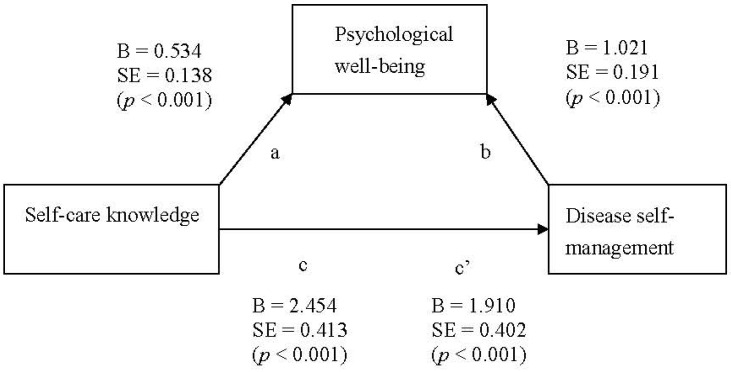
This study aimed to investigate the correlation between self-care knowledge, psychological well-being, and disease self-management in patients with hypertensive nephropathy, and to assess the effect of psychological well-being as a mediator of self-care knowledge and disease self-management.
This is a cross-sectional study. The 220 patients with hypertensive nephropathy were recruited from a teaching hospital in Taiwan using purposive sampling. The average age was 70.14 (SD = 11.96) years old. Among them, 128 (58.2%) were male and 92 (41.8%) were female. Instruments included a hypertensive nephropathy self-care knowledge scale, the World Health Organization-5 Well-Being Index, and the chronic kidney disease self-management instrument. The mediating effect was determined with linear regression models and the Sobel test.
The total explanatory variation of age, systolic blood pressure, psychological well-being, and self-care knowledge on the disease self-management was 27.7%. Psychological well-being was the most important explanatory factor and alone explains 16%. Psychological well-being was a partial mediator of self-care knowledge and quality of life in patients with hypertensive nephropathy, with a total effect of 23.2%.
This study showed that older patients with hypertensive nephropathy and those with a higher systolic blood pressure had lower levels of disease self-management. The higher the patients' self-care knowledge and psychological well-being, the better their disease self-management.
本研究旨在探讨高血压肾病患者自我护理知识、心理幸福感与疾病自我管理之间的相关性,并评估心理幸福感作为自我护理知识与疾病自我管理之间的中介变量的效果。
这是一项横断面研究。采用目的抽样法,从台湾一家教学医院招募了 220 名高血压肾病患者。平均年龄为 70.14(SD=11.96)岁,其中男性 128 名(58.2%),女性 92 名(41.8%)。使用的工具包括高血压肾病自我护理知识量表、世界卫生组织-5 项幸福感指数和慢性肾脏病自我管理量表。采用线性回归模型和 Sobel 检验确定中介效应。
年龄、收缩压、心理幸福感和自我护理知识对疾病自我管理的总解释变异为 27.7%。心理幸福感是最重要的解释因素,单独解释了 16%。心理幸福感是高血压肾病患者自我护理知识和生活质量的部分中介变量,总效应为 23.2%。
本研究表明,年龄较大的高血压肾病患者和收缩压较高的患者疾病自我管理水平较低。患者的自我护理知识和心理幸福感越高,疾病自我管理水平越好。