Tandan Meera, Twomey Bebhinn, Twomey Liam, Egan Mairead, Bury Gerard
School of Medicine, University College Dublin, Belfield, D04 V1W8 Dublin, Ireland.
J Pers Med. 2022 Jul 17;12(7):1157. doi: 10.3390/jpm12071157.
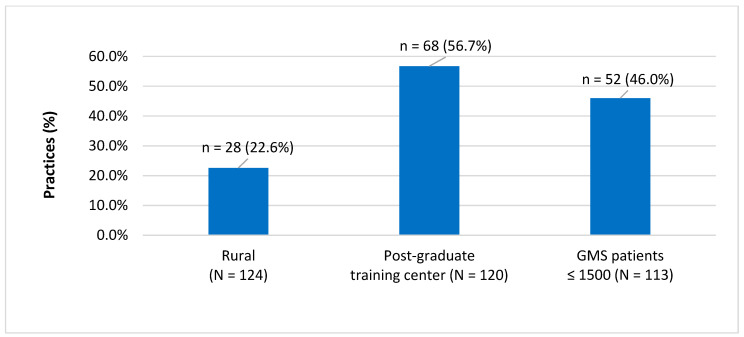
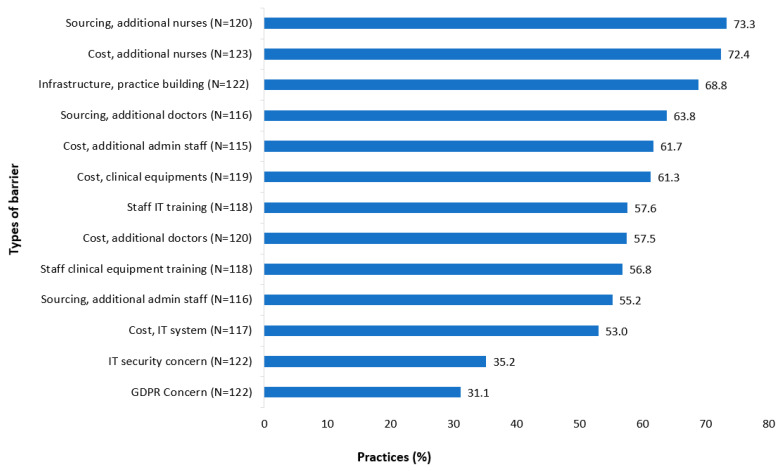
Information on the readiness of Irish general practice to participate in structured chronic disease management (CDM) care is limited. This study explores the logistic, staffing, and organizational preparedness of Irish general practice to do so, stratified by their size, location, and training status; implementation challenges were also explored. An anonymous, paper-based random survey was performed. A chi-square test was applied to compare practices by location (urban/rural), post-graduate training status (with/without), and numbers of GMS patient (≥1500/>1500 patients) and prevalence ratio and Poisson regression analysis to examine the relationship of staffing with key variables. Overall, 125/243 practices participated, 22% were rural, 56.6% were post-graduate training practices, and 53.9% had ≥1500 GMS patients. The rural, non-training practices and those with <1500 GMS patients had substantially lower staffing levels. The average number of GPs was significantly less in rural practices; however, the difference was insignificant for nurses. Salary costs for practice nurses in all practices and staff IT training and clinical equipment in smaller practices were important barriers. Most practices reported ‘inadequate’ waiting times for access to almost all referral and paramedical services. The study recommends addressing the staffing, funding, and training challenges within Irish general practice to effectively implement a structured CDM program.
爱尔兰普通科医疗参与结构化慢性病管理(CDM)护理的准备情况信息有限。本研究探讨了爱尔兰普通科医疗在这方面的后勤、人员配备和组织准备情况,并按其规模、地点和培训状况进行分层;还探讨了实施挑战。进行了一项基于纸质问卷的匿名随机调查。应用卡方检验按地点(城市/农村)、研究生培训状况(有/无)、全科医疗服务(GMS)患者数量(≥1500/<1500名患者)对医疗机构进行比较,并采用患病率比和泊松回归分析来检验人员配备与关键变量之间的关系。总体而言,243家医疗机构中有125家参与,22%为农村医疗机构,56.6%为接受研究生培训的医疗机构,53.9%拥有≥1500名GMS患者。农村、未接受培训的医疗机构以及GMS患者数量<1500的医疗机构人员配备水平显著较低。农村医疗机构的全科医生平均人数明显较少;然而,护士人数的差异不显著。所有医疗机构中执业护士的薪资成本以及较小医疗机构中的员工信息技术培训和临床设备是重要障碍。大多数医疗机构报告称,几乎所有转诊和辅助医疗服务的等待时间“不足”。该研究建议应对爱尔兰普通科医疗中的人员配备、资金和培训挑战,以有效实施结构化CDM项目。