Elad Boaz, Habib Manhal, Caspi Oren
The Department of Cardiology, Rambam Health Care Campus, Haifa 3109601, Israel.
Technion-The Ruth and Bruce Rappaport Faculty of Medicine, Haifa 3525433, Israel.
Life (Basel). 2022 Jul 7;12(7):1006. doi: 10.3390/life12071006.
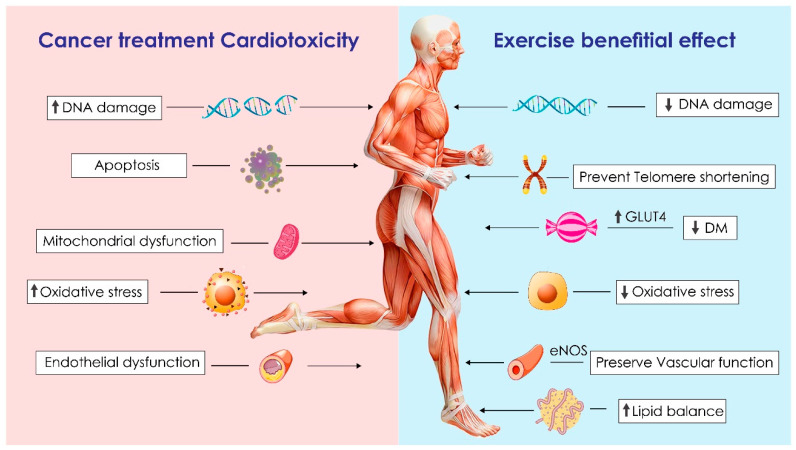
Recent advances in cancer therapy have led to increased survival rates for cancer patients, but also allowed cardiovascular complications to become increasingly evident, with more than 40% of cancer deaths now being attributed to cardiovascular diseases. Cardiotoxicity is the most concerning cardiovascular complication, one caused mainly due to anti-cancer drugs. Among the harmful mechanisms of these drugs are DNA damage, endothelial dysfunction, and oxidative stress. Cancer patients can suffer reduced cardiorespiratory fitness as a secondary effect of anti-cancer therapies, tumor burden, and deconditioning. In the general population, regular exercise can reduce the risk of cardiovascular morbidity, mortality, and cancer. Exercise-induced modifications of gene expression result in improvements of cardiovascular parameters and an increased general fitness, influencing telomere shortening, oxidative stress, vascular function, and DNA repair mechanisms. In cancer patients, exercise training is generally safe and well-tolerated; it is associated with a 10-15% improvement in cardiorespiratory fitness and can potentially counteract the adverse effects of anti-cancer therapy. It is well known that exercise programs can benefit patients with heart disease and cancer, but little research has been conducted with cardio-oncology patients. To date, there are a limited number of effective protective treatments for preventing or reversing cardiotoxicity caused by cancer therapy. Cardiac rehabilitation has the potential to mitigate cardiotoxicity based on the benefits already proven in populations suffering from either cancer or heart diseases. Additionally, the fact that cardiotoxic harm mechanisms coincide with similar mechanisms positively affected by cardiac rehabilitation makes cardiac rehabilitation an even more plausible option for cardio-oncology patients. Due to unstable functional capacity and fluctuating immunocompetence, these patients require specially tailored exercise programs designed collaboratively by cardiologists and oncologists. As the digital era is here, with the digital world and the medical world continuously intertwining, a remote, home-based cardio-oncology rehabilitation program may be a solution for this population.
癌症治疗的最新进展提高了癌症患者的生存率,但也使心血管并发症日益明显,目前超过40%的癌症死亡归因于心血管疾病。心脏毒性是最令人担忧的心血管并发症,主要由抗癌药物引起。这些药物的有害机制包括DNA损伤、内皮功能障碍和氧化应激。癌症患者可能会因抗癌治疗、肿瘤负担和身体机能下降而出现心肺功能下降。在普通人群中,定期锻炼可以降低心血管疾病发病率、死亡率和患癌风险。运动引起的基因表达变化可改善心血管参数并提高总体健康水平,影响端粒缩短、氧化应激、血管功能和DNA修复机制。在癌症患者中,运动训练通常是安全且耐受性良好的;它可使心肺功能提高10 - 15%,并有可能抵消抗癌治疗的不良反应。众所周知,运动计划对心脏病和癌症患者有益,但针对心脏肿瘤患者的研究却很少。迄今为止,用于预防或逆转癌症治疗引起的心脏毒性的有效保护性治疗方法数量有限。基于已在癌症或心脏病患者中证实的益处,心脏康复有减轻心脏毒性的潜力。此外,心脏毒性的损害机制与受心脏康复积极影响的类似机制相吻合,这使得心脏康复对心脏肿瘤患者来说是一个更合理的选择。由于这些患者的功能能力不稳定且免疫能力波动,他们需要由心脏病专家和肿瘤学家共同设计的专门定制的运动计划。随着数字时代的到来,数字世界与医学世界不断交织,远程居家心脏肿瘤康复计划可能是这一人群的一个解决方案。