Scherrer Simone, Rademacher Fenja, Stephan Roger, Peterhans Sophie
Section of Veterinary Bacteriology, Institute for Food Safety and Hygiene, Vetsuisse Faculty, University of Zurich, CH-8057 Zurich, Switzerland.
Pathogens. 2022 Jul 1;11(7):752. doi: 10.3390/pathogens11070752.
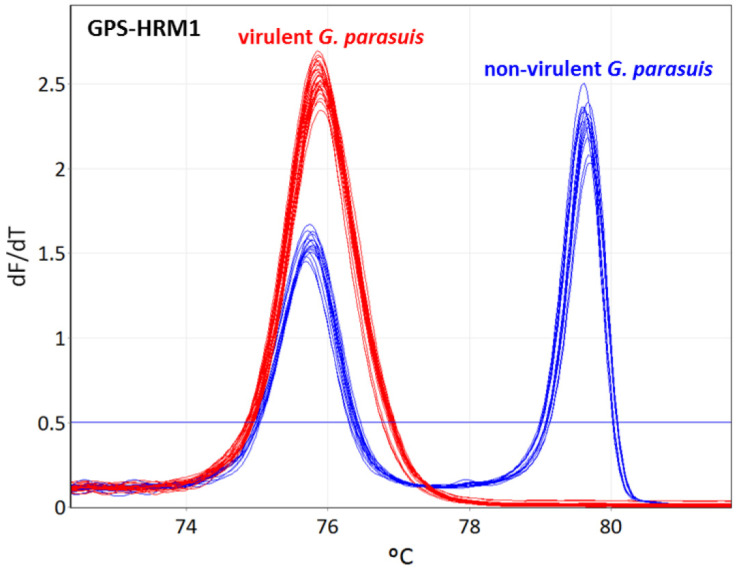
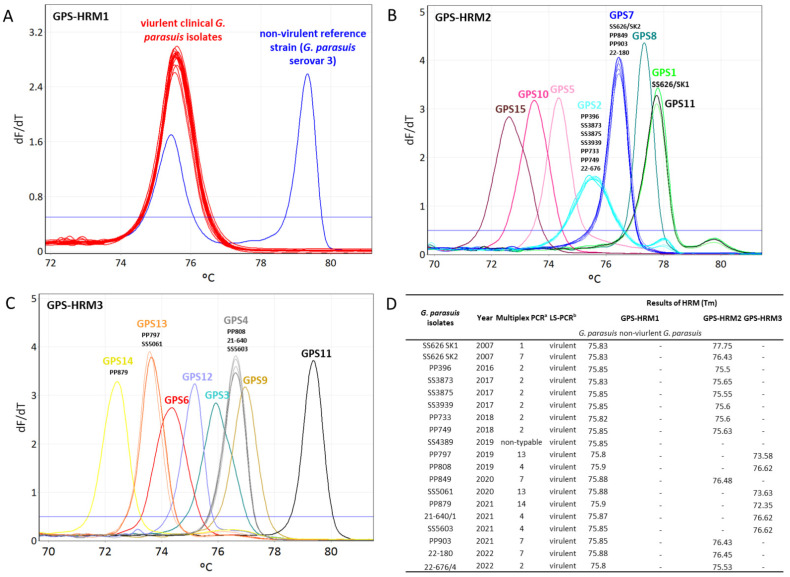
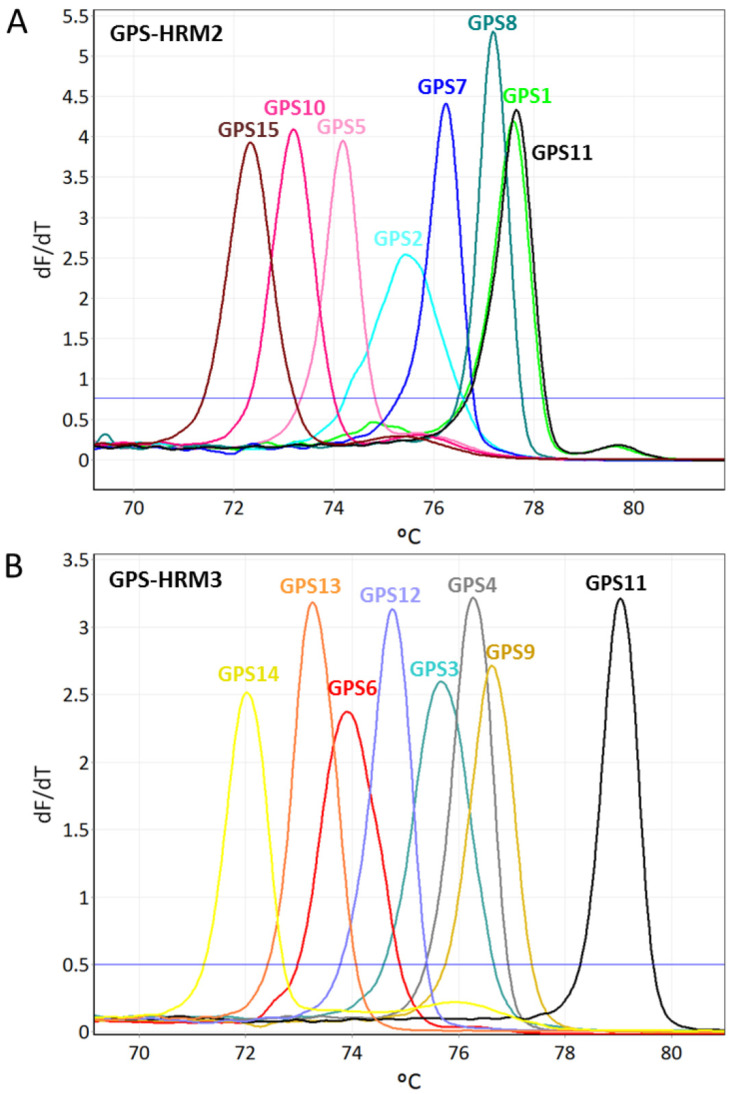
is the etiological agent of Glässer's disease, which is associated with polyserositis and arthritis and has a significant impact on the economy of the pig production industry. For the optimal surveillance of this pathogen, as well as for the investigation of -associated diseases, it is crucial to identify at the serovar level. In this work, we designed and developed new high-resolution melting (HRM) approaches, namely, the species-specific GPS-HRM1 and two serovar-specific HRM assays (GPS-HRM2 and GPS-HRM3), and evaluated the sensitivity and specificity of the assays. The HRM assays demonstrated good sensitivity, with 12.5 fg-1.25 pg of input DNA for GPS-HRM1 and 125 fg-12.5 pg for GPS-HRM2 and GPS-HRM3, as well as a specificity of 100% for the identification of all recognized 15 serovars. Eighteen clinical isolates obtained between 2014 and 2022 in Switzerland were tested by applying the developed HRM assays, which revealed a heterogeneous distribution of serovars 2, 7, 4, 13, 1, and 14. The combination with virulence marker (virulence-associated trimeric autotransporters) allows for the prediction of potentially virulent strains. The assays are simple to execute and enable a reliable low-cost approach, thereby refining currently available diagnostic tools.
是格拉泽氏病的病原体,该疾病与多浆膜炎和关节炎相关,对养猪业的经济有重大影响。为了对这种病原体进行最佳监测以及对相关疾病进行调查,在血清型水平上进行鉴定至关重要。在这项工作中,我们设计并开发了新的高分辨率熔解(HRM)方法,即物种特异性的GPS-HRM1和两种血清型特异性HRM检测方法(GPS-HRM2和GPS-HRM3),并评估了这些检测方法的灵敏度和特异性。HRM检测方法显示出良好的灵敏度,GPS-HRM1的输入DNA为12.5 fg - 1.25 pg,GPS-HRM2和GPS-HRM3为125 fg - 12.5 pg,并且在鉴定所有公认的15种血清型时特异性为100%。应用所开发的HRM检测方法对2014年至2022年期间在瑞士获得的18株临床分离株进行了检测,结果显示血清型2、7、4、13、1和14分布不均。与毒力标记物(与毒力相关的三聚体自转运蛋白)相结合可预测潜在的毒力菌株。这些检测方法易于执行,可实现可靠的低成本方法,从而改进了目前可用的诊断工具。