Boeriu Alina, Roman Adina, Fofiu Crina, Dobru Daniela
Gastroenterology Department, University of Medicine Pharmacy, Sciences, and Technology "George Emil Palade" Targu Mures, 540142 Targu Mures, Romania.
Gastroenterology Department, Mures County Clinical Hospital, 540103 Targu Mures, Romania.
Pathogens. 2022 Jul 21;11(7):819. doi: 10.3390/pathogens11070819.
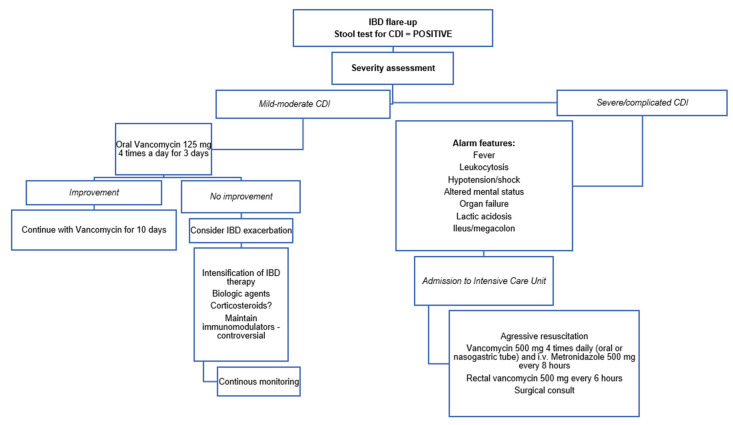
() represents a major health burden with substantial economic and clinical impact. Patients with inflammatory bowel diseases (IBD) were identified as a risk category for infection (CDI). In addition to traditional risk factors for acquisition, IBD-specific risk factors such as immunosuppression, severity and extension of the inflammatory disease were identified. virulence factors, represented by both toxins A and B, induce the damage of the intestinal mucosa and vascular changes, and promote the inflammatory host response. Given the potential life-threatening complications, early diagnostic and therapeutic interventions are required. The screening for CDI is recommended in IBD exacerbations, and the diagnostic algorithm consists of clinical evaluation, enzyme immunoassays (EIAs) or nucleic acid amplification tests (NAATs). An increased length of hospitalization, increased colectomy rate and mortality are the consequences of concurrent CDI in IBD patients. Selection of CD strains of higher virulence, antibiotic resistance, and the increasing rate of recurrent infections make the management of CDI in IBD more challenging. An individualized therapeutic approach is recommended to control CDI as well as IBD flare. Novel therapeutic strategies have been developed in recent years in order to manage severe, refractory or recurrent CDI. In this article, we aim to review the current evidence in the field of CDI in patients with underlying IBD, pointing to pathogenic mechanisms, risk factors for infection, diagnostic steps, clinical impact and outcomes, and specific management.
()是一个重大的健康负担,具有巨大的经济和临床影响。炎症性肠病(IBD)患者被确定为艰难梭菌感染(CDI)的风险类别。除了传统的感染风险因素外,还确定了IBD特异性风险因素,如免疫抑制、炎症性疾病的严重程度和范围。由毒素A和B代表的毒力因子会导致肠黏膜损伤和血管变化,并促进宿主的炎症反应。鉴于潜在的危及生命的并发症,需要早期诊断和治疗干预。建议在IBD病情加重时筛查CDI,诊断算法包括临床评估、酶免疫测定(EIA)或核酸扩增试验(NAAT)。住院时间延长、结肠切除术率增加和死亡率是IBD患者并发CDI的后果。高毒力CD菌株的选择、抗生素耐药性以及反复感染率的增加,使得IBD患者的CDI管理更具挑战性。建议采用个体化治疗方法来控制CDI以及IBD发作。近年来已经开发了新的治疗策略来管理严重、难治性或复发性CDI。在本文中,我们旨在综述IBD患者CDI领域的当前证据,指出致病机制、感染风险因素、诊断步骤、临床影响和结果以及具体管理方法。