Sanwal Satish Kumar, Kumar Parveen, Kesh Hari, Gupta Vijai Kishor, Kumar Arvind, Kumar Ashwani, Meena Babu Lal, Colla Giuseppe, Cardarelli Mariateresa, Kumar Pradeep
ICAR-Central Soil Salinity Research Institute, Karnal 132001, India.
ICAR-Central Coastal Agricultural Research Institute, Ela, Old Goa 403402, India.
Plants (Basel). 2022 Jul 14;11(14):1842. doi: 10.3390/plants11141842.
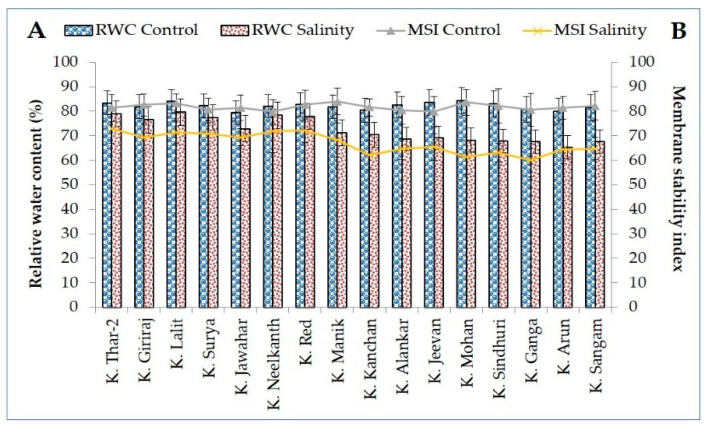
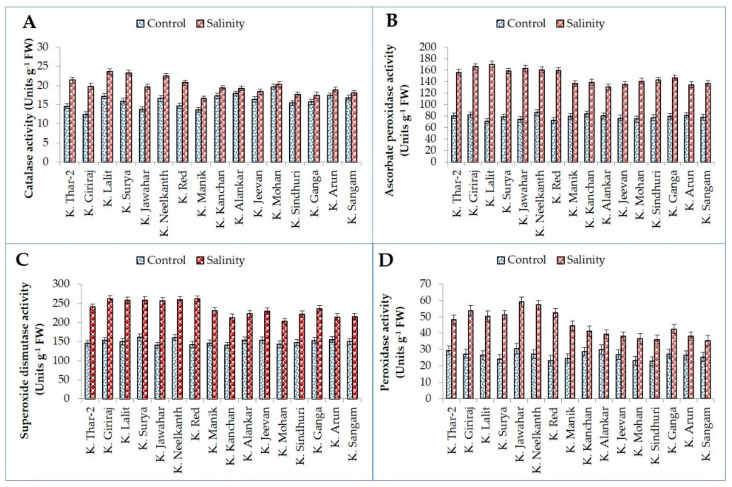
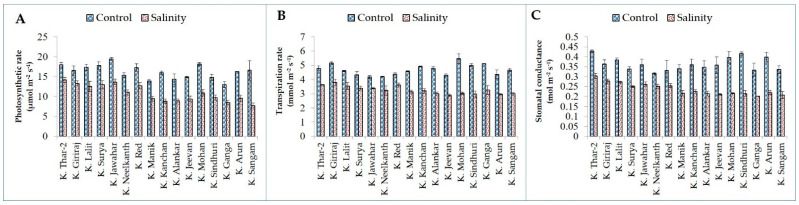
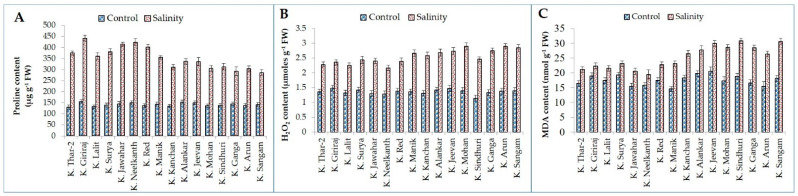
Salinity stress is a major constraint to sustainable crop production due to its adverse impact on crop growth, physiology, and productivity. As potato is the fourth most important staple food crop, enhancing its productivity is necessary to ensure food security for the ever-increasing population. Identification and cultivation of salt-tolerant potato genotypes are imperative mitigating strategies to cope with stress conditions. For this purpose, fifty-three varieties of potato were screened under control and salt stress conditions for growth and yield-related traits during 2020. Salt stress caused a mean reduction of 14.49%, 8.88%, and 38.75% in plant height, stem numbers, and tuber yield, respectively in comparison to control. Based on percent yield reduction, the genotypes were classified as salt-tolerant (seven genotypes), moderately tolerant (thirty-seven genotypes), and salt-sensitive genotypes (nine genotypes). Seven salt-tolerant and nine salt-sensitive genotypes were further evaluated to study their responses to salinity on targeted physiological, biochemical, and ionic traits during 2021. Salt stress significantly reduced the relative water content (RWC), membrane stability index (MSI), photosynthesis rate (Pn), transpiration rate (E), stomatal conductance, and K/Na ratio in all the sixteen genotypes; however, this reduction was more pronounced in salt-sensitive genotypes compared to salt-tolerant ones. The better performance of salt-tolerant genotypes under salt stress was due to the strong antioxidant defense system as evidenced by greater activity of super oxide dismutase (SOD), peroxidase (POX), catalase (CAT), and ascorbate peroxidase (APX) and better osmotic adjustment (accumulation of proline). The stepwise regression approach identified plant height, stem numbers, relative water content, proline content, HO, POX, tuber K/Na, and membrane stability index as predominant traits for tuber yield, suggesting their significant role in alleviating salt stress. The identified salt-tolerant genotypes could be used in hybridization programs for the development of new high-yielding and salt-tolerant breeding lines. Further, these genotypes can be used to understand the genetic and molecular mechanism of salt tolerance in potato.
盐胁迫由于对作物生长、生理和生产力产生不利影响,是可持续作物生产的主要限制因素。由于马铃薯是第四大重要主食作物,提高其生产力对于确保不断增长的人口的粮食安全至关重要。鉴定和培育耐盐马铃薯基因型是应对胁迫条件的必要缓解策略。为此,2020年在对照和盐胁迫条件下对53个马铃薯品种进行了生长和产量相关性状的筛选。与对照相比,盐胁迫分别使株高、茎数和块茎产量平均降低了14.49%、8.88%和38.75%。根据产量降低百分比,这些基因型被分为耐盐型(7个基因型)、中度耐盐型(37个基因型)和盐敏感型基因型(9个基因型)。2021年,对7个耐盐基因型和9个盐敏感基因型进行了进一步评估,以研究它们对盐度在目标生理、生化和离子性状方面的反应。盐胁迫显著降低了所有16个基因型的相对含水量(RWC)、膜稳定性指数(MSI)、光合速率(Pn)、蒸腾速率(E)、气孔导度和K/Na比值;然而,与耐盐基因型相比,盐敏感基因型的这种降低更为明显。耐盐基因型在盐胁迫下表现更好是由于强大的抗氧化防御系统,超氧化物歧化酶(SOD)、过氧化物酶(POX)、过氧化氢酶(CAT)和抗坏血酸过氧化物酶(APX)的活性更高以及更好的渗透调节(脯氨酸积累)证明了这一点。逐步回归方法确定株高、茎数、相对含水量、脯氨酸含量、HO、POX、块茎K/Na和膜稳定性指数是块茎产量的主要性状,表明它们在缓解盐胁迫方面的重要作用。鉴定出的耐盐基因型可用于杂交计划,以培育新的高产和耐盐育种系。此外,这些基因型可用于了解马铃薯耐盐性的遗传和分子机制。