Liu Yuchen, Fang Ming, Zhao Ruifeng, Liu Hengyan, Tian Min, Zhong Sheng, Bai Shizhu
State Key Laboratory of Military Stomatology, School of Stomatology, The Fourth Military Medical University, Xi'an 710032, China.
National Clinical Research Center for Oral Diseases, School of Stomatology, The Fourth Military Medical University, Xi'an 710032, China.
Polymers (Basel). 2022 Jul 12;14(14):2835. doi: 10.3390/polym14142835.
In this study, we evaluated the effect of periodontal splints made from different materials on the stress distributions in compromised periodontal tissues and cement layers, using a computer simulation of mastication.
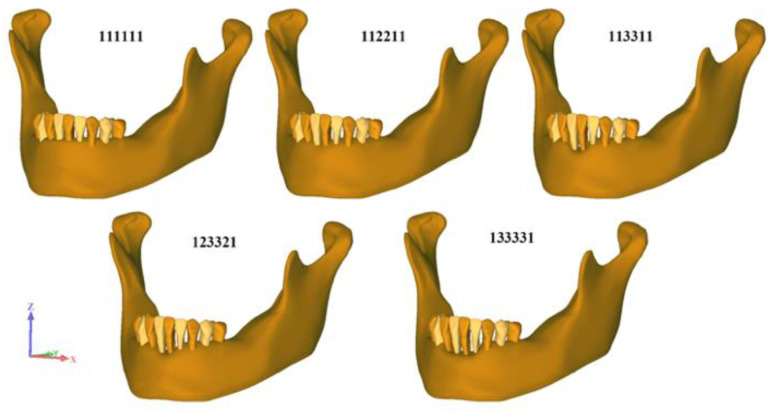
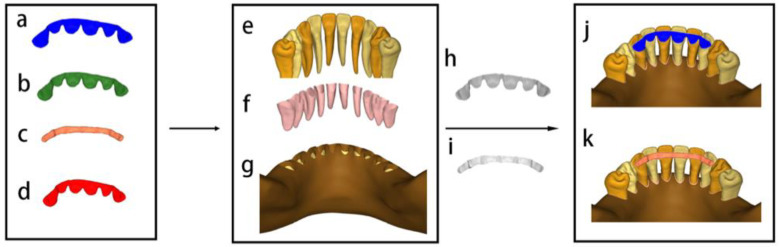
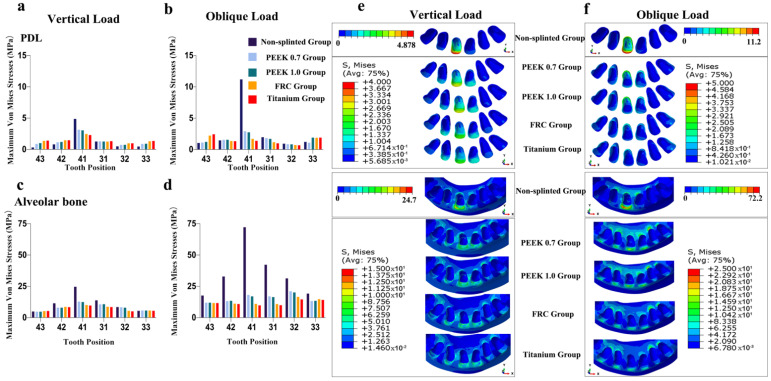
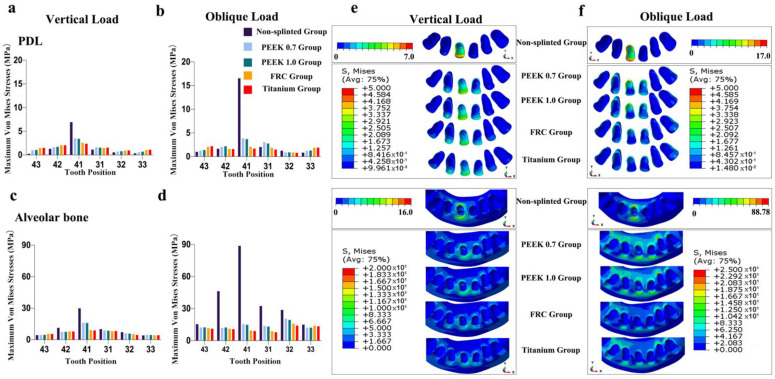
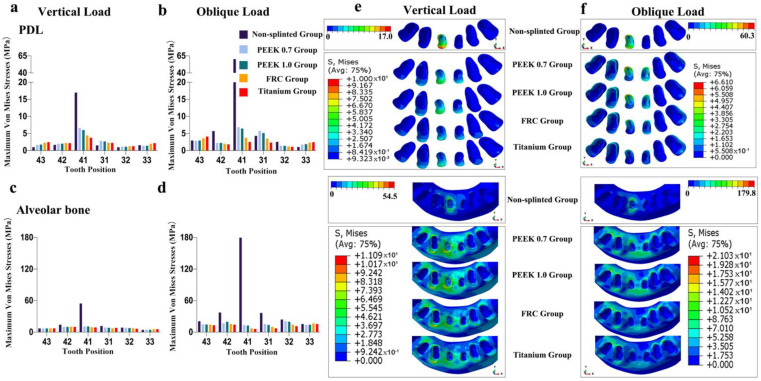
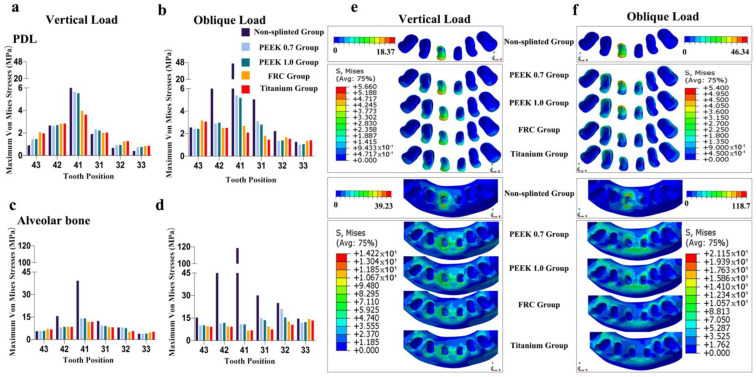
Twenty-five 3D models were created for a segment of mandibular teeth with different periodontal splints bilaterally extended to the canines. The models were divided into five groups according to the different materials and thicknesses (mm) of the splints: the non-splinted group, PEEK 0.7 group, PEEK 1.0 group, FRC group, and titanium group. Each group was subdivided based on five bone loss levels. Tooth 41 of each model was subjected to vertical and oblique (θ = 45°) static loads of 100 N, respectively, onto the incisal edge. The von Mises stresses and maximum principal stress were analyzed using Abaqus software.
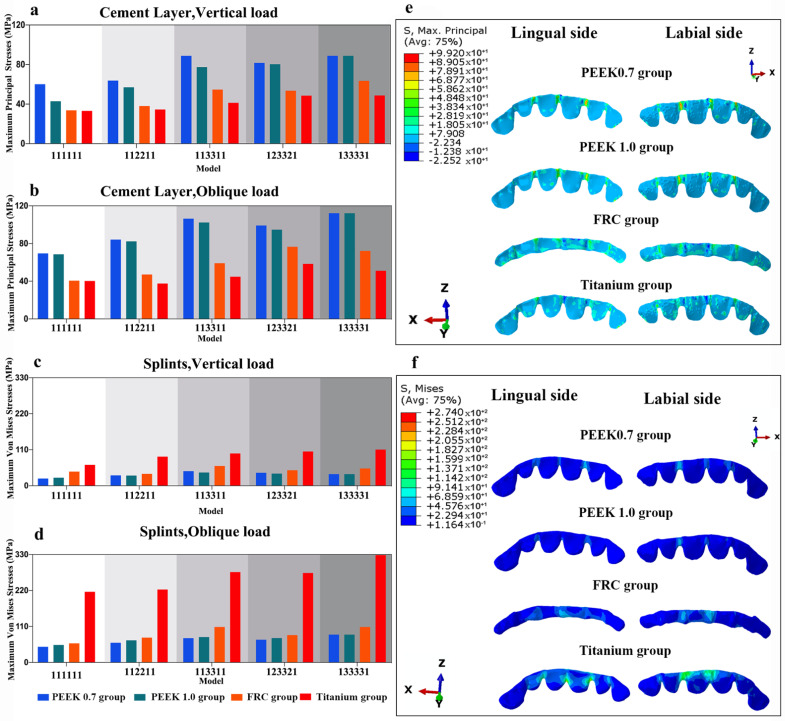
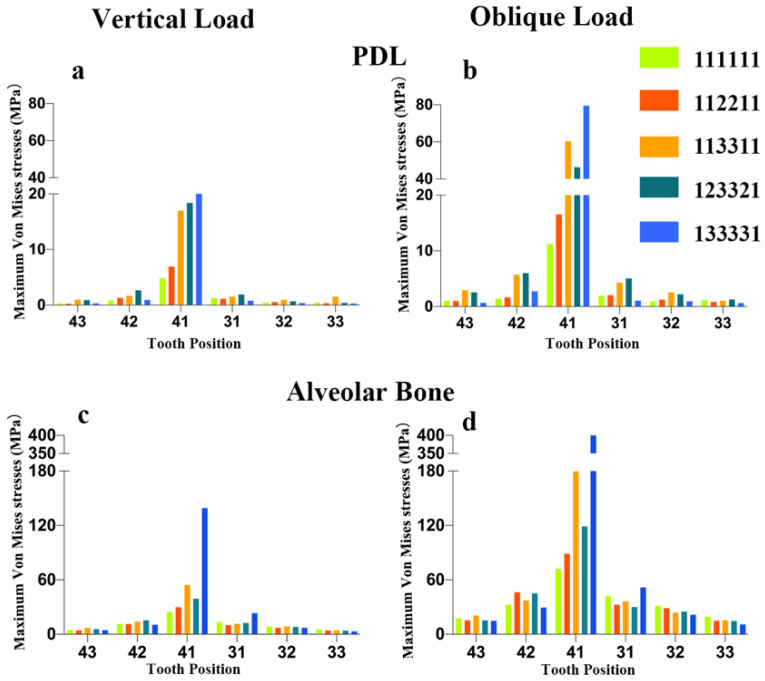
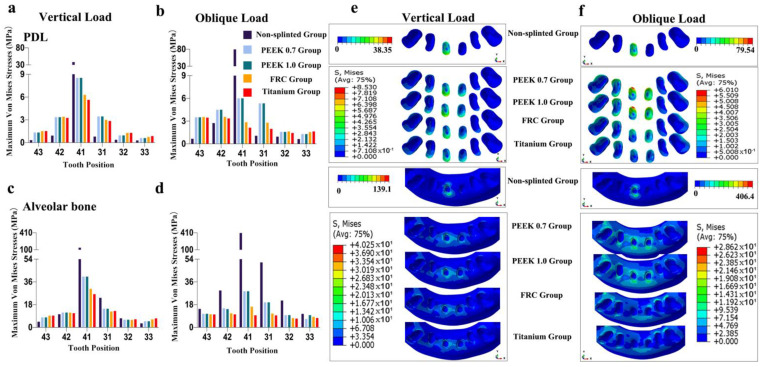
Oblique loading resulted in higher stresses on periodontal tissues, cement layers, and splints than those caused by vertical loading. The lower the supporting bone level, the greater the stress difference between the splinted groups and the non-splinted group. In model 133,331, with severe bone loss, the maximum von Mises stress values on the alveolar bone in tooth 41 under oblique loading dramatically decreased from 406.4 MPa in the non-splinted group to 28.62 MPa in the PEEK group and to 9.59 MPa in the titanium group. The four splinted groups presented similar stress distributions in periodontal tissues. The lowest stress level on the splint was observed in the PEEK 0.7 group, and the highest stress level was transferred to the cement layer in this group. Stress concentrations were primarily exhibited at the connectors near the load-carrying area.
The tested splinted groups were all effective in distributing the loads on periodontal tissues around splinted teeth with similar patterns. Using splinting materials with low elastic moduli reduced the stress concentration at the splint connectors, whereas the tensile stress concentration was increased in the cement layer. Thus, the use of adhesive cement with a higher elastic modulus is recommended when applying less rigid PEEK splints.
在本研究中,我们通过咀嚼的计算机模拟,评估了不同材料制成的牙周夹板对受损牙周组织和牙骨质层应力分布的影响。
创建了25个下颌牙齿节段的三维模型,双侧不同的牙周夹板延伸至尖牙。根据夹板的不同材料和厚度(毫米)将模型分为五组:无夹板组、聚醚醚酮0.7组、聚醚醚酮1.0组、纤维增强复合材料组和钛组。每组根据五种骨吸收水平进一步细分。每个模型的41号牙在切缘分别承受100 N的垂直和倾斜(θ = 45°)静载荷。使用Abaqus软件分析冯·米塞斯应力和最大主应力。
倾斜加载导致牙周组织、牙骨质层和夹板上的应力高于垂直加载。支持骨水平越低,夹板组和无夹板组之间的应力差异越大。在骨吸收严重的133,331号模型中,倾斜加载下41号牙牙槽骨上的最大冯·米塞斯应力值从无夹板组的406.4 MPa急剧降至聚醚醚酮组的28.62 MPa和钛组的9.59 MPa。四个夹板组在牙周组织中呈现相似的应力分布。聚醚醚酮0.7组夹板上的应力水平最低,该组中最高应力水平转移至牙骨质层。应力集中主要出现在承载区域附近的连接部位。
测试的夹板组在以相似模式分布夹板周围牙周组织上的载荷方面均有效。使用低弹性模量的夹板材料可降低夹板连接部位的应力集中,而牙骨质层中的拉应力集中增加。因此,在应用刚性较小的聚醚醚酮夹板时,建议使用具有较高弹性模量的粘结性牙骨质。