
D2D 辅助的多层蜂窝网络中的主动缓存。
Proactive Caching in D2D Assisted Multitier Cellular Network.
机构信息
Department of Electrical and Computer Engineering, COMSATS University Islamabad, Wah Campus, Wah 47040, Pakistan.
Faculty of Electrical and Computer Engineering, University of Engineering and Technology Peshawar, Peshawar 25000, Pakistan.
出版信息
Sensors (Basel). 2022 Jul 6;22(14):5078. doi: 10.3390/s22145078.
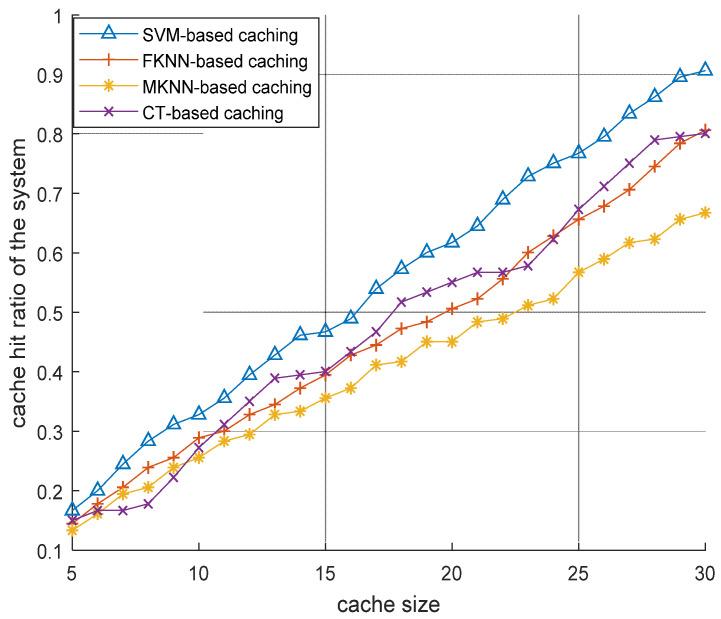
Cache-enabled networks suffer hugely from the challenge of content caching and content delivery. In this regard, cache-enabled device-to-device (D2D) assisted multitier cellular networks are expected to relieve the network data pressure and effectively solve the problem of content placement and content delivery. Consequently, the user can have a better opportunity to get their favored contents from nearby cache-enabled transmitters (CETs) through reliable and good-quality links; however, as expected, designing an effective caching policy is a challenging task due to the limited cache memory of CETs and uncertainty in user preferences. In this article, we introduce a joint content placement and content delivery technique for D2D assisted multitier cellular networks (D2DMCN). A support vector machine (SVM) is employed to predict the content popularity to determine which content is to be cached and where it is to be cached, thereby increasing the overall cache hit ratio (CHR). The content request is satisfied either by the neighboring node through the D2D link or by the cache-enabled base stations (BSs) of the multitier cellular networks (MCNs). Similarly, to solve the problem of optimal content delivery, the Hungarian algorithm is employed aiming to improve the quality of satisfaction. The simulation results indicate that the proposed content placement strategy effectively optimizes the overall cache hit ratio of the system. Similarly, an effective content delivery approach reduces the request content delivery delay and power consumption.
缓存使能网络在内容缓存和内容分发方面面临巨大挑战。在这方面,缓存使能的设备到设备(D2D)辅助多蜂窝网络有望缓解网络数据压力,并有效地解决内容放置和内容分发问题。因此,用户可以通过可靠和高质量的链路,从附近的缓存使能发射机(CET)更好地获得他们喜欢的内容;然而,正如预期的那样,由于 CET 的缓存内存有限以及用户偏好的不确定性,设计有效的缓存策略是一项具有挑战性的任务。在本文中,我们为 D2D 辅助多蜂窝网络(D2DMCN)引入了一种联合内容放置和内容分发技术。支持向量机(SVM)用于预测内容流行度,以确定要缓存哪些内容以及要将其缓存到何处,从而提高整体缓存命中率(CHR)。内容请求可以通过 D2D 链路从相邻节点或多蜂窝网络(MCN)的缓存使能基站(BS)来满足。同样,为了解决最佳内容交付问题,采用匈牙利算法来提高满意度质量。仿真结果表明,所提出的内容放置策略可以有效地优化系统的整体缓存命中率。同样,有效的内容交付方法可以减少请求内容的交付延迟和功耗。




 Zotero 插件