Department of Surgery and Cancer, Imperial College London, London, UK.
Department of Bioengineering, Faculty of Engineering, Imperial College London, London, UK.
Eur J Cardiothorac Surg. 2022 Aug 3;62(3). doi: 10.1093/ejcts/ezac392.
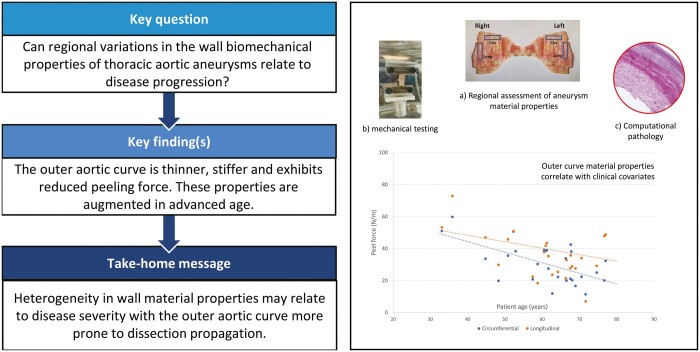
This study aims to characterize the material properties of ascending thoracic aortic aneurysmal tissue, using regional biomechanical assessment of both tensile and dissection propagation peel strength.
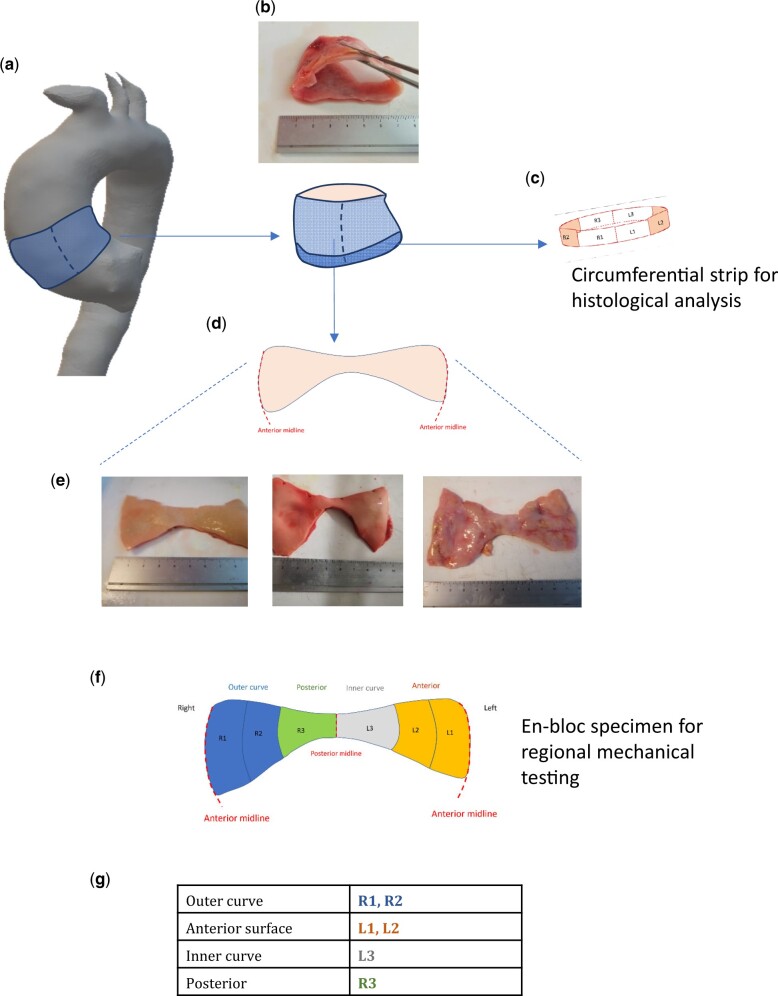
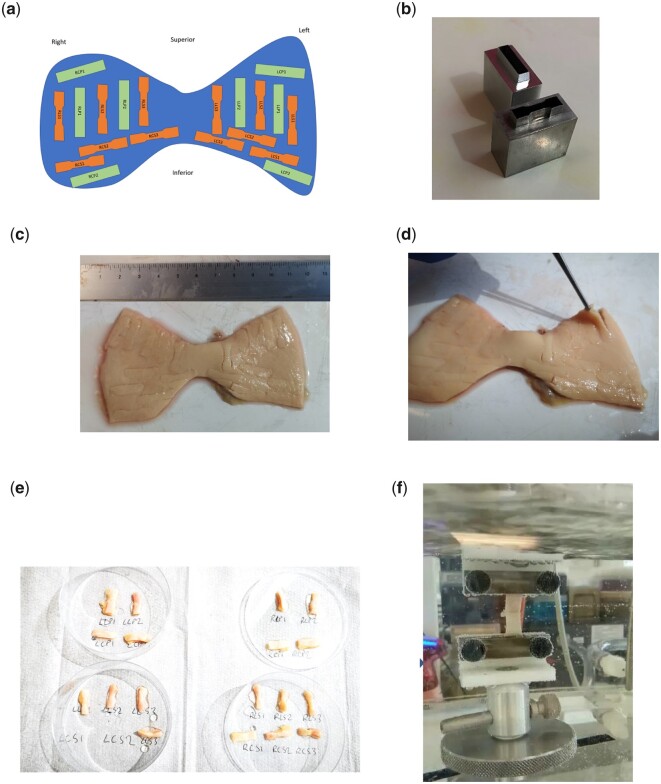
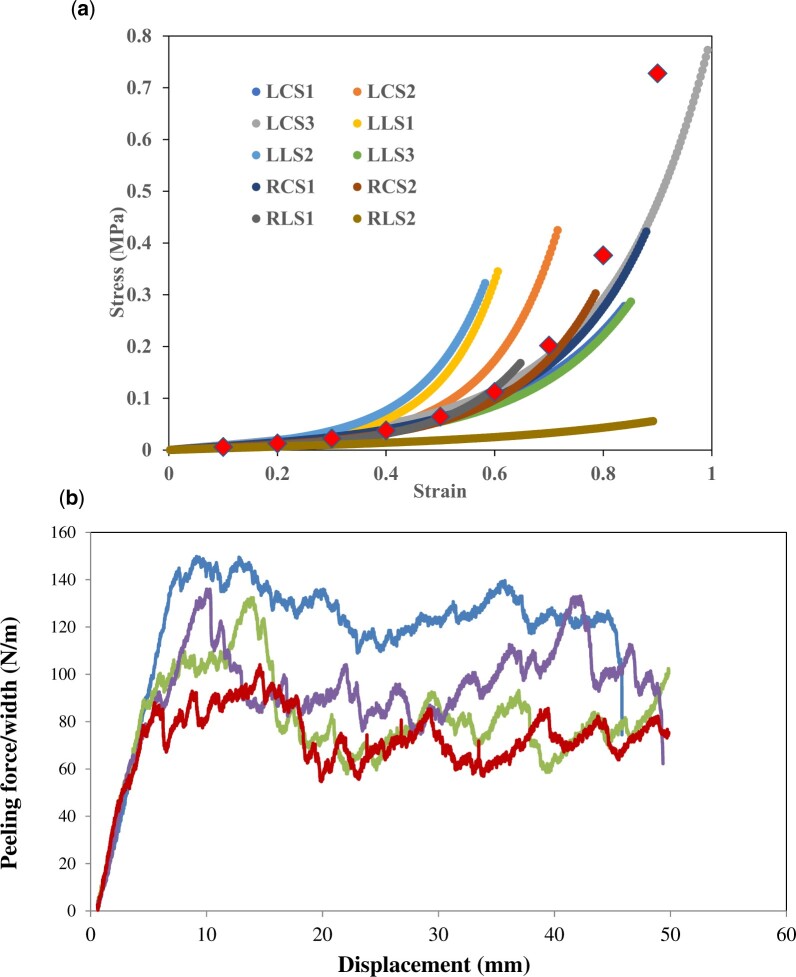
Thirty-four aneurysm specimens (proximal thoracic aorta) were harvested en-bloc from patients undergoing surgery for aneurysm replacement. Specimens were processed into regional samples of similar shapes covering the whole aneurysm isosurface, according to a structured protocol, in both orientations (longitudinal and circumferential). Thickness mapping, uniaxial tensile and peel tests were conducted, enabling calculation of the following parameters: true stress/strain, tangential modulus, tensile strength, peeling force and dissection energy. Two constitutive material models were used (hyperelastic models of Delfino and Ogden) to fit the data. A circumferential strip of tissue was also obtained for computational histology [regional quantification of (i) elastin, (ii) collagen and (iii) smooth muscle cells].
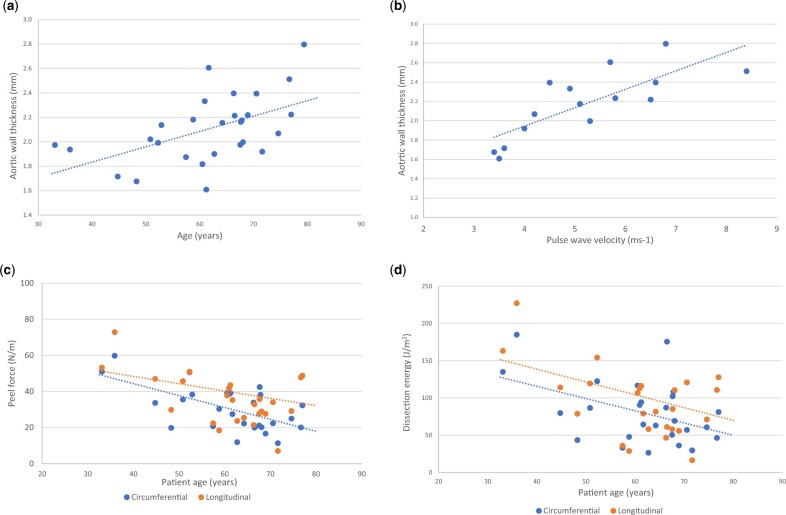
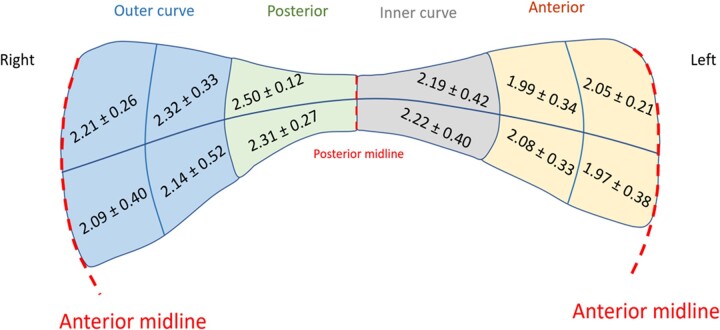
The aortic wall was thinner on the outer curve (2.21, standard deviation (SD) 0.4 mm vs inner curve 2.50, SD 0.12 mm). Advanced patient age and higher pulse wave velocity (externally measured) were predictors of increased aortic wall thickness. Tensile strength was higher in the circumferential versus longitudinal direction when analysed according to anatomical regions. Both peel force (35.5, 22 N/m) and dissection energy (88.5, 69 J/m2) were on average lowest at the outer curve of the aneurysm in the longitudinal orientation. Delfino and Ogden model constants varied throughout anatomical regions, with the outer curve being associated a higher ɑ constant (Delfino) and lower µ1 constant (Ogden) (P < 0.05) indicating increased stiffness. Histologically, collagen abundance was significantly related to circumferential and longitudinal strength (P= 0.010), whilst smooth muscle cell count had no relation with any mechanical property (P > 0.05).
Our results suggest that the outer aortic curve is more prone to dissection propagation and perhaps less prone to rupture than the inner aortic curve. This strengthens the notion of disease heterogeneity in ascending thoracic aortic aneurysms and has implications for the pathogenesis of aortic dissection.
本研究旨在通过对拉伸和剥离传播剥离强度的区域性生物力学评估,对胸主动脉瘤组织的材料特性进行特征描述。
从因动脉瘤置换手术而接受手术的患者中整块采集 34 个(胸主动脉近端)动脉瘤标本。根据一个结构化方案,以类似形状的区域样本对标本进行处理,覆盖整个动脉瘤等表面,采用两种取向(纵向和周向)。进行厚度测绘、单轴拉伸和剥离试验,从而计算以下参数:真应力/应变、切向模量、拉伸强度、剥离力和剥离能。使用两种本构材料模型(Delfino 和 Ogden 的超弹性模型)来拟合数据。还获得了一段用于计算组织学的周向组织条带[(i)弹性蛋白、(ii)胶原蛋白和(iii)平滑肌细胞的区域定量]。
主动脉壁在外侧曲线处较薄(2.21,标准差(SD)0.4 mm 比内侧曲线 2.50,SD 0.12 mm)。患者年龄较大和脉搏波速度较高(外部测量)是主动脉壁增厚的预测因素。根据解剖区域分析,周向拉伸强度高于纵向拉伸强度。当以纵向方向在动脉瘤的外侧曲线处时,剥离力(35.5,22 N/m)和剥离能(88.5,69 J/m2)平均最低。Delfino 和 Ogden 模型常数在整个解剖区域中变化,外侧曲线与较高的ɑ常数(Delfino)和较低的μ1 常数(Ogden)相关(P < 0.05),表明刚度增加。组织学上,胶原蛋白丰度与周向和纵向强度显著相关(P=0.010),而平滑肌细胞计数与任何机械性能均无关(P > 0.05)。
我们的结果表明,主动脉外曲线比主动脉内曲线更容易发生剥离传播,而不易发生破裂。这进一步证实了胸主动脉瘤存在疾病异质性的观点,并且对主动脉夹层的发病机制有影响。