Mackwood Matthew, Butcher Rebecca, Vaclavik Danielle, Alford-Teaster Jennifer A, Curtis Kevin M, Lowry Mary, Tosteson Tor D, Zhao Wenyan, Tosteson Anna N A
Department of Community and Family Medicine, Geisel School of Medicine at Dartmouth, Lebanon, NH, United States.
The Dartmouth Institute for Health Policy & Clinical Practice, Geisel School of Medicine at Dartmouth, Lebanon, NH, United States.
JMIR Cancer. 2022 Aug 16;8(3):e33768. doi: 10.2196/33768.
The COVID-19 pandemic necessitated a rapid shift to telemedicine to minimize patient and provider exposure risks. While telemedicine has been used in a variety of primary and specialty care settings for many years, it has been slow to be adopted in oncology care. Health care provider and administrator perspectives on factors affecting telemedicine use in oncology settings are not well understood, and the conditions associated with the COVID-19 pandemic offered the opportunity to study the adoption of telemedicine and the resulting provider and staff perspectives on its use.
The aim of this paper is to study the factors that influenced telemedicine uptake and sustained use in outpatient oncology clinics at a US cancer center to inform future telemedicine practices.
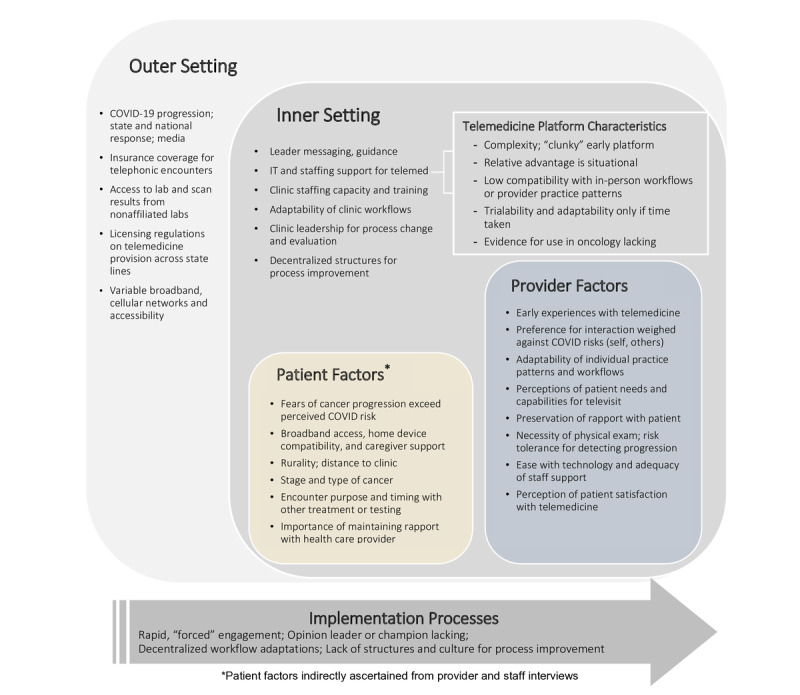
We used purposive sampling to recruit a mix of oncology specialty providers, practice managers, as well as nursing and administrative staff representing 5 outpatient oncology clinics affiliated with the Dartmouth Cancer Center, a large regional cancer center in the northeast of United States, to participate in semistructured interviews conducted over 6 weeks in spring 2021. The interview guide was informed by the 5 domains of the Consolidated Framework for Implementation Research, which include inner and outer setting factors, characteristics of the intervention (ie, telemedicine modality), individual-level factors (eg, provider and patient characteristics), and implementation processes. In total, 11 providers, 3 leaders, and 6 staff participated following verbal consent, and thematic saturation was reached across the full sample. We used a mixed deductive and inductive qualitative analysis approach to study the main influences on telemedicine uptake, implementation, and sustainability during the first year of the COVID-19 pandemic across the 5 settings.
The predominant influencers of telemedicine adoption in this study were individual provider experiences and assumptions about patient preference and accessibility. Providers' early telemedicine experiences, especially if negative, influenced preferences for telephone over video and affected sustained use. Telemedicine was most favorably viewed for lower-acuity cancer care, visits less dependent on physical exam, and for patient and caregiver education. A lack of clinical champions, leadership guidance, and vision hindered the implementation of standardized practices and were cited as essential for telemedicine sustainability. Respondents expressed anxiety about sustaining telemedicine use if reimbursements for telephonic visits diminished or ceased. Opportunities to enhance future efforts include a need to provide additional guidance supporting telemedicine use cases and evidence of effectiveness in oncology care and to address provider concerns with communication quality.
In a setting of decentralized care processes, early challenges in telemedicine implementation had an outsized impact on the nature and amount of sustained use. Proactively designed telemedicine care processes with attention to patient needs will be essential to support a sustained role for telemedicine in cancer care.
新冠疫情使得迅速转向远程医疗成为必要,以尽量降低患者和医护人员的暴露风险。虽然远程医疗已在各种初级和专科护理环境中使用多年,但在肿瘤护理领域的采用速度一直较慢。医疗保健提供者和管理人员对影响肿瘤环境中远程医疗使用的因素的看法尚不清楚,而新冠疫情带来的情况为研究远程医疗的采用以及医护人员和工作人员对其使用的看法提供了机会。
本文旨在研究影响美国一家癌症中心门诊肿瘤诊所远程医疗采用和持续使用的因素,为未来的远程医疗实践提供参考。
我们采用目的抽样法,招募了肿瘤专科提供者、实践经理以及代表达特茅斯癌症中心(美国东北部的一个大型区域癌症中心)附属的5家门诊肿瘤诊所的护理和行政人员,参与2021年春季为期6周的半结构化访谈。访谈指南基于实施研究综合框架的5个领域制定,包括内部和外部环境因素、干预措施的特征(即远程医疗模式)、个人层面的因素(如提供者和患者特征)以及实施过程。共有11名提供者、3名负责人和6名工作人员在口头同意后参与,整个样本达到了主题饱和。我们采用演绎和归纳相结合的定性分析方法,研究新冠疫情第一年中5个环境下对远程医疗采用、实施和可持续性的主要影响因素。
本研究中远程医疗采用的主要影响因素是个体提供者的经验以及对患者偏好和可及性的假设。提供者早期的远程医疗经验,尤其是负面经验,影响了他们对电话而非视频的偏好,并影响了持续使用情况。对于低 acuity 癌症护理、对体格检查依赖较少的就诊以及患者和护理人员教育,远程医疗的评价最为积极。缺乏临床倡导者、领导指导和愿景阻碍了标准化实践的实施,被认为是远程医疗可持续性的关键因素。受访者表示,如果电话就诊的报销减少或停止,他们对持续使用远程医疗感到焦虑。加强未来努力的机会包括需要提供更多支持远程医疗用例的指导以及肿瘤护理有效性的证据,并解决提供者对沟通质量的担忧。
在分散的护理流程环境中,远程医疗实施初期的挑战对持续使用的性质和数量产生了巨大影响。积极设计关注患者需求的远程医疗护理流程对于支持远程医疗在癌症护理中的持续作用至关重要。