Department of Pharmacy, School of Health Sciences, National and Kapodistrian University of Athens, Panepistimiopolis, 15784, Zografou, Greece.
AAPS PharmSciTech. 2022 Jul 28;23(6):205. doi: 10.1208/s12249-022-02351-4.
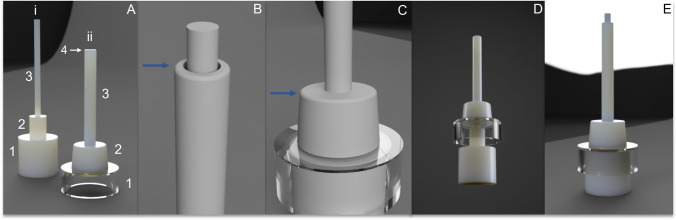
The purpose of the current study is the development and the in vitro evaluation of a novel device for the nasal delivery of biodegradable polymeric films. The Matrix-Piston nasal Device (MPD) was designed and then printed employing Fused Deposition Modeling. Particularly, the CAD model of MPD was produced considering the human anatomical features of the nasal cavity and aiming to deliver the formulation on the olfactory region. The device consists of two independent parts constructed by different materials. For the 3D-printing process, different materials were tested to decide the most applicable for each part. More precisely, Thermoplastic Polyurethene (TPU) polymer was selected to print the matrix, while Acrylonitrile Butadiene Styrene (ABS) for the piston. Furthermore, two nasal casts were printed to be used for the assessment of the device. Namely, an hydroxypropyl-methyl cellulose-based drug-free film, containing polyethylene glycol 400 as plasticizer and methyl-β-cyclodextrin as permeation enhancer, was formed on the MPD to be tested for its ability to be detached from the device and positioned on the artificial olfactory region of the nasal cast. The deposition of the film on the targeted area of the semi-realistic nasal cast took place successfully.
本研究的目的是开发和体外评价一种用于鼻腔给药的新型可生物降解聚合物薄膜的装置。基质-活塞鼻腔给药装置(MPD)是通过熔融沉积建模设计和打印的。特别是,考虑到鼻腔的人体解剖学特征,设计了 MPD 的 CAD 模型,旨在将制剂递送到嗅觉区。该装置由两个用不同材料构造的独立部分组成。对于 3D 打印过程,测试了不同的材料,以确定每种材料的最适用材料。更确切地说,选择热塑性聚氨酯(TPU)聚合物来打印基质,而丙烯腈-丁二烯-苯乙烯(ABS)用于打印活塞。此外,还打印了两个鼻模型以评估装置。即,在 MPD 上形成含有聚乙二醇 400 作为增塑剂和甲基-β-环糊精作为渗透增强剂的羟丙基甲基纤维素无药膜,以测试其从装置上分离并定位在鼻模型的人工嗅觉区的能力。薄膜成功地沉积在半逼真鼻模型的目标区域上。