Department of Acupuncture, South Area of Guang'anmen Hospital, China Academy of Chinese Medical Sciences, No. 138 Xingfeng Street, Daxing District, Beijing, 102618, China.
Department of Acupuncture, Guang'anmen Hospital, China Academy of Chinese Medical Sciences, Beijing, 100053, China.
Trials. 2022 Jul 27;23(1):605. doi: 10.1186/s13063-022-06486-4.
The global incidence of dry eye disease (DED) is very high. DED seriously affects the quality of life of patients; however, the current curative effect of medicine for moderate to severe DED is poor. This randomized clinical trial was planned to investigate the effect of acupuncture compared with artificial tears (AT) on moderate to severe DED.
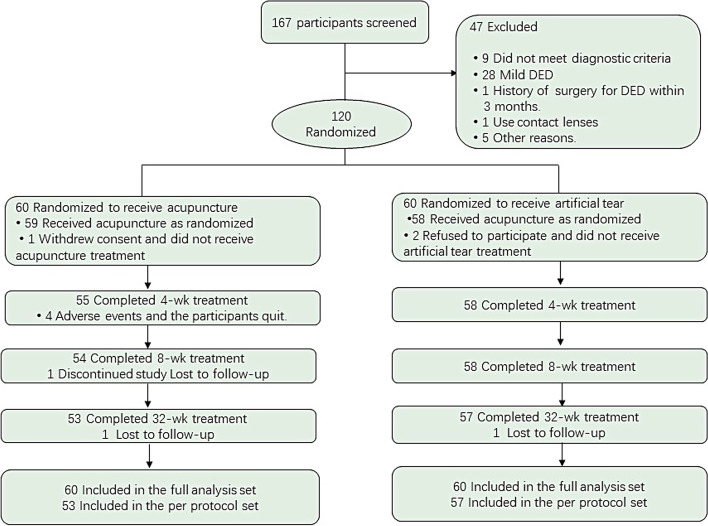
A randomized clinical trial was performed at 2 hospitals in China. 120 DED patients were randomly equally divided into an acupuncture and an artificial tear group. Either acupuncture or artificial tears was performed for an 8-week period, and a 24-week follow-up was performed. The primary outcome measure was the Schirmer-I test (SIT) change from baseline. The secondary outcome measures included the numerical rating scale (NRS) change from baseline for improvement in ocular symptoms, the ocular surface disease index (OSDI), the tear-film break-up time (TBUT), corneal fluorescein staining (CFS), and acupuncture acceptability. Adverse events also were monitored and documented.
For the primary outcome, the mean changes from baseline in the SIT values were significantly different between the acupuncture (5.75 [2.53-9.75]) and AT (0.52 [- 1.18-2.46]) groups at week 8 with a between difference of 5.23 (P < 0.05). Between-group differences of 8.49 in OSDI score change from baseline differed significantly at week 8 (P < 0.05). However, between-group differences of the changes in the average symptom NRS score, TBUT, and CFS did not differ significantly at week 8. Five cases experienced acupuncture-related adverse events.
This randomized clinical trial found that acupuncture at BL1 significantly promoted tear secretion. Acupuncture showed greater benefits than AT for moderate to severe DED. However, the study findings warrant verification.
Registration number: ChiCTR1800015831. Name of trial registry: Efficacy and safety of acupuncture in the treatment of moderate to severe dry eye disease: a randomized controlled trial. Registered on 23 April 2018 ( https://clinicaltrials.gov/ ).
全球干眼症(DED)的发病率非常高。DED 严重影响患者的生活质量;然而,目前对于中重度 DED 的药物治疗效果不佳。本随机临床试验旨在研究与人工泪液(AT)相比,针刺治疗中重度 DED 的效果。
本研究在我国的 2 家医院进行了一项随机临床试验。将 120 例 DED 患者随机均分为针刺组和人工泪液组。两组均接受 8 周的治疗,并进行 24 周的随访。主要观察指标为基础期的泪液分泌试验(Schirmer-I test,SIT)改变。次要观察指标包括基础期改善眼症的数字评分量表(numerical rating scale,NRS)改变、眼表疾病指数(ocular surface disease index,OSDI)、泪膜破裂时间(tear-film break-up time,TBUT)、角膜荧光素染色(corneal fluorescein staining,CFS)和针刺可接受性。还监测和记录了不良事件。
主要结局方面,在第 8 周时,针刺组(5.75[2.53-9.75])与 AT 组(0.52[-1.18-2.46])的 SIT 值的平均变化与基础期相比差异有统计学意义(P<0.05)。第 8 周时,OSDI 评分改变的组间差异为 8.49(P<0.05),差异有统计学意义。然而,第 8 周时,平均症状 NRS 评分、TBUT 和 CFS 的变化的组间差异无统计学意义。5 例患者出现与针刺相关的不良事件。
本随机临床试验发现,针刺 BL1 可显著促进泪液分泌。与 AT 相比,针刺在治疗中重度 DED 方面具有更大的优势。然而,还需要进一步的验证。
注册号:ChiCTR1800015831。试验注册名称:针刺治疗中重度干眼的疗效和安全性:一项随机对照试验。注册日期:2018 年 4 月 23 日(https://clinicaltrials.gov/)。