Zhu Yining, Xu Yining, Xuan Rongrong, Huang Jialu, István Bíró, Fekete Gusztáv, Gu Yaodong
Faculty of Sports Science, Ningbo University, Ningbo, China.
The Affiliated Hospital of Medical School, Ningbo University, Ningbo, China.
Front Aging Neurosci. 2022 Jul 11;14:919059. doi: 10.3389/fnagi.2022.919059. eCollection 2022.
Amyotrophic lateral sclerosis (ALS) is a progressive neuromuscular disease whose primary hallmark is the progressive degeneration of motor neurons in the brainstem, spinal cord, and cerebral cortex that leads to weakness, spasticity, fatigue, skeletal muscle atrophy, paralysis, and even death. Exercise, as a non-pharmacological tool, may generally improve muscle strength, cardiovascular function, and quality of life. However, there are conflicting reports about the effect of exercise training in adults with ALS.
This systematic review and network meta-analysis aim to conduct a mixed comparison of different exercise interventions for function, respiratory, fatigue, and quality of life in adults with ALS.
Randomized controlled trials with ALS participants were screened and included from the databases of PubMed, Medline, and Web of Science. Physical exercise interventions were reclassified into aerobic exercise, resistance training, passive exercise, expiratory muscle exercise, and standard rehabilitation. Patient-reported outcome measures would be reclassified from perspectives of function, respiratory, fatigue, and quality of life. The effect size would be transferred into the percentage change of the total score.
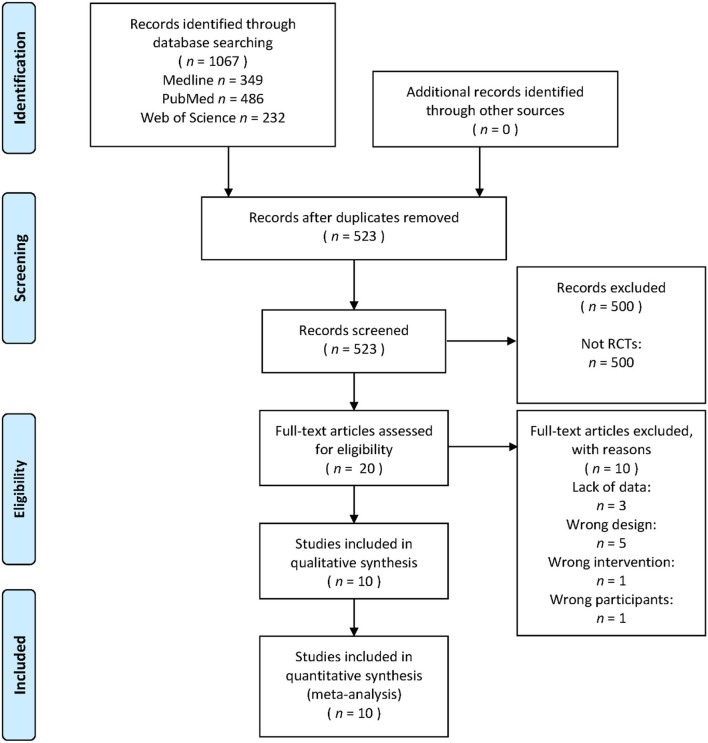
There were 10 studies included, with the agreement between authors reaching a kappa-value of 0.73. The network meta-analysis, which was conducted under the consistency model, identified that a combined program of aerobic exercise, resistance exercise, and standard rehabilitation showed the highest potential to improve quality of life (0.64 to be the best) and reduce the fatigue (0.39 to be the best) for ALS patients, while exercise program of aerobic and resistance training showed the highest potential (0.51 to be the best) to improve ALS patients' physical function. The effect of exercise on the respiratory was still unclear.
A multi-modal exercise and rehabilitation program would be more beneficial to ALS patients. However, the safety and guide for practice remain unclear, and further high-quality randomized controlled trials (RCTs) with a larger sample are still needed.
https://www.crd.york.ac.uk/prospero/display_record.php?ID=CRD42021253442, CRD42021253442.
肌萎缩侧索硬化症(ALS)是一种进行性神经肌肉疾病,其主要特征是脑干、脊髓和大脑皮层中的运动神经元进行性退化,导致肌无力、痉挛、疲劳、骨骼肌萎缩、瘫痪甚至死亡。运动作为一种非药物手段,通常可以改善肌肉力量、心血管功能和生活质量。然而,关于运动训练对成年ALS患者的影响,存在相互矛盾的报道。
本系统评价和网状Meta分析旨在对成年ALS患者不同运动干预对功能、呼吸、疲劳和生活质量的影响进行混合比较。
从PubMed、Medline和Web of Science数据库中筛选并纳入有ALS参与者的随机对照试验。体育锻炼干预措施重新分类为有氧运动、抗阻训练、被动运动、呼气肌锻炼和标准康复。患者报告的结局指标将从功能、呼吸、疲劳和生活质量的角度重新分类。效应量将转换为总分的百分比变化。
共纳入10项研究,作者间的一致性达到kappa值为0.73。在一致性模型下进行的网状Meta分析确定,有氧运动、抗阻运动和标准康复的联合方案显示出改善ALS患者生活质量(最佳为0.64)和减轻疲劳(最佳为0.39)的最大潜力,而有氧和抗阻训练的运动方案显示出改善ALS患者身体功能的最大潜力(最佳为0.51)。运动对呼吸的影响仍不明确。
多模式运动和康复方案对ALS患者更有益。然而,安全性和实践指南仍不明确,仍需要进一步开展更大样本量的高质量随机对照试验(RCT)。
https://www.crd.york.ac.uk/prospero/display_record.php?ID=CRD42021253442,CRD42021253442。