Wang Hong, Qi Jiaqian, Li Xueqian, Chu Tiantian, Qiu Huiying, Fu Chengcheng, Tang Xiaowen, Ruan Changgeng, Wu Depei, Han Yue
National Clinical Research Center for Hematologic Diseases, Jiangsu Institute of Hematology, The First Affiliated Hospital of Soochow University, Suzhou, China.
Institute of Blood and Marrow Transplantation, Collaborative Innovation Center of Hematology, Soochow University, Suzhou, China.
Front Oncol. 2022 Jul 11;12:940320. doi: 10.3389/fonc.2022.940320. eCollection 2022.
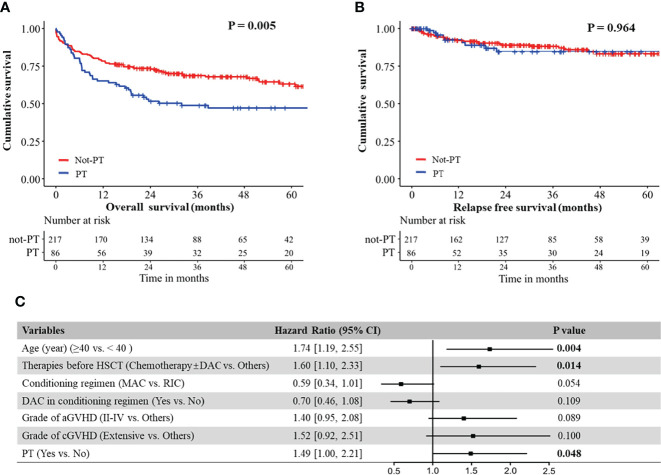
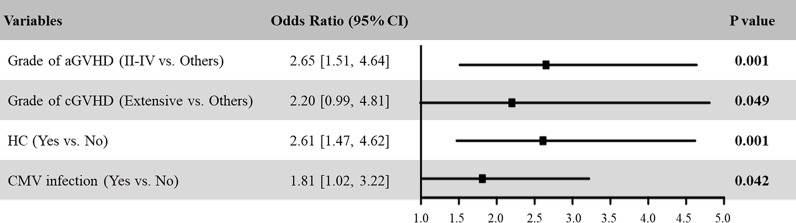
Prolonged isolated thrombocytopenia (PT) is a common complication affecting the outcome of stem cell transplantation. In this study, we undertook a real-world study of 303 myelodysplastic syndrome (MDS) patients who received allogeneic hematopoietic stem cell transplantation (HSCT) between December 2007 and June 2018. 28.4% of MDS patients suffered from PT after HSCT. Survival analysis indicated that PT was associated with worse overall survival (OS) in MDS patients. The 2-year and 5-year OS in MDS patients with PT after HSCT were 49% and 47%, significantly worse than that of 68% and 60% in patients without PT (P=0.005). For RFS, patients with PT did not have an increased risk of disease relapse (P=0.964). After multivariate adjustment, PT was proved to be the independent risk factor associated with the worse OS (HR 1.49, 95% CI 1.00-2.21, P =0.048). We further analyzed risk factors associated with the occurrence of PT in MDS patients. Multiple logistic regression identified grade II-IV aGVHD, extensive chronic GVHD, hemorrhagic cystitis, and CMV activation as significant risk factors for developing PT. Among these variables, the Odds Ratio (OR) of grade II-IV aGVHD was the highest (P =0.001, OR: 2.65, 95% CI: 1.51-4.64). These data indicated the prognostic value of PT in MDS after HSCT. The identification of risk factors for PT may help improve patient management and lead to the design of effective treatment strategies.
持续性孤立性血小板减少症(PT)是影响干细胞移植结局的常见并发症。在本研究中,我们对2007年12月至2018年6月期间接受异基因造血干细胞移植(HSCT)的303例骨髓增生异常综合征(MDS)患者进行了一项真实世界研究。28.4%的MDS患者在HSCT后发生PT。生存分析表明,PT与MDS患者较差的总生存期(OS)相关。HSCT后发生PT的MDS患者的2年和5年OS分别为49%和47%,显著低于未发生PT患者的68%和60%(P=0.005)。对于无复发生存期(RFS),发生PT的患者疾病复发风险未增加(P=0.964)。多因素调整后,PT被证明是与较差OS相关的独立危险因素(HR 1.49,95%CI 1.00-2.21,P =0.048)。我们进一步分析了与MDS患者发生PT相关的危险因素。多因素logistic回归分析确定II-IV级急性移植物抗宿主病(aGVHD)、广泛性慢性移植物抗宿主病、出血性膀胱炎和巨细胞病毒(CMV)激活是发生PT的显著危险因素。在这些变量中,II-IV级aGVHD的优势比(OR)最高(P =0.001,OR:2.65,95%CI:1.51-4.64)。这些数据表明PT在HSCT后MDS中的预后价值。识别PT的危险因素可能有助于改善患者管理并促成有效治疗策略的设计。