Central Council for Research in Ayurvedic Sciences, New Delhi, India.
Ministry of Ayush, Government of India, New Delhi, India.
Front Public Health. 2022 Jul 6;10:904279. doi: 10.3389/fpubh.2022.904279. eCollection 2022.
During the second wave of the COVID-19 pandemic in India, the Ministry of Ayush conducted a community study to provide therapeutic care to patients with asymptomatic, mild, and moderate COVID-19 in home isolation based on the empirical evidence generated on the efficacy of AYUSH-64 in COVID-19.
To document disease characteristics, care-seeking behavior, and outcomes in patients with asymptomatic, mild, or moderate COVID-19 in home isolation who used AYUSH-64 for COVID-19.
Cross-sectional analysis of the data generated through a community study conducted in India from 08 May to 31 August 2021 was performed to study the disease characteristics, care-seeking behavior during home isolation, clinical outcomes, adverse events, and the association between various risk factors and clinical recovery during the study period. The data were collected through semi-structured questionnaires, available in electronic data collection format at the baseline, 7, 14, and 21 days. A logistic regression was performed to explore the relationship between relevant variables and clinical recovery.
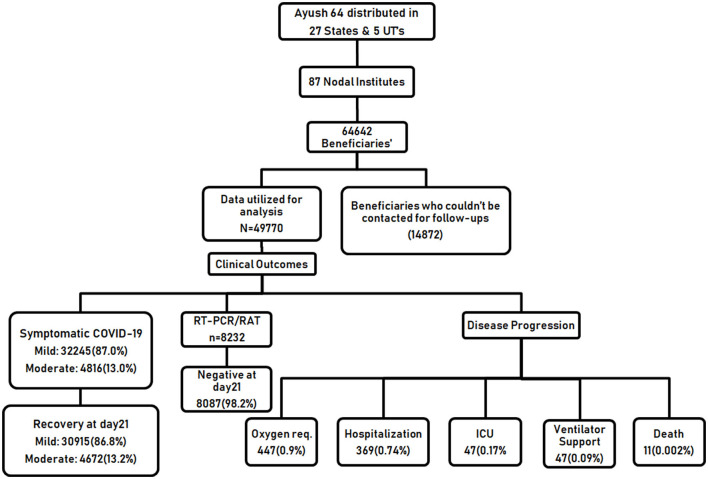
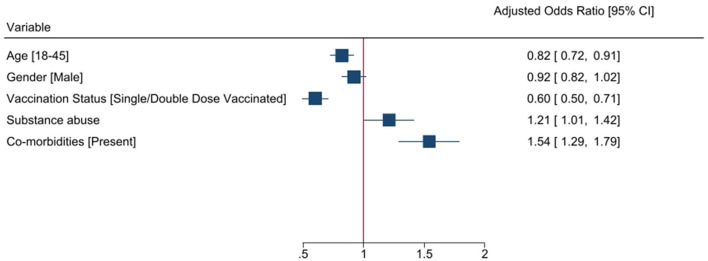
Data from 64,642 participants were analyzed for baseline assessment, and final analysis was done for 49,770 participants. The mean age of the enrolled participants was 38.8 ± 11.7 years, and 8.4% had co-morbidities. AYUSH-64 was utilized as an add-on to the standard care by 58.3% of participants. Comparable clinical outcomes were observed in participants utilizing AYUSH-64 either as a standalone or as an add-on to standard care, in terms of clinical recovery, disease progression, the requirement for oxygen supplementation, hospitalization, ICU admission, and need for ventilator support. Younger age, having no co-morbidities or substance abuse, and having been vaccinated were associated with early clinical recovery than those who were older and not vaccinated.
The study findings suggest that AYUSH-64 use, either standalone or as an adjunct to standard care, in asymptomatic, mild, or moderate COVID-19 is associated with good clinical outcomes. Ayush services and interventions can be effectively integrated into the mainstream public health architecture to serve public health goals.
在印度第二波 COVID-19 疫情期间,印度卫生部根据 AYUSH-64 在 COVID-19 方面的疗效实证,开展了一项社区研究,为在家隔离的无症状、轻症和中度 COVID-19 患者提供治疗护理。
记录在家隔离的无症状、轻症或中度 COVID-19 患者使用 AYUSH-64 进行治疗的疾病特征、寻求医疗服务的行为和结局。
对 2021 年 5 月 8 日至 8 月 31 日在印度进行的社区研究产生的数据进行横断面分析,以研究在家隔离期间的疾病特征、寻求医疗服务的行为、临床结局、不良事件以及研究期间各种风险因素与临床康复之间的关系。数据通过电子数据收集格式的半结构化问卷在基线、第 7、14 和 21 天收集。进行逻辑回归以探索相关变量与临床康复之间的关系。
对 64642 名参与者进行了基线评估数据分析,对 49770 名参与者进行了最终分析。纳入参与者的平均年龄为 38.8 ± 11.7 岁,8.4%有合并症。58.3%的参与者将 AYUSH-64 作为标准治疗的附加治疗。在临床康复、疾病进展、需要补充氧气、住院、入住 ICU 和需要呼吸机支持方面,使用 AYUSH-64 作为单独治疗或作为标准治疗的附加治疗的参与者观察到可比的临床结局。年龄较小、无合并症或药物滥用、已接种疫苗与年龄较大和未接种疫苗的参与者相比,早期临床康复的可能性更大。
研究结果表明,在无症状、轻症或中度 COVID-19 患者中,使用 AYUSH-64 作为单独治疗或作为标准治疗的附加治疗与良好的临床结局相关。阿育吠陀服务和干预措施可以有效地整合到主流公共卫生架构中,以服务于公共卫生目标。