Department of Computer Science, University of Twente, Enschede, The Netherlands.
PLoS One. 2022 Jul 28;17(7):e0272270. doi: 10.1371/journal.pone.0272270. eCollection 2022.
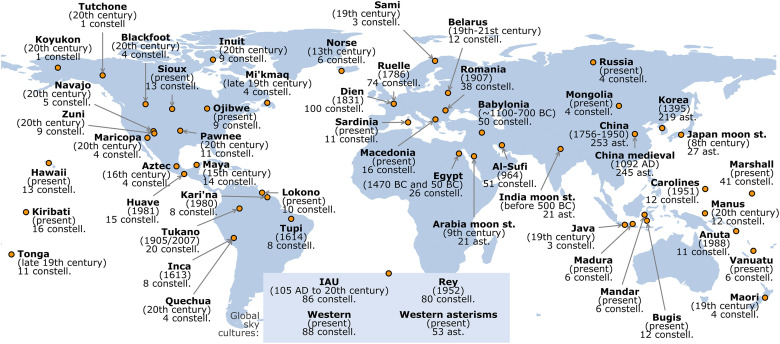
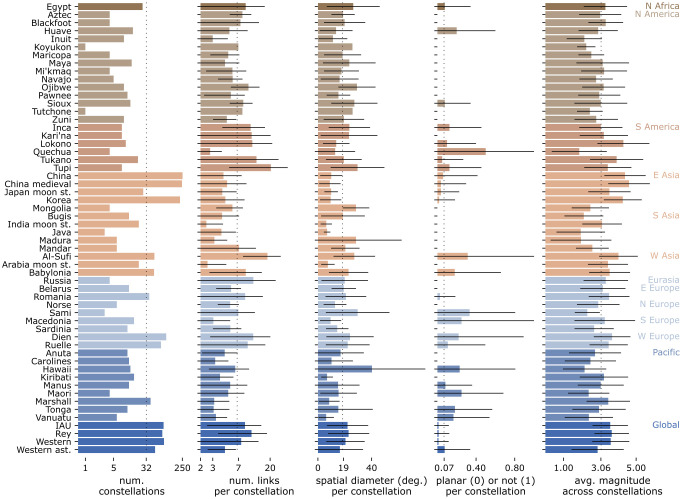
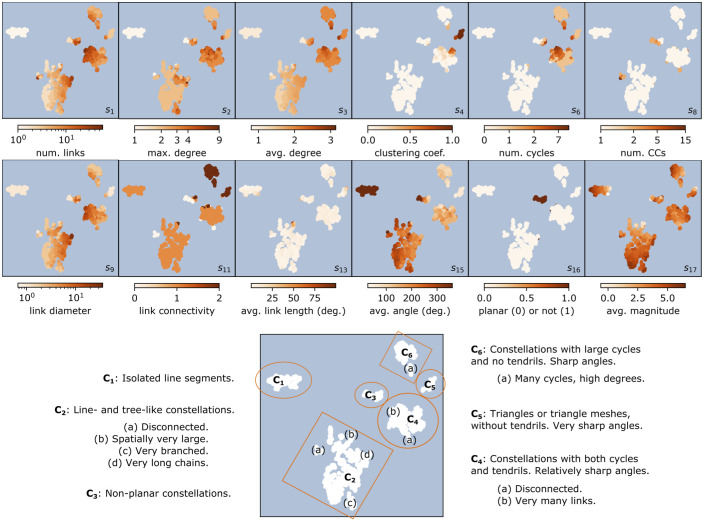
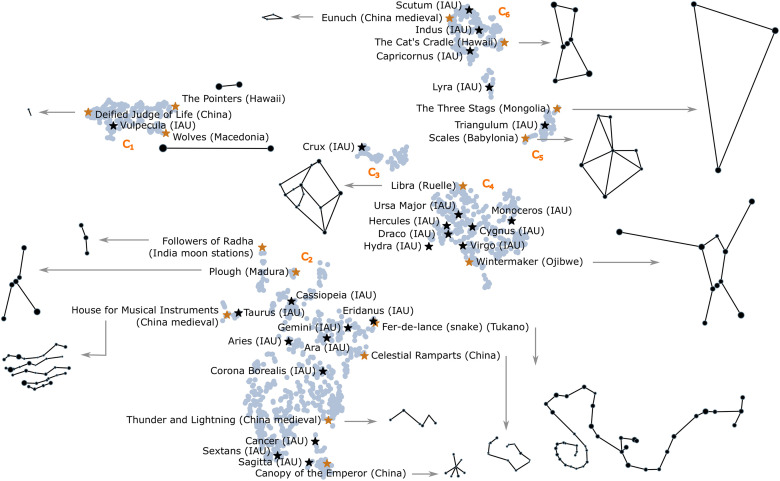
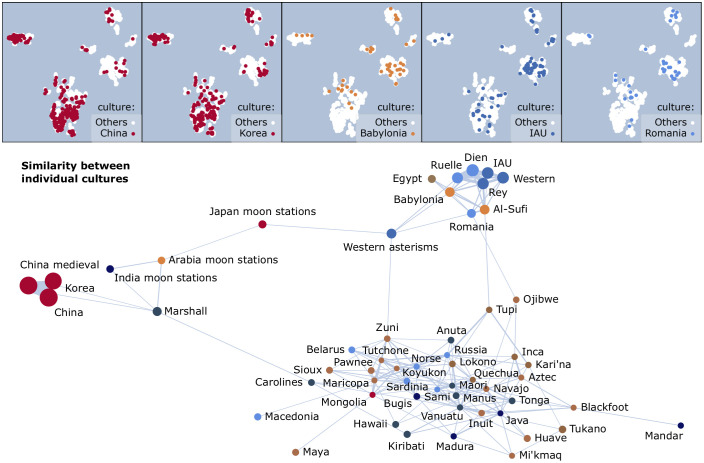
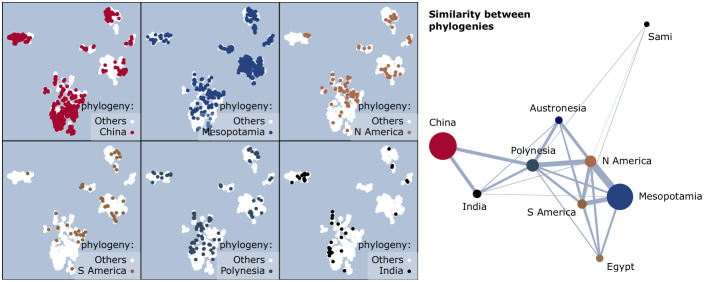
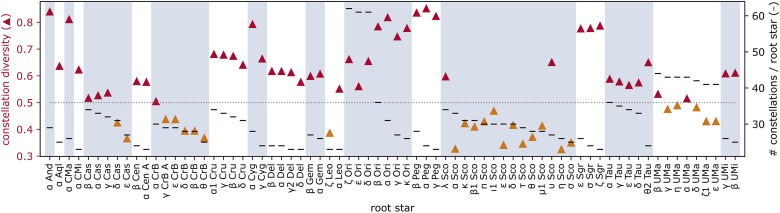
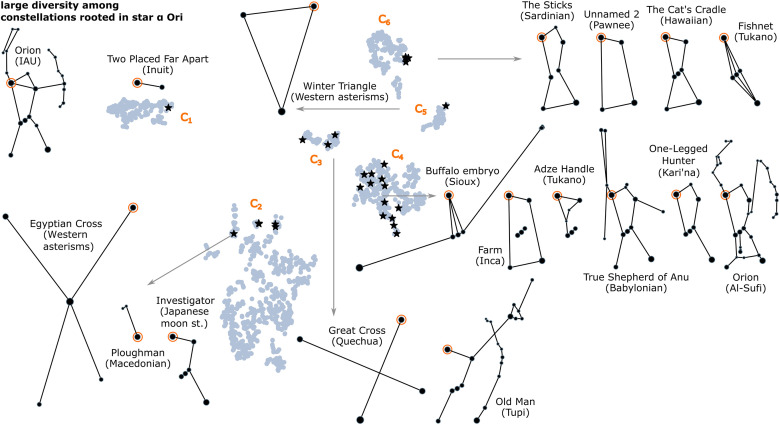
In traditional astronomies across the world, groups of stars in the night sky were linked into constellations-symbolic representations rich in meaning and with practical roles. In some sky cultures, constellations are represented as line (or connect-the-dot) figures, which are spatial networks drawn over the fixed background of stars. We analyse 1802 line figures from 56 sky cultures spanning all continents, in terms of their network, spatial, and brightness features, and ask what associations exist between these visual features and culture type or sky region. First, an embedded map of constellations is learnt, to show clusters of line figures. We then form the network of constellations (as linked by their similarity), to study how similar cultures are by computing their assortativity (or homophily) over the network. Finally, we measure the diversity (or entropy) index for the set of constellations drawn per sky region. Our results show distinct types of line figures, and that many folk astronomies with oral traditions have widespread similarities in constellation design, which do not align with cultural ancestry. In a minority of sky regions, certain line designs appear universal, but this is not the norm: in the majority of sky regions, the line geometries are diverse.
在世界各地的传统天文学中,夜空中的星群被连接成星座——这些星座具有丰富的象征意义和实际作用。在一些天空文化中,星座被表示为线条(或连接点)图形,这些图形是在恒星的固定背景上绘制的空间网络。我们分析了来自五大洲 56 种天空文化的 1802 个线条图形,从网络、空间和亮度特征方面进行了分析,并探讨了这些视觉特征与文化类型或天空区域之间的关联。首先,我们学习了星座的嵌入式地图,以显示线条图形的聚类。然后,我们形成了星座的网络(通过它们的相似性连接),通过计算网络上的相似性来研究相似文化之间的相似性。最后,我们根据每个天空区域绘制的星座集来测量多样性(或熵)指数。我们的研究结果表明存在不同类型的线条图形,并且许多具有口头传统的民间天文学在星座设计方面具有广泛的相似性,这些相似性与文化渊源无关。在少数天空区域中,某些线条设计似乎是普遍存在的,但这并非常态:在大多数天空区域中,线条几何形状是多样化的。