Monogastric Research Centre, School of Agriculture and Environment, Massey University, Palmerston North 4442, New Zealand.
Evonik Operations GmbH, Animal Nutrition, 63457 Hanau, Germany.
Poult Sci. 2022 Sep;101(9):102016. doi: 10.1016/j.psj.2022.102016. Epub 2022 Jun 20.
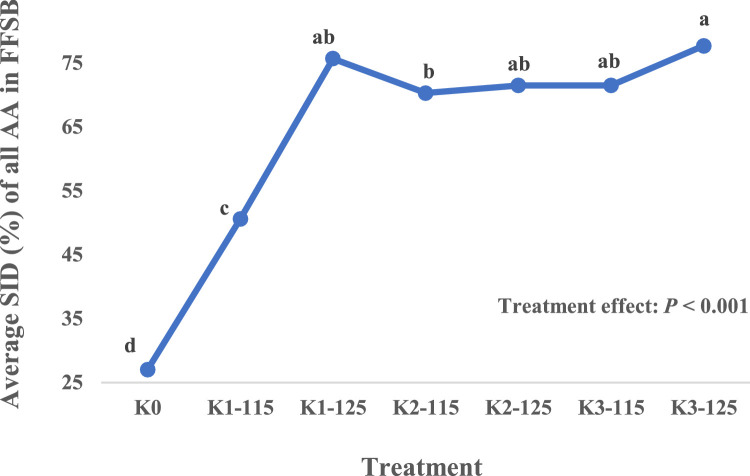
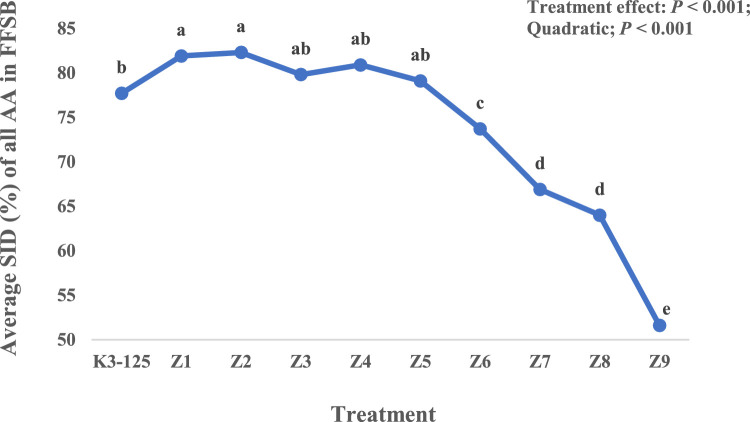
The influence of wet-heating (WH) and expansion temperature (ET), and autoclaving time (AT) on the nitrogen-corrected apparent metabolizable energy (AME) and standardized ileal digestibility (SID) of AA in full-fat soybeans (FFSB) for broilers was examined in 2 experiments. The AME and SID AA of FFSB were determined by the difference and direct methods, respectively. In Experiment 1, raw FFSB (K0) were either treated by WH at 80°C for 1 min and expanded at 115°C (K1-115) or 125°C (K1-125), WH at 100°C for 6 min and expanded at 115°C (K2-115) or 125°C (K2-125), or WH at 100°C for 16 min and expanded at 115°C (K3-115) or 125°C (K3-125). Wet-heating and ET significantly (P < 0.001) increased the AME in FFSB. Among heat-treated FFSB, K1-115 and K1-125 resulted in the lowest and highest AME values, respectively, with all samples wet-heated at 100°C being intermediate. The K3-125 had AME values similar (P > 0.05) to K1-125. Among heat-treated FFSB, the highest average SID AA was recorded for K3-125. In Experiment 2, K3-125 from experiment 1 was divided into 9 batches and autoclaved at 110°C for 15 (Z1), 30 (Z2), 45 (Z3), 60 (Z4), 120 (Z5), 180 (Z6), 240 (Z7), 300 (Z8), and 360 (Z9) min. A quadratic (P < 0.01) pattern was observed for the effects of AT on AME. The AME was unaffected until 300 min AT and then declined at 360 min. The AT quadratically (P < 0.001) affected the average SID AA where the SID increased from K3-125 to Z1, plateaued to Z5, and then declined to Z9. In conclusion, the results demonstrated that WH at 100°C for 16 min followed by expansion at 125°C as the most optimal wet-heating and expansion processing, associated with the highest SID AA. Autoclaving at 110°C for 30 min enhanced energy utilization and AA digestibility in FFSB, suggesting that further advantages may be achieved by short-time autoclaving of previously wet-heated and expanded FFSB samples.
本研究旨在探讨湿热处理(WH)和膨化温度(ET)以及高压灭菌时间(AT)对全脂大豆(FFSB)肉鸡可利用代谢能(AME)和标准回肠可消化氨基酸(SID)的影响。采用差值法和直接法分别测定 FFSB 的 AME 和 SID。在试验 1 中,将未经处理的 FFSB(K0)分别进行 80°C 湿热处理 1 分钟并在 115°C(K1-115)或 125°C(K1-125)膨化,100°C 湿热处理 6 分钟并在 115°C(K2-115)或 125°C(K2-125)膨化,或 100°C 湿热处理 16 分钟并在 115°C(K3-115)或 125°C(K3-125)膨化。湿热处理和 ET 显著(P<0.001)提高了 FFSB 的 AME。在经过热处理的 FFSB 中,K1-115 和 K1-125 的 AME 值最低和最高,所有在 100°C 下湿热处理的样品均处于中间水平。K3-125 的 AME 值与 K1-125 相似(P>0.05)。在经过热处理的 FFSB 中,K3-125 的平均 SID AA 最高。在试验 2 中,将来自试验 1 的 K3-125 分为 9 批,在 110°C 下分别高压灭菌 15(Z1)、30(Z2)、45(Z3)、60(Z4)、120(Z5)、180(Z6)、240(Z7)、300(Z8)和 360(Z9)分钟。AT 对 AME 的影响呈二次曲线(P<0.01)。直到 300 分钟 AT,AME 才不受影响,然后在 360 分钟时下降。AT 对平均 SID AA 的影响呈二次曲线(P<0.001),其中 SID 从 K3-125 增加到 Z1,在 Z5 达到平台期,然后在 Z9 下降。综上所述,结果表明,100°C 湿热处理 16 分钟,随后在 125°C 膨化是最理想的湿热和膨化处理方式,与最高的 SID AA 相关。在 110°C 高压灭菌 30 分钟可以提高 FFSB 的能量利用率和氨基酸消化率,这表明对先前经过湿热处理和膨化的 FFSB 样品进行短时间高压灭菌可能会带来进一步的优势。