Małusecka Ewa, Giglok Monika, Suwiński Rafał, Rutkowski Tomasz Wojciech, Mazurek Agnieszka Maria
Center for Translational Research and Molecular Biology of Cancer, Maria Sklodowska-Curie National Research Institute of Oncology Gliwice Branch, Gliwice, Poland.
Radiotherapy Clinic and Teaching Hospital, Maria Sklodowska-Curie National Research Institute of Oncology Gliwice Branch, Gliwice, Poland.
Contemp Oncol (Pozn). 2022;26(2):128-132. doi: 10.5114/wo.2022.118132. Epub 2022 Jun 30.
The availability and non-invasiveness of circulating cell-free DNA (cfDNA) opens up new possibilities for real-time serial testing. The relationship between cfDNA concentration, clinical factors and suitability for monitoring was analyzed in patients with newly diagnosed anal squamous cell carcinoma (ASCC).
Blood samples were collected at several points during and after treatment. Patients were homogeneously treated with chemoradiotherapy.
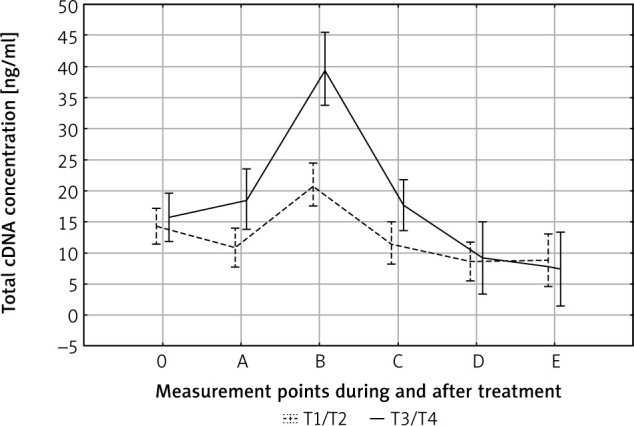
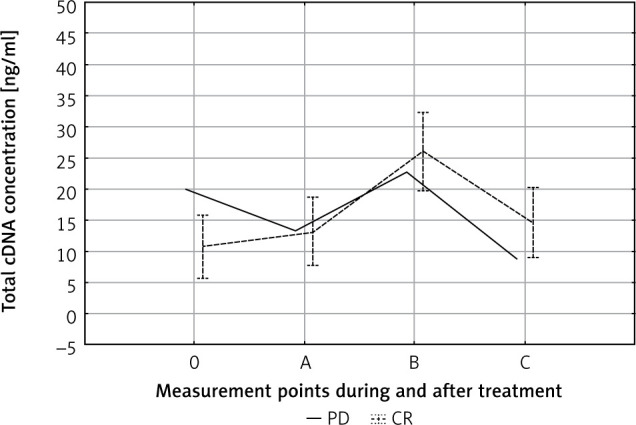
The concentration of cfDNA strongly correlated with the tumor volume ( = 0.9, = 0.00006) and number of neutrophils ( = 0.706, = 0.0069). Monitoring of cfDNA levels during treatment showed an increase after initiation of therapy, a peak at the end of treatment with significantly higher values for advanced than in T1/T2 tumors, and a decrease (T3/T4) during follow-up. However, neither the concentration of cfDNA before treatment nor its changes correlated with the response to chemoradiotherapy. There was no association between baseline cfDNA levels and T, N, age and gender.
Substantial changes in plasma cfDNA content can be observed after chemoradiotherapy for ASCC. However, the small number of cases studied makes it difficult to assess the usefulness of the cfDNA test.
循环游离DNA(cfDNA)的可获取性和非侵入性为实时连续检测开辟了新的可能性。我们分析了新诊断的肛管鳞状细胞癌(ASCC)患者中cfDNA浓度、临床因素与监测适用性之间的关系。
在治疗期间及治疗后的多个时间点采集血样。患者均接受同步放化疗。
cfDNA浓度与肿瘤体积(r = 0.9,P = 0.00006)及中性粒细胞数量(r = 0.706,P = 0.0069)密切相关。治疗期间对cfDNA水平的监测显示,治疗开始后cfDNA水平升高,治疗结束时达到峰值,晚期肿瘤的值显著高于T1/T2期肿瘤,随访期间cfDNA水平下降(T3/T4期)。然而,治疗前cfDNA的浓度及其变化均与同步放化疗的反应无关。基线cfDNA水平与T分期、N分期、年龄及性别之间均无关联。
ASCC患者同步放化疗后血浆cfDNA含量有显著变化。然而,由于研究的病例数较少,难以评估cfDNA检测的实用性。