Chen Chen, Gao Yu, Zhao Demei, Ma Zhouji, Su Yunyan, Mo Ran
Department of Nutrition, Nanjing Drum Tower Hospital, The Affiliated Hospital of Nanjing University Medical School, Nanjing, China.
Department of Burns & Plastic Surgery, Nanjing Drum Tower Hospital, The Affiliated Hospital of Nanjing University Medical School, Nanjing, China.
Front Surg. 2022 Jul 12;9:870044. doi: 10.3389/fsurg.2022.870044. eCollection 2022.
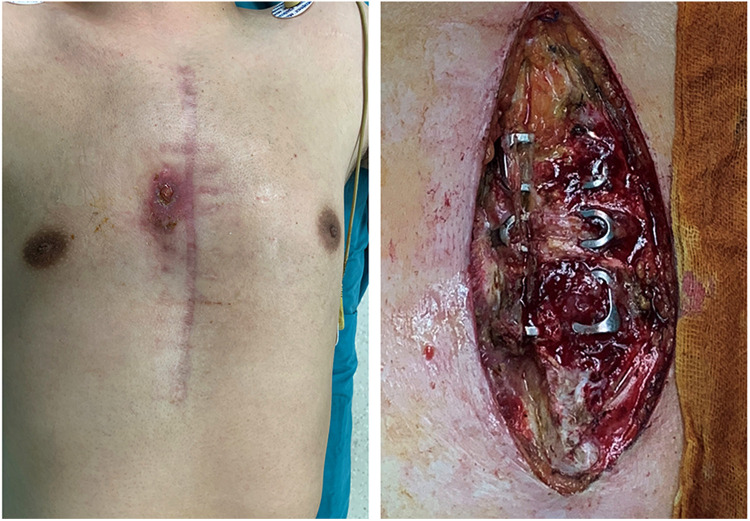
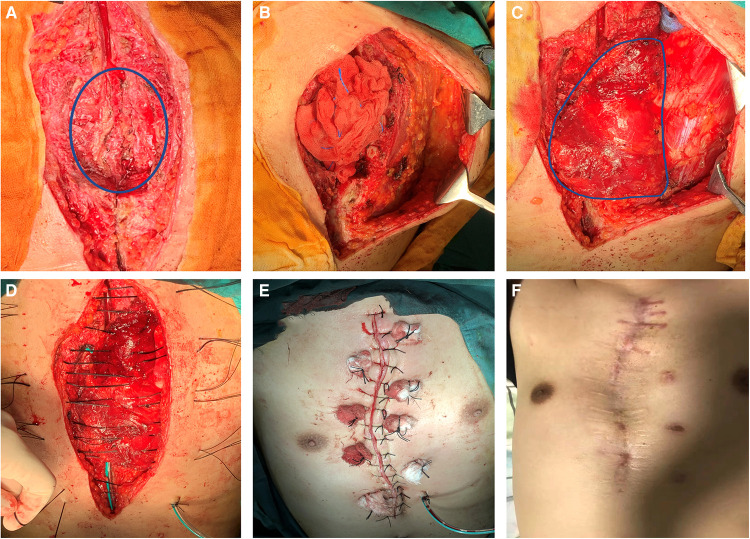
One of the most drastic complications of median sternal incision is deep sternal wound infection (DSWI), as it can lead to prolonged hospitalization, increased expected costs, re-entry into the ICU and even reoperation. Since the pectoralis major muscle flap (PMMF) technique was proposed in the 1980s, it has been widely used for sternal reconstruction after debridement. Although numerous studies on DSWI have been conducted over the years, the literature on DSWI in Chinese population remains limited. The purpose of this study was to investigate the clinical characteristics of DSWI in patients and the clinical effect of the PMMF at our institution.
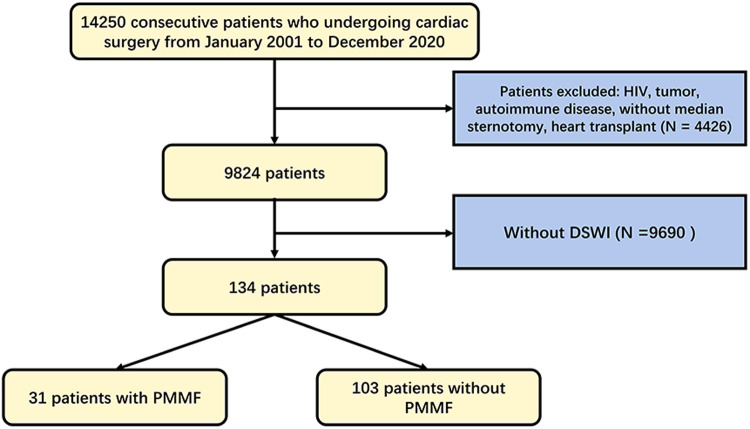
This study retrospectively analyzed all 14,250 consecutive patients who underwent cardiac surgery in the Department of Cardiothoracic Surgery of Drum Tower Hospital from 2001 to 2020. Ultimately, 134 patients were diagnosed with DSWI.,31 of whom had recently undergone radical debridement and transposition of the PMMF in the cardiothoracic surgery or burns and plastic surgery departments because of DSWIs, while the remaining patients had undergone conservative treatment or other methods of dressing debridement.
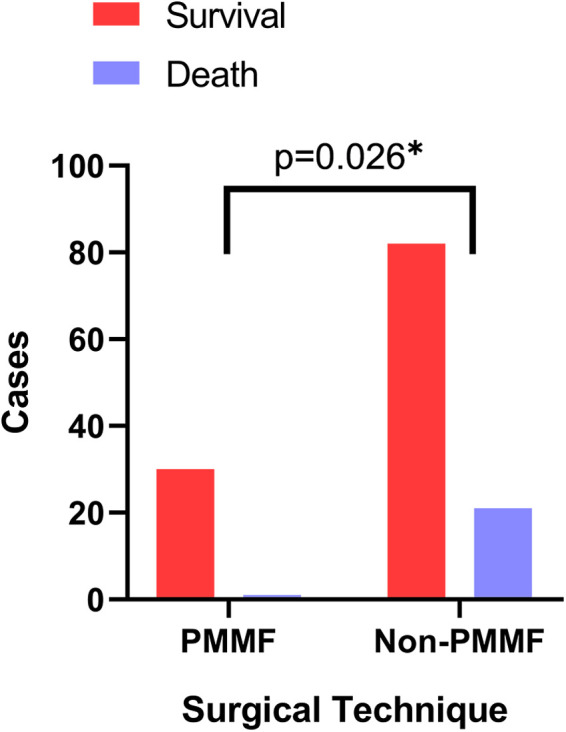
In total, 9,824 patients were enrolled in the study between 2001 and 2020, of whom 134 met the DSWI criteria and 9690 served as controls. Body mass index (OR = 1.08; = 0.02; 95% CI, 1.01∼1.16) and repeat sternotomy (OR = 5.93; < 0.01; 95% CI, 2.88∼12.25) were important risk factors for DSWI. Of the 134 patients with DSWI, 31 underwent the PMMF technique, and the remaining 103 served as controls. There were significant differences in coronary artery bypass grafting (CABG) ( < 0.01), valve replacement ( = 0.04) and repeat sternotomy ( < 0.01) between the case group and the control group. The postoperative extubation time ( < 0.001), ICU time ( < 0.001), total hospitalization time ( < 0.001) and postoperative hospitalization time ( < 0.001) in the PMMF group were significantly lower than those in the control group. The results of multivariate regression analysis showed that PMMF surgery was an important protective factor for the postoperative survival of DSWI patients (OR = 0.12; = 0.04; 95% CI, 0.01∼0.90).
Staphylococcus aureus was the most common bacteria causing DSWI, which was associated with BMI and reoperation, and can be validly treated with PMMF.
正中胸骨切开术最严重的并发症之一是深部胸骨伤口感染(DSWI),因为它会导致住院时间延长、预期费用增加、再次入住重症监护病房甚至再次手术。自20世纪80年代胸大肌肌瓣(PMMF)技术被提出以来,它已被广泛用于清创术后的胸骨重建。尽管多年来对DSWI进行了大量研究,但关于中国人群DSWI的文献仍然有限。本研究的目的是调查我院DSWI患者的临床特征以及PMMF的临床效果。
本研究回顾性分析了2001年至2020年在鼓楼医院胸心外科连续接受心脏手术的14250例患者。最终,134例患者被诊断为DSWI。其中31例因DSWI近期在胸心外科或烧伤整形科接受了根治性清创和PMMF转位术,其余患者接受了保守治疗或其他换药清创方法。
2001年至2020年共有9824例患者纳入研究,其中134例符合DSWI标准,9690例作为对照。体重指数(OR = 1.08;P = 0.02;95%CI,1.01~1.16)和再次胸骨切开术(OR = 5.93;P < 0.01;95%CI,2.88~12.25)是DSWI的重要危险因素。在134例DSWI患者中,31例行PMMF技术,其余103例作为对照。病例组和对照组在冠状动脉旁路移植术(CABG)(P < 0.01)、瓣膜置换术(P = 0.04)和再次胸骨切开术(P < 0.01)方面存在显著差异。PMMF组的术后拔管时间(P < 0.001)、重症监护病房时间(P < 0.001)、总住院时间(P < 0.001)和术后住院时间(P < 0.001)均显著低于对照组。多因素回归分析结果显示,PMMF手术是DSWI患者术后生存的重要保护因素(OR = 0.12;P = 0.04;95%CI,0.01~0.90)。
金黄色葡萄球菌是引起DSWI最常见的细菌,它与BMI和再次手术有关,PMMF可有效治疗DSWI。