Johnson Alisa J, Cole James, Fillingim Roger B, Cruz-Almeida Yenisel
Pain Research and Intervention Center of Excellence, University of Florida, Gainesville, FL, United States.
Department of Community Dentistry and Behavioral Science, College of Dentistry, University of Florida, Gainesville, FL, United States.
Front Pain Res (Lausanne). 2022 Jul 12;3:868546. doi: 10.3389/fpain.2022.868546. eCollection 2022.
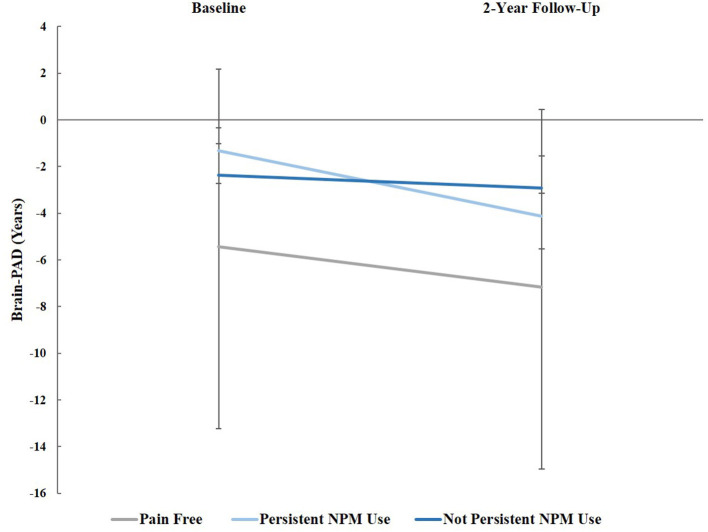
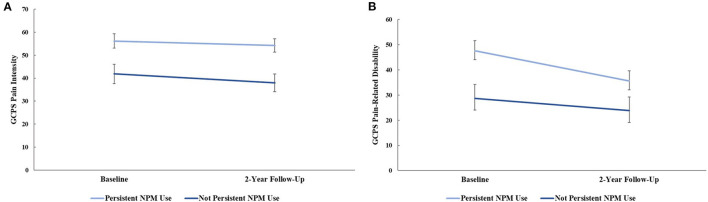
Chronic pain has been associated with changes in pain-related brain structure and function, including advanced brain aging. Non-pharmacological pain management is central to effective pain management. However, it is currently unknown how use of non-pharmacological pain management is associated with pain-related brain changes. The objective of the current study was to examine the association between brain-predicted age difference and use of non-pharmacological pain management (NPM) in a sample of middle-aged and older adults with and without chronic knee pain across two time points. One-hundred and 12 adults (mean age = 57.9 ± 8.2 years) completed sociodemographic measures, clinical pain measures, structural T1-weighted brain magnetic resonance imaging, and self-reported non-pharmacological pain management. Using a validated approach, we estimated a brain-predicted age difference (brain-PAD) biomarker, calculated as brain-predicted age minus chronological age, and the change in brain-PAD across 2 years. Repeated measures analysis of covariance was conducted to determine associations of non-pharmacological pain management and brain-PAD, adjusting for age, sex, study site, and clinical pain. There was a significant timepain/NPM interaction effect in brain-PAD ( < 0.05). Tests of simple main effects indicated that those persistently using NPM had a "younger" brain-PAD over time, suggesting a potential protective factor in persistent NPM use. Future studies are warranted to determine the influence of NPM in brain aging and pain-related neurological changes.
慢性疼痛与疼痛相关的脑结构和功能变化有关,包括脑老化加速。非药物疼痛管理是有效疼痛管理的核心。然而,目前尚不清楚非药物疼痛管理的使用与疼痛相关的脑变化之间有何关联。本研究的目的是在有和没有慢性膝关节疼痛的中年及老年成年人样本中,在两个时间点检查脑预测年龄差异与非药物疼痛管理(NPM)使用之间的关联。112名成年人(平均年龄 = 57.9 ± 8.2岁)完成了社会人口学测量、临床疼痛测量、结构性T1加权脑磁共振成像以及自我报告的非药物疼痛管理。我们采用一种经过验证的方法,估计了一种脑预测年龄差异(brain-PAD)生物标志物,计算方法为脑预测年龄减去实际年龄,并计算了两年间brain-PAD的变化。进行重复测量协方差分析以确定非药物疼痛管理与brain-PAD之间的关联,并对年龄、性别、研究地点和临床疼痛进行校正。在brain-PAD方面存在显著的时间-疼痛/NPM交互效应(<0.05)。简单主效应检验表明,持续使用NPM的人随着时间推移具有“更年轻”的brain-PAD,这表明持续使用NPM可能是一个保护因素。有必要开展未来研究以确定NPM对脑老化和疼痛相关神经变化的影响。