Lee Shina, Kim Seung-Jung
Department of Internal Medicine, School of Medicine, Ewha Womans University, Seoul, South Korea.
Front Med (Lausanne). 2022 Jul 12;9:935977. doi: 10.3389/fmed.2022.935977. eCollection 2022.
Endothelial dysfunction commonly occurs in chronic kidney disease (CKD) patients and increases the risk for cardiovascular disease. Among CKD patients, biomarkers involved in the pathogenesis of CKD-mineral bone disorder (CKD-MBD), such as phosphorus, parathyroid hormone, and fibroblast growth factor 23, are associated with endothelial dysfunction. We investigated whether these biomarkers induce endothelial dysfunction in CKD patients with normal phosphorus levels.
This cross-sectional study examined CKD patients with normal phosphorus levels; patients with an estimated glomerular filtration rate (eGFR) <15 or who were under dialysis were excluded. Iontophoresis with laser doppler flowmetry (ILDF) and peripheral arterial tonometry were performed to assess endothelial function in 85 patients. Pearson's correlation coefficient, multiple regression, and mediation analyses were performed to examine the association between CKD-MBD biomarkers and endothelial dysfunction.
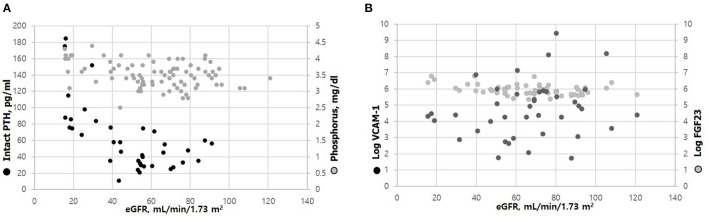
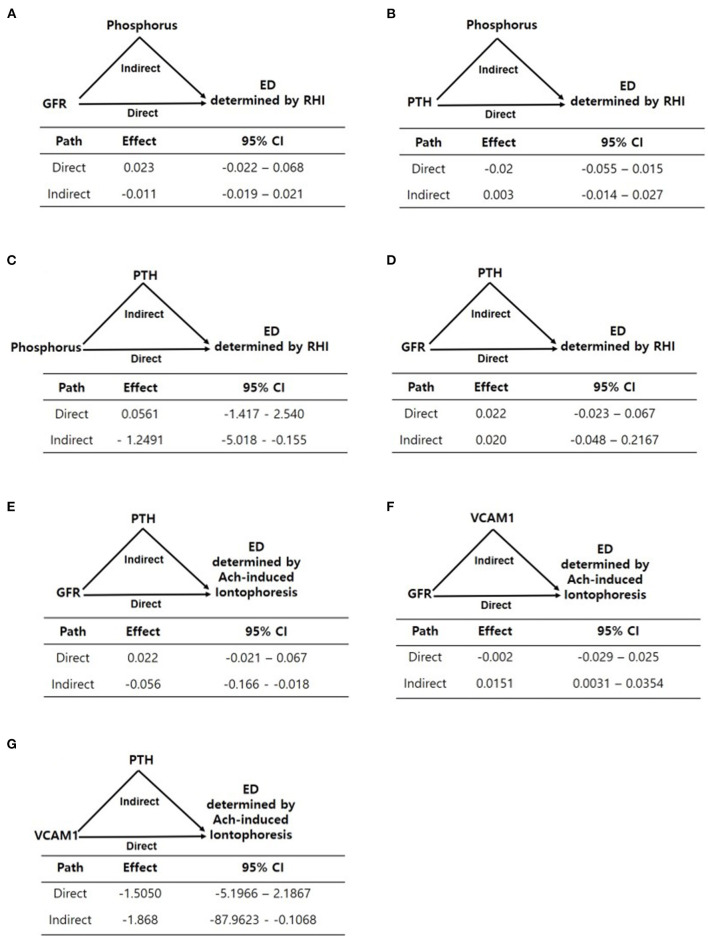
Endothelial dysfunction was observed in all subjects with a low response to ILDF and 27% of subjects according to peripheral arterial tonometry. Acetylcholine (Ach)-induced ILDF was significantly associated with eGFR ( = 0.22, = 0.04), intact parathyroid hormone (iPTH; = -0.46, < 0.01), and VCAM-1 ( = -0.36, < 0.01). The reactive hyperemia index (RHI) was significantly related to phosphorus levels ( = 0.32, < 0.01) and iPTH ( = -0.39, = 0.02). After adjusting for eGFR, iPTH and VCAM-1 remained independent factors for predicting endothelial dysfunction measured using Ach-induced ILDF. In addition, iPTH and phosphorus levels were independent predictors for endothelial dysfunction measured using RHI in the eGFR-adjusted model. Mediation analyses showed that the individual indirect effects of iPTH were significantly affected ILDF and RHI.
Serum levels of phosphorus and iPTH are associated with endothelial dysfunction, even in CKD patients with normal phosphorus levels.
内皮功能障碍常见于慢性肾脏病(CKD)患者,会增加心血管疾病风险。在CKD患者中,参与CKD-矿物质骨代谢紊乱(CKD-MBD)发病机制的生物标志物,如磷、甲状旁腺激素和成纤维细胞生长因子23,与内皮功能障碍相关。我们研究了这些生物标志物是否会在血磷水平正常的CKD患者中诱发内皮功能障碍。
这项横断面研究纳入了血磷水平正常的CKD患者;排除了估算肾小球滤过率(eGFR)<15或正在接受透析的患者。对85例患者进行了离子导入激光多普勒血流仪检查(ILDF)和外周动脉张力测量,以评估内皮功能。进行Pearson相关系数、多元回归和中介分析,以检验CKD-MBD生物标志物与内皮功能障碍之间的关联。
根据ILDF反应低下,所有受试者均存在内皮功能障碍,根据外周动脉张力测量,27%的受试者存在内皮功能障碍。乙酰胆碱(Ach)诱导的ILDF与eGFR显著相关(r = 0.22,P = 0.04)、完整甲状旁腺激素(iPTH;r = -0.46,P < 0.01)和血管细胞黏附分子-1(VCAM-1;r = -0.36,P < 0.01)。反应性充血指数(RHI)与血磷水平显著相关(r = 0.32,P < 0.01)和iPTH(r = -0.39,P = 0.02)。在调整eGFR后,iPTH和VCAM-1仍然是预测使用Ach诱导的ILDF测量的内皮功能障碍的独立因素。此外,在eGFR调整模型中,iPTH和血磷水平是使用RHI测量的内皮功能障碍的独立预测因素。中介分析表明,iPTH的个体间接效应显著影响ILDF和RHI。
即使在血磷水平正常的CKD患者中,血磷和iPTH水平也与内皮功能障碍相关。