Business School, University of Shanghai for Science and Technology, Shanghai, China.
School of Public Health, Shanghai Jiao Tong University School of Medicine, Shanghai, China.
Front Public Health. 2022 Jul 12;10:927553. doi: 10.3389/fpubh.2022.927553. eCollection 2022.
As a heavily populated megacity, Shanghai faces major epidemic risks. However, Shanghai's control of COVID-19 has been successful owing to both the strict government policy and wide community participation. Here, we investigated the impact of these stakeholders and examined who played a major role across different epidemic stages.
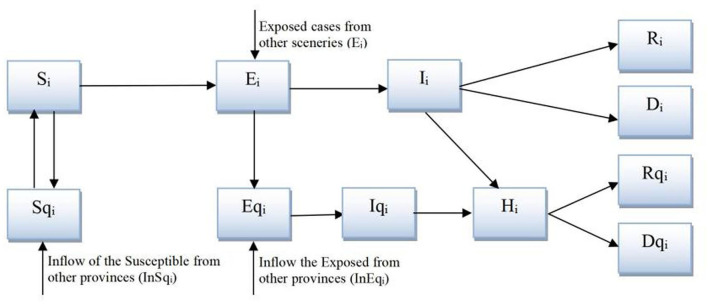
We extended the classic susceptible-exposed-infectious-recovered (SEIR) model considering the heterogeneous contact structure in four social sceneries, i.e., school, workplace, public entertainment venues, and neighborhood community, which could reflect the impact of lockdown policy and wide participation of residents happened at the community level.
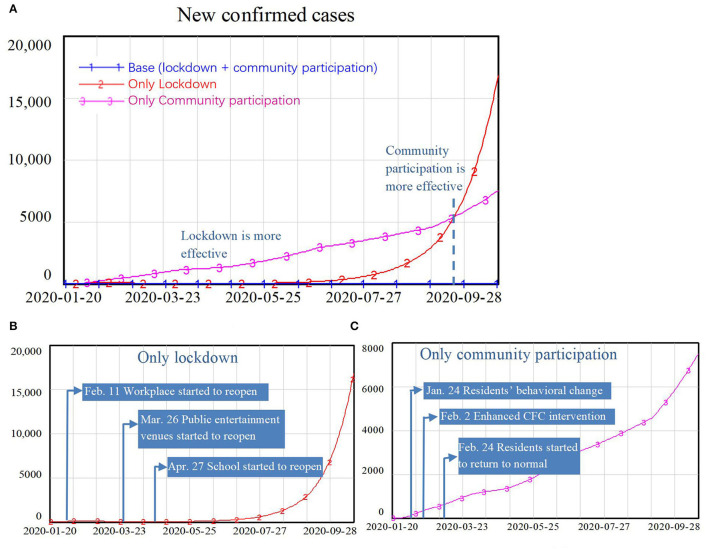
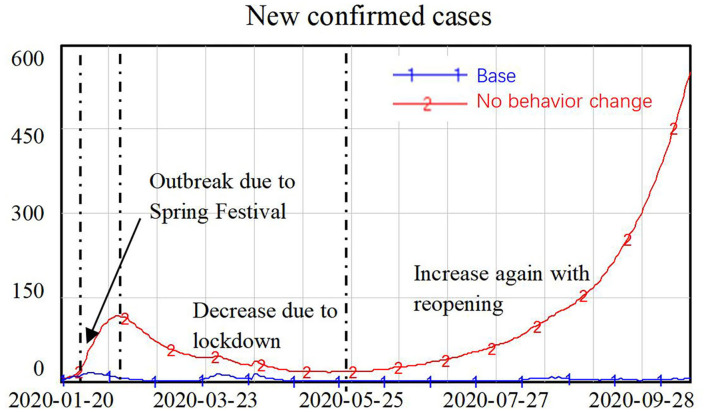
The simulation results showed that without lockdown policy and only with community participation, the daily new confirmed cases would gradually increase to more than 7,000 [292/1,000,000] at the end of Sep. However, without community participation and only with a lockdown policy, the daily new confirmed cases sharply decreased to 30 [1.2/1,000,000] at the end of the 1st month and remained low for several months. However, when a lockdown policy was gradually lifted, the new confirmed cases increased exponentially, eventually reaching more than 17,000 [708/1,000,000]. Therefore, a government lockdown policy was necessary for the rapid control of COVID-19 during the outbreak stage while community participation is more important in keeping the number of new confirmed cases low during the reopening stage.
Government lockdown policy and community participation play different roles in the control of COVID-19 at different stages of the epidemic: although the government played a leading role in setting up policies, the broader participation of community fever clinics (CFCs) and the general public were especially crucial in winning the battle against COVID-19 in the long run.
作为一个人口稠密的特大城市,上海面临着重大的疫情风险。然而,由于政府的严格政策和广泛的社区参与,上海成功地控制了 COVID-19。在这里,我们调查了这些利益相关者的影响,并研究了在不同疫情阶段谁发挥了主要作用。
我们扩展了经典的易感-暴露-感染-恢复(SEIR)模型,考虑了学校、工作场所、公共娱乐场所和社区四个社会场景中的异质接触结构,这可以反映封锁政策和社区层面居民广泛参与的影响。
模拟结果表明,如果没有封锁政策,只有社区参与,每天新确诊的病例将逐渐增加到 7000 多例[292/100 万]在 9 月底。然而,如果没有社区参与,只有封锁政策,每天新确诊的病例将急剧下降到 30 例[1.2/100 万]在第一个月结束时,并且在几个月内保持低位。然而,当封锁政策逐渐放宽时,新确诊的病例呈指数增长,最终超过 17000 例[708/100 万]。因此,政府封锁政策对于疫情爆发阶段 COVID-19 的快速控制是必要的,而社区参与对于重新开放阶段新确诊病例数量的保持较低水平更为重要。
政府封锁政策和社区参与在疫情的不同阶段对 COVID-19 的控制发挥着不同的作用:尽管政府在制定政策方面发挥了主导作用,但社区发热门诊(CFC)和广大公众的更广泛参与对于长期战胜 COVID-19 尤为关键。