He Zonglin, Chiu Joyce Wai-Ting, Lin Yuchen, Akinwunmi Babatunde, Wong Tak Hap, Zhang Casper J P, Ming Wai-Kit
Department of Infectious Diseases and Public Health, Jockey Club College of Veterinary Medicine and Life Science, City University of Hong Kong, Hong Kong, Hong Kong SAR, China.
Division of Life Science, The Hong Kong University of Science and Technology, Hong Kong, Hong Kong SAR, China.
Front Psychiatry. 2022 Jul 12;13:796567. doi: 10.3389/fpsyt.2022.796567. eCollection 2022.
The present study aimed to investigate the construct structure behind the psychosocial response, behavioral response, prenatal depression, and post-traumatic stress disorder (PTSD) in pregnant women during the COVID-19 pandemic in China.
The validated Chinese version of the Edinburgh Postnatal Depression Scale (EPDS), PTSD CheckList (PCL)-6, and two newly established scales for COVID-19-related psychological and behavioral responses were used. Structural equation modeling (SEM) analysis was applied to evaluate the structural relationships of psychological and behavioral responses during the COVID-19 pandemic.
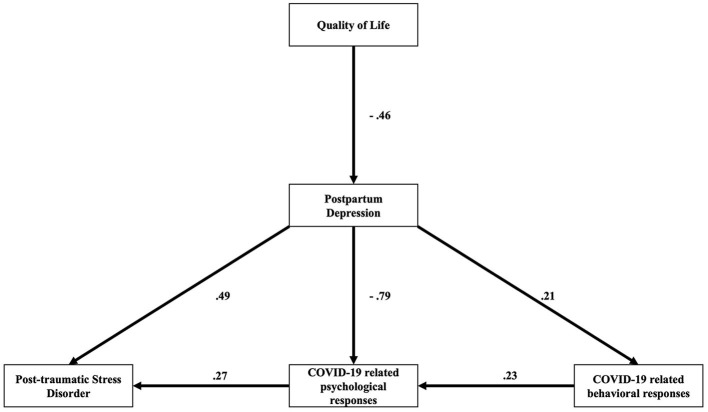
Of the 1,908 mothers who completed the questionnaires, 1,099 met the criteria for perinatal depression, and 287 were positively screened for PTSD, where 264 women exceed the cut-off points for both. Pregnant women with full-time or part-time jobs tended to have the lowest scores of EPDS (10.07 ± 5.11, < 0.001) and stress levels (23.85 ± 7.96, = 0.004), yet they were more likely to change their behavior in accordance with the COVID-19 outbreak (13.35 ± 3.42, = 0.025). The structural model fit the data (χ = 43.260, < 0.001) and resulted in satisfactory fit indices (CFI = 0.984, TLI = 0.959, RMSEA = 0.072, and χ/d = 10.815), all path loadings were significant ( < 0.05). The SEM indicates that the level of QoL was attributable to the occurrence of PND, leading to PTSD, and COVID-19 related behavioral and psychological responses.
The inter-relationships between the COVID-19-related psychosocial and behavioral responses have been assessed, indicating that the pandemic increased the burden of perinatal depression. Psychoeducation, as well as other psychological interventions, may be needed to alleviate the COVID-19-based anxiety and increase their engagement in protective behaviors.
本研究旨在探究中国新冠疫情期间孕妇心理社会反应、行为反应、产前抑郁及创伤后应激障碍(PTSD)背后的结构关系。
使用经过验证的中文版爱丁堡产后抑郁量表(EPDS)、创伤后应激障碍检查表(PCL)-6以及两个新建立的与新冠疫情相关心理和行为反应的量表。采用结构方程模型(SEM)分析来评估新冠疫情期间心理和行为反应的结构关系。
在1908名完成问卷的母亲中,1099名符合围产期抑郁标准,287名PTSD筛查呈阳性,其中264名女性两项均超过临界值。全职或兼职工作的孕妇EPDS得分往往最低(10.07±5.11,<0.001)且压力水平最低(23.85±7.96,=0.004),但她们更有可能根据新冠疫情爆发改变行为(13.35±3.42,=0.025)。结构模型拟合数据(χ=43.260,<0.001),并得出令人满意的拟合指数(CFI=0.984,TLI=0.959,RMSEA=0.072,χ/d=10.815),所有路径负荷均显著(<0.05)。SEM表明生活质量水平归因于产后抑郁的发生,进而导致PTSD以及与新冠疫情相关的行为和心理反应。
已评估了与新冠疫情相关的心理社会和行为反应之间的相互关系,表明疫情增加了围产期抑郁负担。可能需要进行心理教育以及其他心理干预,以减轻基于新冠疫情的焦虑,并增加她们参与保护行为的程度。