Department of Cardiology Sun Yat-Sen Memorial Hospital, Sun Yat-Sen University Guangzhou China.
Guangdong Province Key Laboratory of Arrhythmia and Electrophysiology Guangzhou China.
J Am Heart Assoc. 2022 Aug 2;11(15):e024302. doi: 10.1161/JAHA.121.024302. Epub 2022 Jul 29.
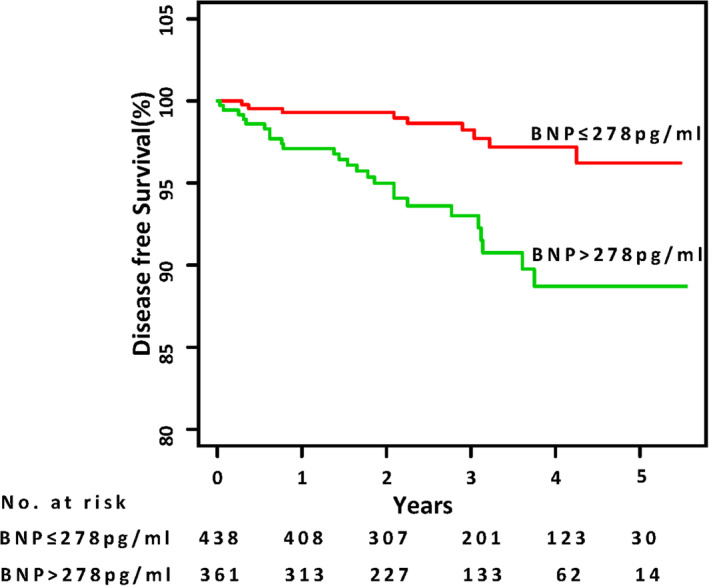
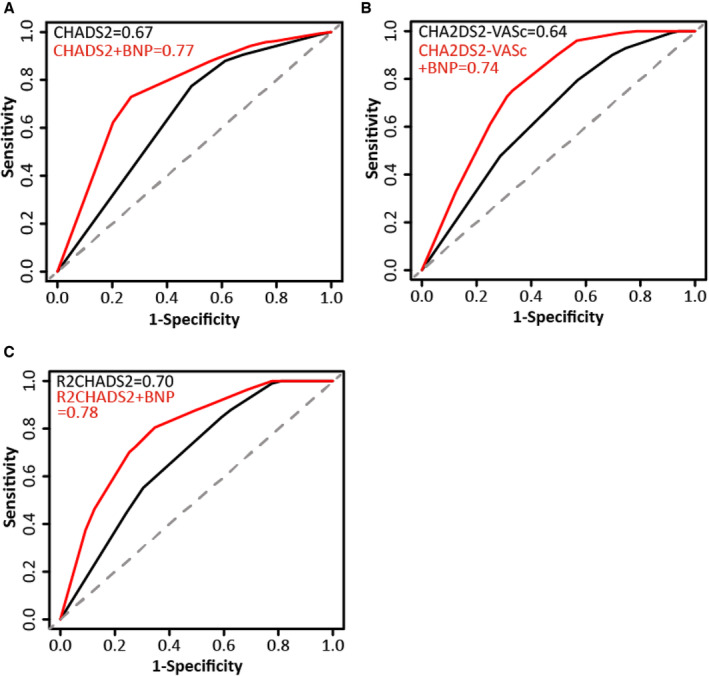
Background B-type natriuretic peptide (BNP) is a well-known biomarker for prognosis in heart failure with patients with preserved ejection fraction. However, the clinical predictive ability of BNP for the risk of stroke in HFpEF is not clear. Methods and Results A total of 799 patients with HFpEF from the TOPCAT (Treatment of Preserved Cardiac Function Heart Failure With an Aldosterone Antagonist) trial were included. Association of baseline BNP with risk of stroke was assessed using the Cox proportional hazard model. The discriminatory ability of BNP was expressed using the C index. The improvement in 5-year stroke prediction was assessed by C statistic, categorical net reclassification improvement index, and relative integrated discrimination improvement. A total of 34 (4.3%) patients among the 799 patients with HFpEF experienced stroke events over a median of 2.85 years of follow-up. The stroke group showed a higher BNP level than the nonstroke group (375 pg/mL versus 241 pg/mL, respectively; =0.006). Higher BNP levels were associated with increased risk of stroke after multivariable adjustment (hazard ratio, 3.29 [95% CI, 1.51-7.16]) and had a moderate performance for stroke prediction (C index, 0.67). Adding BNP to CHADS/CHADS-VASc/RCHADS scores improved their predictive value for stroke (CHADS: C index, 0.67; BNP+CHADS: C index, 0.77; net reclassification improvement, 40.9%; integrated discrimination improvement, 3.0%; CHADS-VASc: C index, 0.64; BNP+CHADS-VASc: C index, 0.74; net reclassification improvement, 41.4%; integrated discrimination improvement, 2.2%; RCHADS: C index, 0.70; BNP+RCHADS: C index, 0.78; net reclassification improvement, 40.9%; integrated discrimination improvement, 3.2%). Conclusions BNP is associated with an increased risk of stroke in patients with HFpEF and may be a valuable biomarker for stroke prediction in HFpEF.
背景 B 型利钠肽(BNP)是射血分数保留的心力衰竭患者预后的一个著名生物标志物。然而,BNP 对 HFpEF 患者中风风险的临床预测能力尚不清楚。
方法和结果 共纳入了 TOPCAT(醛固酮拮抗剂治疗射血分数保留的心力衰竭)试验中的 799 例 HFpEF 患者。使用 Cox 比例风险模型评估基线 BNP 与中风风险的相关性。使用 C 指数表示 BNP 的区分能力。通过 C 统计量、分类净重新分类改善指数和相对综合判别改善来评估 5 年中风预测的改善情况。在中位随访 2.85 年期间,799 例 HFpEF 患者中共有 34 例(4.3%)发生中风事件。中风组的 BNP 水平高于非中风组(分别为 375pg/ml 和 241pg/ml,=0.006)。多变量调整后,较高的 BNP 水平与中风风险增加相关(危险比,3.29[95%CI,1.51-7.16]),并且对中风预测具有中等的性能(C 指数,0.67)。将 BNP 添加到 CHADS/CHADS-VASc/RCHADS 评分中可提高其对中风的预测价值(CHADS:C 指数,0.67;BNP+CHADS:C 指数,0.77;净重新分类改善,40.9%;综合判别改善,3.0%;CHADS-VASc:C 指数,0.64;BNP+CHADS-VASc:C 指数,0.74;净重新分类改善,41.4%;综合判别改善,2.2%;RCHADS:C 指数,0.70;BNP+RCHADS:C 指数,0.78;净重新分类改善,40.9%;综合判别改善,3.2%)。
结论 BNP 与 HFpEF 患者中风风险增加相关,可能是 HFpEF 患者中风预测的有价值的生物标志物。