Lee Sae Mi, Ryu Ki-Jin, Son Serhim, Lee Yeon Ju, Park Hyuntae, Kim Tak
Department of Obstetrics and Gynecology, Korea University Anam Hospital, Korea University College of Medicine, Seoul, Korea.
Department of Biostatistics, Korea University Anam Hospital, Korea University College of Medicine, Seoul, Korea.
Obstet Gynecol Sci. 2022 Sep;65(5):468-476. doi: 10.5468/ogs.22001. Epub 2022 Jul 29.
To evaluate menopause-related changes in body fat distribution and their relationship with insulin resistance in middleaged Korean women.
We analyzed women aged 40-60 years using data from the National Health and Nutrition Examination Survey conducted from 2008 to 2011. Body fat was measured using dual-energy X-ray absorptiometry. Insulin resistance was assessed using the homeostasis model assessment of insulin resistance (HOMA-IR).
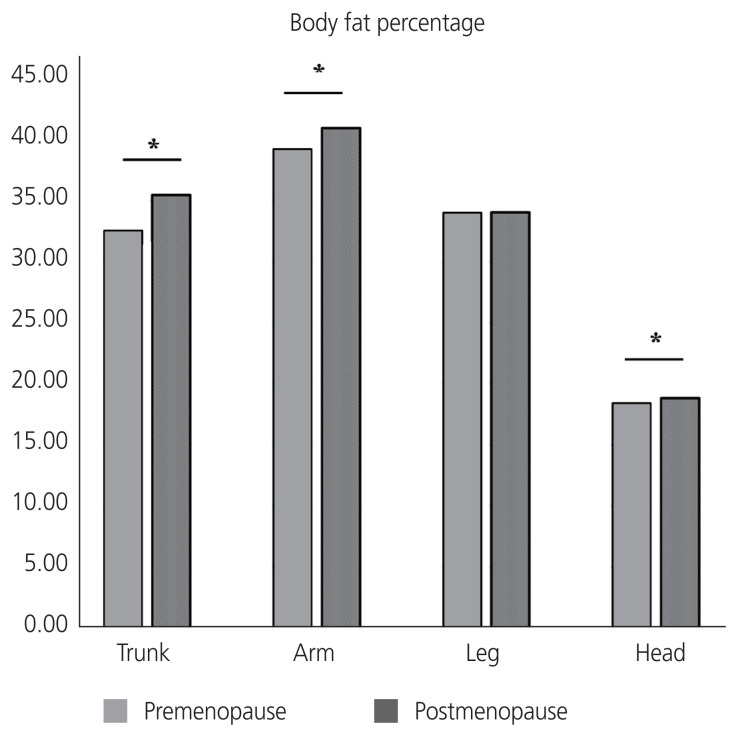
Among 3,468 participants, menopausal women (n=1,489) had a higher body mass index (BMI) and higher trunk, arm, and head fat percentages than premenopausal women (n=1,979). However, no significant difference was found in the leg fat percentage according to menopausal status. Multivariable regression analysis for HOMA-IR showed that trunk fat percentage, BMI, and waist circumference positively correlated with insulin resistance and leg fat percentage negatively correlated after adjusting for several confounding factors, whereas menopausal status was not associated with HOMAIR.
Middle-aged women not only have different body weights and BMI but also have different body fat distributions according to menopausal status. Each fat percentage change in the trunk and leg is differently associated with metabolic health, particularly insulin resistance. To evaluate the metabolic health of middle-aged women, BMI is generally noted; however, body fat distribution, which can be easily assessed using dual-energy X-ray absorptiometry, should also be considered.
评估韩国中年女性与绝经相关的体脂分布变化及其与胰岛素抵抗的关系。
我们使用2008年至2011年进行的全国健康与营养检查调查的数据,对40 - 60岁的女性进行了分析。使用双能X线吸收法测量体脂。使用胰岛素抵抗稳态模型评估(HOMA-IR)来评估胰岛素抵抗。
在3468名参与者中,绝经女性(n = 1489)的体重指数(BMI)以及躯干、手臂和头部的脂肪百分比均高于绝经前女性(n = 1979)。然而,根据绝经状态,腿部脂肪百分比未发现显著差异。对HOMA-IR进行多变量回归分析显示,在调整了几个混杂因素后,躯干脂肪百分比、BMI和腰围与胰岛素抵抗呈正相关,腿部脂肪百分比与胰岛素抵抗呈负相关,而绝经状态与HOMA-IR无关。
中年女性不仅体重和BMI不同,而且根据绝经状态体脂分布也不同。躯干和腿部的各脂肪百分比变化与代谢健康,尤其是胰岛素抵抗的关联各不相同。为评估中年女性的代谢健康,通常会关注BMI;然而,使用双能X线吸收法可轻松评估的体脂分布也应予以考虑。