Department of Nursing, West China Second University Hospital, Sichuan University, No. 20, Section 3, People's South Road, 610041, Chengdu, Sichuan, China.
Key Laboratory of Birth Defects and Related Diseases of Women and Children, Sichuan University, Ministry of Education, Chengdu, Sichuan, China.
BMC Public Health. 2024 Mar 28;24(1):914. doi: 10.1186/s12889-024-18405-0.
Nutritional status is a modifiable factor associated with perimenopausal women's health and quality of life. Assessing body composition indicators helps to comprehensively understand nutritional status compared with using body mass index (BMI) only. However, few published studies measured the trends in body composition among perimenopausal women.
To assess the one-year trajectory of the nutritional status of perimenopausal women and to explore its influential factors.
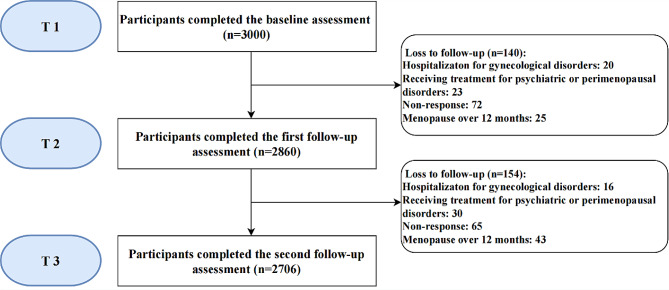
A community-based observational study with 3-wave repeated measurements at 6-month intervals was carried out. The nutritional status indicators include weight, body mass index (BMI), and body composition variables. Bioelectrical impedance analysis was used to assess body composition. Repeated measures ANOVA and Chi-square test were used to calculate the changes in nutritional status and generalized estimating equations were performed to explore their influential factors.
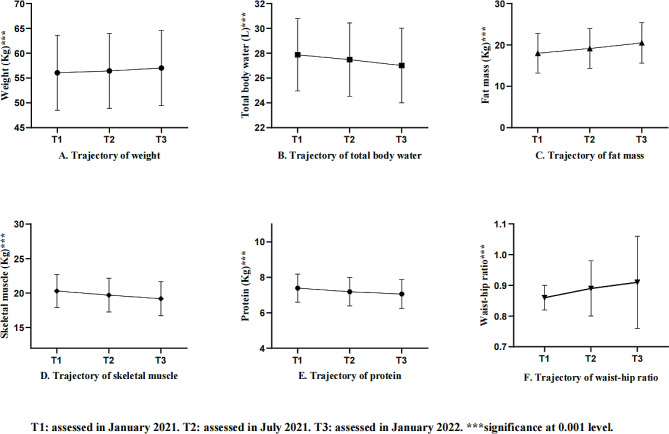
2760 participants completed the study. Increasing trajectories in weight (from 56.05 ± 7.55 to 57.02 ± 7.60), fat mass (from 17.99 ± 4.80 to 20.49 ± 4.90), and waist-hip ratio (from 0.86 ± 0.04 to 0.91 ± 0.15) were found (P < 0.001). Decreasing trajectories in skeletal muscle (from 20.30 ± 2.38 to 19.19 ± 2.46), protein level (from 7.39 ± 0.79 to 7.06 ± 0.81), and total body water (from 27.87 ± 2.92 to 27.00 ± 3.01) were found (P < 0.001). Being married/unmarried with a partner and without negative life events were associated with higher total body water, skeletal muscle, and protein level, while negatively associated with fat mass and waist-hip ratio. Age was positively associated with fat mass (P < 0.001). Participants with junior high school education were prone to increased fat mass (P = 0.018) compared with those holding primary school education and below. A per capita monthly income of 1500 to 3000 Yuan was associated with higher total body water, skeletal muscle, and protein level (P < 0.001) compared with a per capita monthly income of less than 1500 Yuan.
Worsening nutritional status exists in perimenopausal women, which is characterized by increased weight, fat mass, and waist-hip ratio, and decreased skeletal muscle, total body water, and protein level. For greater efficiency, precision nutritional interventions are needed, and recipients should be classified into different risk levels based on their sociodemographic background.
营养状况是与围绝经期妇女健康和生活质量相关的可改变因素。与仅使用体重指数(BMI)相比,评估身体成分指标有助于更全面地了解营养状况。然而,很少有发表的研究测量围绝经期妇女的身体成分趋势。
评估围绝经期妇女营养状况的一年轨迹,并探讨其影响因素。
进行了一项基于社区的观察性研究,采用 6 个月间隔的 3 次重复测量。营养状况指标包括体重、体重指数(BMI)和身体成分变量。生物电阻抗分析用于评估身体成分。重复测量方差分析和卡方检验用于计算营养状况的变化,广义估计方程用于探讨其影响因素。
2760 名参与者完成了这项研究。体重(从 56.05±7.55 增加到 57.02±7.60)、脂肪量(从 17.99±4.80 增加到 20.49±4.90)和腰臀比(从 0.86±0.04 增加到 0.91±0.15)呈增加趋势(P<0.001)。骨骼肌(从 20.30±2.38 减少到 19.19±2.46)、蛋白质水平(从 7.39±0.79 减少到 7.06±0.81)和总身体水分(从 27.87±2.92 减少到 27.00±3.01)呈下降趋势(P<0.001)。已婚/未婚且有伴侣以及没有负性生活事件与更高的总身体水分、骨骼肌和蛋白质水平相关,而与脂肪量和腰臀比呈负相关。年龄与脂肪量呈正相关(P<0.001)。与小学及以下学历相比,初中及以上学历的参与者更容易增加脂肪量(P=0.018)。人均月收入在 1500 至 3000 元之间与更高的总身体水分、骨骼肌和蛋白质水平相关(P<0.001),而人均月收入低于 1500 元则与更高的总身体水分、骨骼肌和蛋白质水平相关。
围绝经期妇女的营养状况恶化,表现为体重、脂肪量和腰臀比增加,骨骼肌、总身体水分和蛋白质水平下降。为了提高效率,需要进行精确的营养干预,并且应根据社会人口背景将受助者分为不同的风险水平。