Department of Cardiology, Corporate Member of Freie Universität Berlin and Humboldt-Universität zu Berlin, Charité - Universitätsmedizin Berlin, Augustenburger Platz 1, 13353, Berlin, Germany.
Department of Experimental Surgery, Corporate Member of Freie Universität Berlin and Humboldt-Universität zu Berlin, Charité - Universitätsmedizin Berlin, Augustenburger Platz 1, 13353, Berlin, Germany.
BMC Cardiovasc Disord. 2022 Aug 1;22(1):345. doi: 10.1186/s12872-022-02792-6.
Arterial stiffness is a common characteristic in patients with chronic heart failure (CHF), and arterial tonometric technologies related to arterial stiffness are novel and effective methods and have an important value in the diagnosis and prognosis of CHF. In terms of ameliorating arterial stiffness in patients with CHF, exercise training is considered an adjuvant treatment and also an effective means in the diagnosis and judgment of prognosis. However, there are huge controversies and inconsistencies in these aspects. The objective of this meta-analysis was to systematically test the connection of arterial tonometry and exercise in patients with CHF.
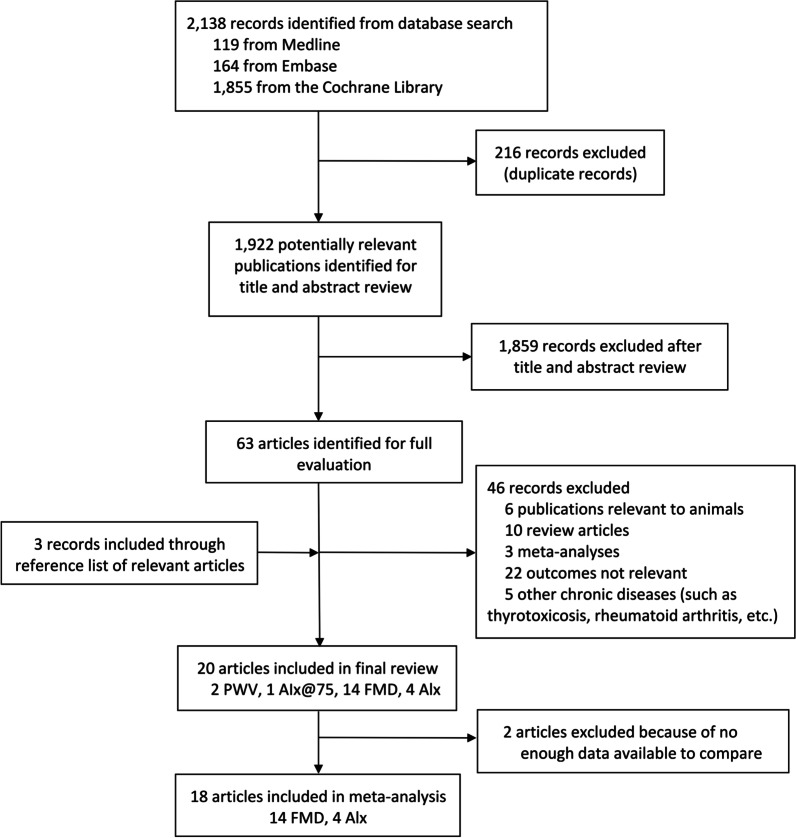
Databases, including MEDLINE, EMBASE, and Cochrane Central Register of Controlled Trials (CENTRAL) in The Cochrane Library, were accessed from inception to 7 March 2022. The meta-analysis was then conducted, and trial sequential analysis (TSA) was performed jointly to further verify our tests and reach more convincing conclusions by using RevMan version 5.4 software, STATA version 16.0 software, and TSA version 0.9.5.10 Beta software.
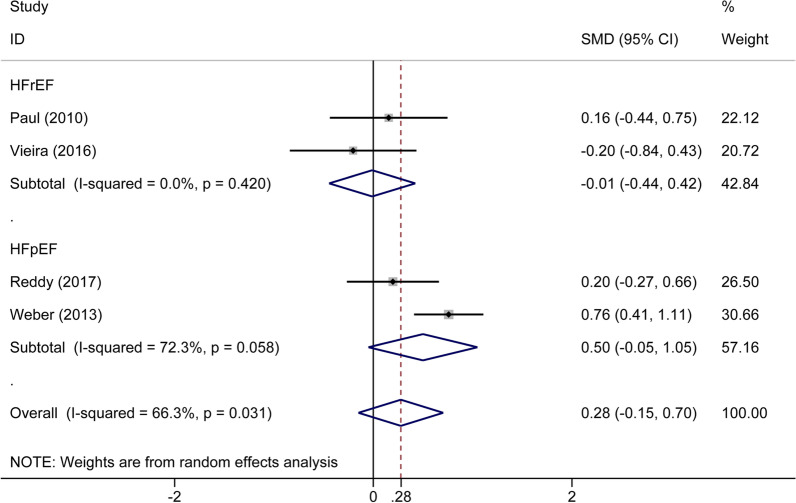
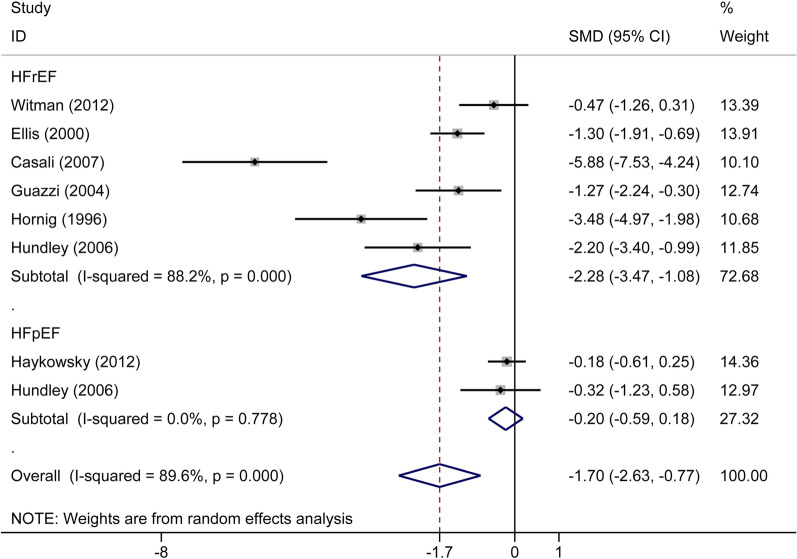
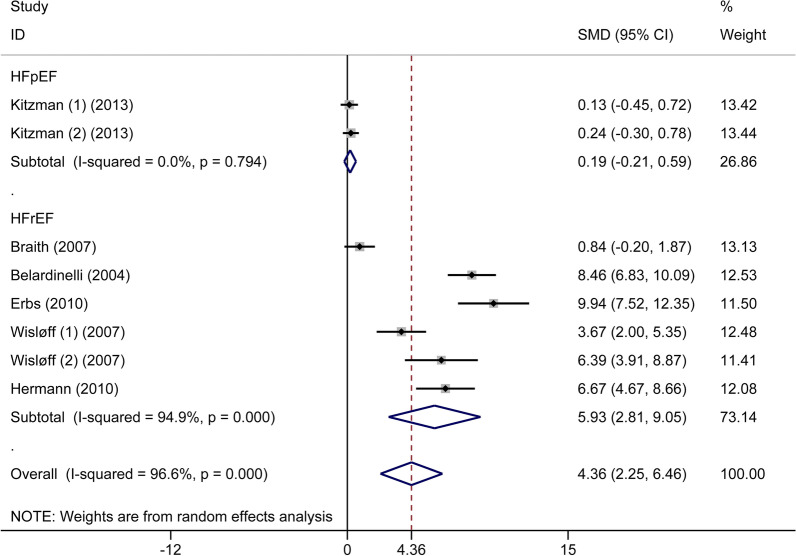
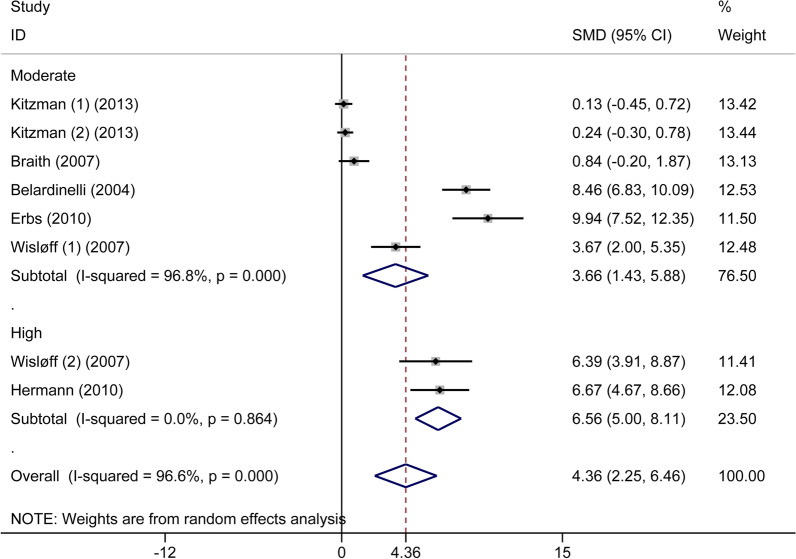
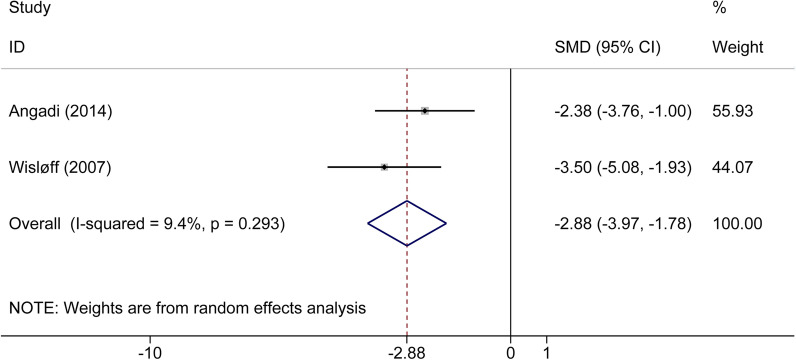
Eighteen articles were included, with a total of 876 participants satisfying the inclusion criteria. The pooling revealed that flow-mediated dilation (FMD) was lower in basal condition [standardized mean difference (SMD): - 2.28%, 95% confidence interval (CI) - 3.47 to - 1.08, P < 0.001] and improved significantly after exercise (SMD: 5.96%, 95% CI 2.81 to 9.05, P < 0.001) in patients with heart failure with reduced ejection fraction (HFrEF) compared with healthy participants. The high-intensity training exercise was more beneficial (SMD: 2.88%, 95% CI 1.78 to 3.97, P < 0.001) than the moderate-intensity training exercise to improve FMD in patients with CHF. For augmentation index (AIx), our study indicated no significant differences (SMD: 0.50%, 95% CI - 0.05 to 1.05, P = 0.074) in patients with heart failure with preserved ejection fraction (HFpEF) compared with healthy participants. However, other outcomes of our study were not identified after further verification using TSA, and more high-quality studies are needed to reach definitive conclusions in the future.
This review shows that FMD is lower in basal condition and improves significantly after exercise in patients with HFrEF compared with healthy population; high-intensity training exercise is more beneficial than moderate-intensity training exercise to improve FMD in patients with CHF; besides, there are no significant differences in AIx in patients with HFpEF compared with the healthy population. More high-quality studies on this topic are warranted.
动脉僵硬度是慢性心力衰竭(CHF)患者的常见特征,与动脉僵硬度相关的动脉张力测量技术是新颖且有效的方法,在 CHF 的诊断和预后中有重要价值。在改善 CHF 患者的动脉僵硬度方面,运动训练被认为是一种辅助治疗方法,也是诊断和判断预后的有效手段。然而,在这些方面存在巨大的争议和不一致。本荟萃分析的目的是系统地检验动脉张力测量和 CHF 患者运动之间的关系。
从建库起至 2022 年 3 月 7 日,我们检索了 MEDLINE、EMBASE 和 Cochrane 图书馆中的 Cochrane 对照试验中心注册库(CENTRAL)等数据库。然后进行荟萃分析,并联合进行试验序贯分析(TSA),使用 RevMan 版本 5.4 软件、STATA 版本 16.0 软件和 TSA 版本 0.9.5.10 Beta 软件进一步验证我们的检验,并通过使用这些软件得出更有说服力的结论。
共纳入 18 篇文章,共有 876 名符合纳入标准的参与者。汇总结果显示,射血分数降低的心力衰竭(HFrEF)患者的血流介导的扩张(FMD)在基础状态下较低[标准化均数差(SMD):-2.28%,95%置信区间(CI):-3.47 至-1.08,P<0.001],运动后显著改善(SMD:5.96%,95%CI:2.81 至 9.05,P<0.001),与健康参与者相比。与中等强度训练相比,高强度训练更有益于(SMD:2.88%,95%CI:1.78 至 3.97,P<0.001)改善 CHF 患者的 FMD。对于增强指数(AIx),我们的研究表明,射血分数保留的心力衰竭(HFpEF)患者与健康参与者相比无显著差异(SMD:0.50%,95%CI:-0.05 至 1.05,P=0.074)。然而,我们使用 TSA 进一步验证后,没有发现其他研究结果,未来需要更多高质量的研究来得出明确的结论。
本综述表明,与健康人群相比,HFrEF 患者的 FMD 在基础状态下较低,运动后显著改善;与中等强度训练相比,高强度训练更有益于改善 CHF 患者的 FMD;HFpEF 患者的 AIx 与健康人群相比无显著差异。需要更多关于这个主题的高质量研究。