Integrative Biosciences Center, Department of Biological Sciences, Wayne State University, Detroit, MI, United States.
C.S. Mott Center for Human Growth and Development, Department of Obstetrics and Gynecology School of Medicine, Wayne State University, Detroit, MI, United States.
Front Endocrinol (Lausanne). 2022 Jul 11;13:938094. doi: 10.3389/fendo.2022.938094. eCollection 2022.
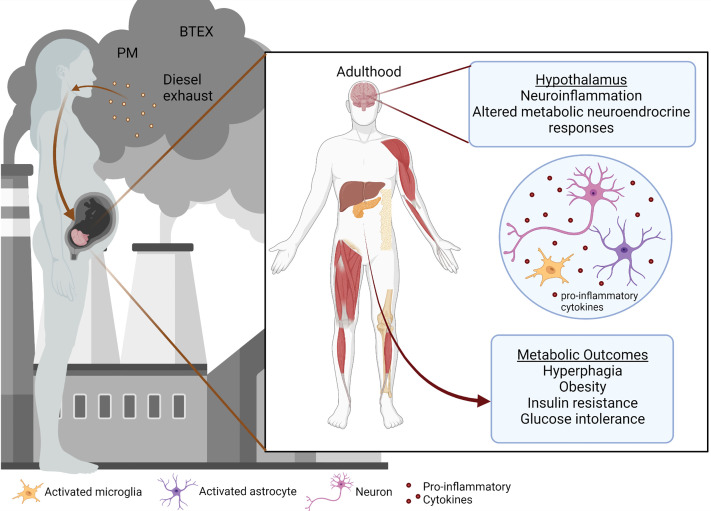
Environmental contaminants in ambient air pollution pose a serious risk to long-term metabolic health. Strong evidence shows that prenatal exposure to pollutants can significantly increase the risk of Type II Diabetes (T2DM) in children and all ethnicities, even without the prevalence of obesity. The central nervous system (CNS) is critical in regulating whole-body metabolism. Within the CNS, the hypothalamus lies at the intersection of the neuroendocrine and autonomic systems and is primarily responsible for the regulation of energy homeostasis and satiety signals. The hypothalamus is particularly sensitive to insults during early neurodevelopmental periods and may be susceptible to alterations in the formation of neural metabolic circuitry. Although the precise molecular mechanism is not yet defined, alterations in hypothalamic developmental circuits may represent a leading cause of impaired metabolic programming. In this review, we present the current knowledge on the links between prenatal pollutant exposure and the hypothalamic programming of metabolism.
环境污染物在大气污染中构成严重的长期代谢健康风险。强有力的证据表明,即使在没有肥胖流行的情况下,产前暴露于污染物也会显著增加儿童和所有种族人群患 II 型糖尿病(T2DM)的风险。中枢神经系统(CNS)在调节全身代谢中起着关键作用。在 CNS 内,下丘脑位于神经内分泌和自主神经系统的交汇处,主要负责调节能量平衡和饱腹感信号。下丘脑在早期神经发育期间对损伤特别敏感,并且可能容易受到神经代谢回路形成的改变。尽管确切的分子机制尚未确定,但下丘脑发育回路的改变可能代表代谢编程受损的主要原因。在这篇综述中,我们介绍了产前污染物暴露与代谢的下丘脑编程之间联系的最新知识。