Zhou Yujing, Zhao Shengwen, Wu Tong, Zhang Han
Department of Nuclear Medicine, Harbin Medical University Cancer Hospital, Harbin, China.
Department of Radiology, Heilongjiang Academy of Traditional Chinese Medicine, Harbin, China.
Front Pharmacol. 2022 Jul 13;13:968163. doi: 10.3389/fphar.2022.968163. eCollection 2022.
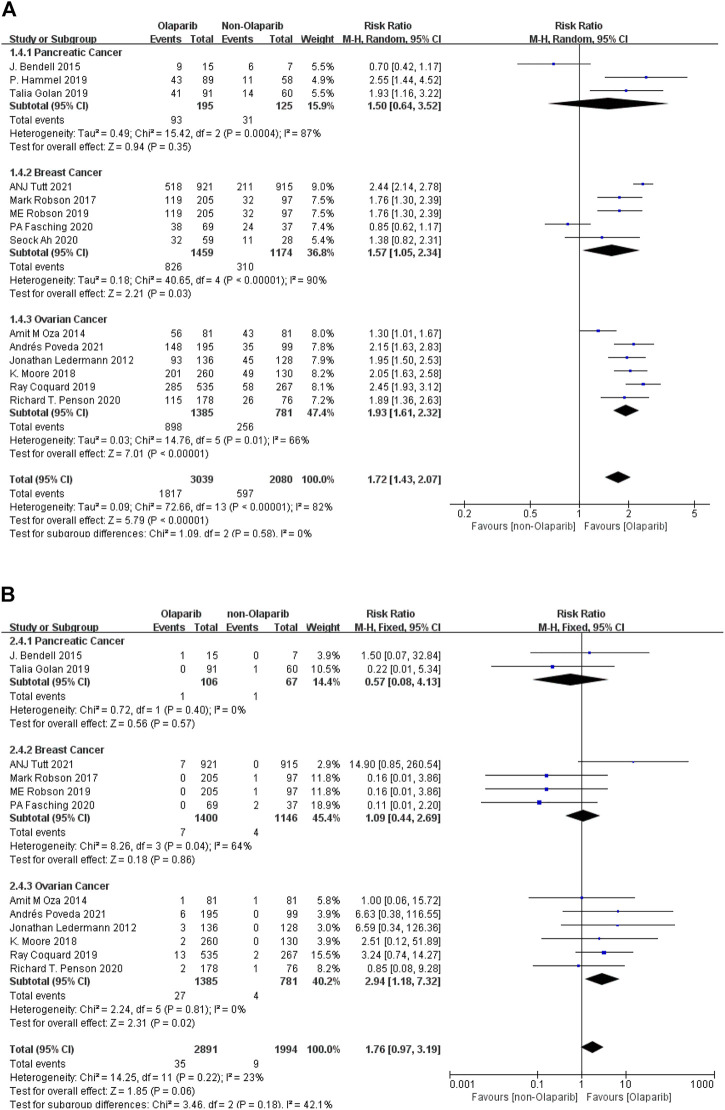
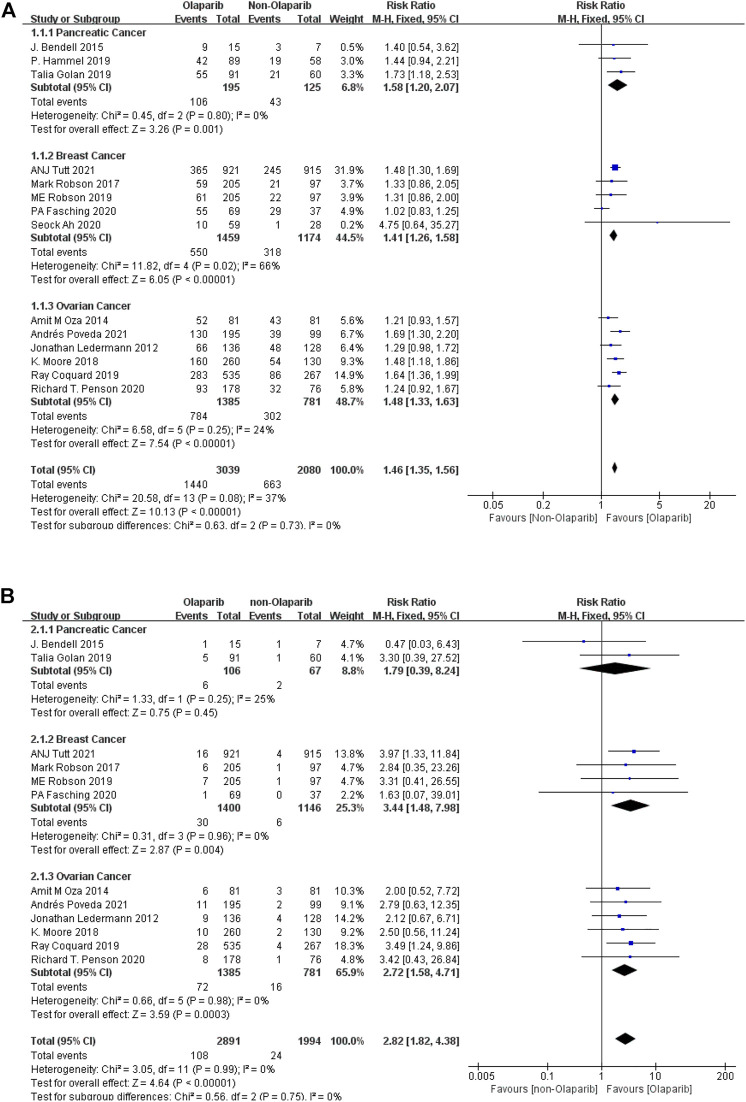
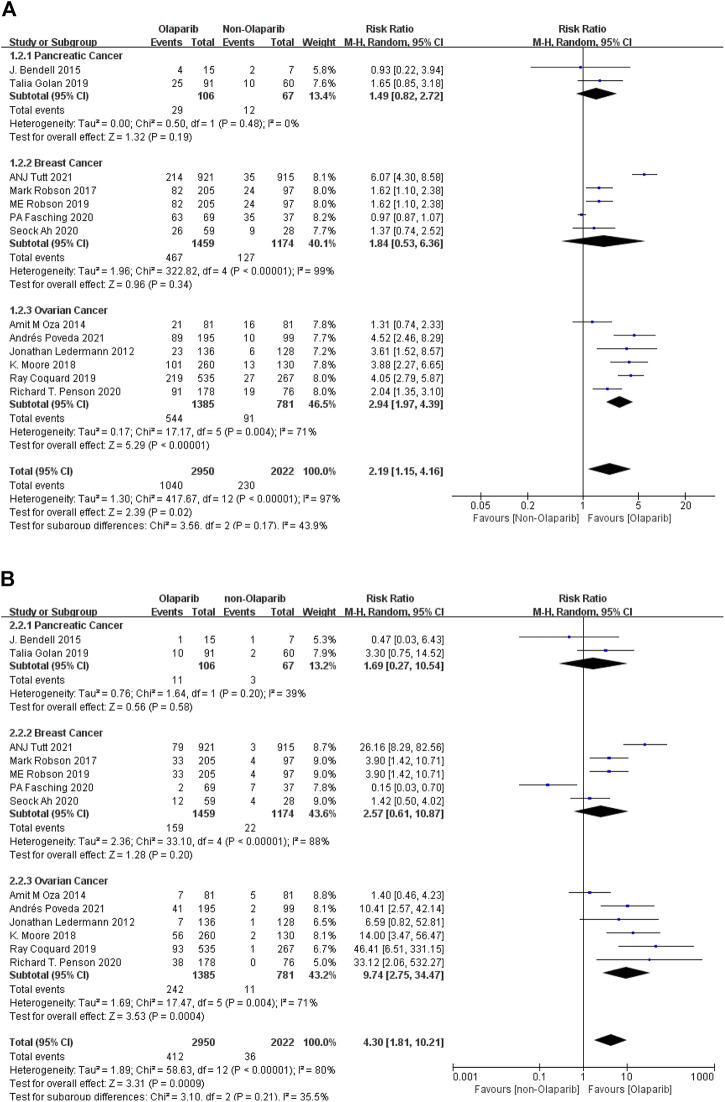
Meta-analysis of safety of Olaparib in the treatment of different indications. The databases of PubMed, The Cochrane Library, EMbase, CNKI, WanFang Data and VIP were searched by computer to collect the research on the indications and the incidence of adverse reactions caused by Olaparib for different cancer types. The search time was from the establishment of the database to May 2022. After two researchers independently screened the literature, extracted the data and evaluated the bias risk included in the study, we used RevMan 5.4 software for meta-analysis. A total of 14 studies were included, with a total sample size of 5119 cases. By meta-analysis, the adverse reactions of Olaparib in the treatment of pancreatic cancer, breast cancer and ovarian cancer were compared. In adverse reactions of any grade, the results showed that fatigue (RR = 1.58, 95% CI [1.20-2.07], = 0.001) was the most serious in the treatment of pancreatic cancer with Olaparib. Anemia (RR = 2.94, 95% CI [1.97-4.39], < 0.00001), neutropenia (RR = 1.37, 95% CI [0.80-2.33], = 0.25), nausea (RR = 1.93, 95% CI [1.61-2.32], < 0.00001) and vomiting (RR = 1.96, 95% CI [1.59-2.41], < 0.00001) were the most severe in ovarian cancer. In adverse reactions of grade 3 or above, fatigue (RR = 3.44, 95% CI [1.48-7.98], = 0.004) and vomiting (RR = 1.09, 95% CI [0.42-2.81], = 0.86) were the most serious adverse reactions in the treatment of breast cancer with Olaparib. Anemia (RR = 9.74, 95% CI [2.75-34.47], = 0.0004), neutropenia (RR = 1.33, 95% CI [0.87-2.02], = 0.19) and nausea (RR = 2.94, 95% CI [1.18-7.32], = 0.02) were the most severe in ovarian cancer. In addition, the incidence of decreased white blood cell count and hepatotoxicity in the treatment of breast cancer, and the incidence of decreased platelet count, constipation and abdominal pain in the treatment of ovarian cancer were higher than those in pancreatic cancer. Current evidence showed that the risk of adverse reactions of Olaparib in the treatment of different indications is different, and specific analysis and treatment should be carried out for different cancer types. Due to the limitation of the quantity and quality of the included studies, the above conclusions need to be verified by more high-quality studies.
奥拉帕利治疗不同适应证安全性的Meta分析。通过计算机检索PubMed、Cochrane图书馆、EMbase、中国知网、万方数据和维普数据库,收集关于奥拉帕利治疗不同癌症类型的适应证及不良反应发生率的研究。检索时间为各数据库建库至2022年5月。两名研究人员独立筛选文献、提取数据并评估研究中包含的偏倚风险后,使用RevMan 5.4软件进行Meta分析。共纳入14项研究,总样本量为5119例。通过Meta分析,比较了奥拉帕利治疗胰腺癌、乳腺癌和卵巢癌的不良反应。在任何级别的不良反应中,结果显示,奥拉帕利治疗胰腺癌时疲劳(RR = 1.58,95%CI[1.20 - 2.07],P = 0.001)最为严重。贫血(RR = 2.94,95%CI[1.97 - 4.39],P < 0.00001)、中性粒细胞减少(RR = 1.37,95%CI[0.80 - 2.33],P = 0.25)、恶心(RR = 1.93,95%CI[1.61 - 2.32],P < 0.00001)和呕吐(RR = 1.96,95%CI[1.59 - 2.41],P < 0.00001)在卵巢癌中最为严重。在3级及以上不良反应中,奥拉帕利治疗乳腺癌时疲劳(RR = 3.44,95%CI[1.48 - 7.98],P = 0.004)和呕吐(RR = 1.09,95%CI[0.42 - 2.81],P = 0.86)是最严重的不良反应。贫血(RR = 9.74,95%CI[2.75 -